pi-infinite-context
Keep long-lived Pi sessions searchable by recursively folding finished context into summarized archive nodes.
Package details
Install pi-infinite-context from npm and Pi will load the resources declared by the package manifest.
$ pi install npm:pi-infinite-context- Package
pi-infinite-context- Version
0.1.28- Published
- Oct 29, 2026
- Downloads
- 479/mo · 458/wk
- Author
- fdietze
- License
- MIT
- Types
- extension
- Size
- 75.6 KB
- Dependencies
- 0 dependencies · 5 peers
Pi manifest JSON
{
  "extensions": [
    "extensions/infinite-context/index.ts"
  ]
}
Security note
Pi packages can execute code and influence agent behavior. Review the source before installing third-party packages.
README
pi-infinite-context
A Pi extension for long-running sessions. The agent replaces old work in its context with short summaries. The original messages stay saved and searchable.
Install
pi install npm:pi-infinite-contextStart a new session after installing.
How it works
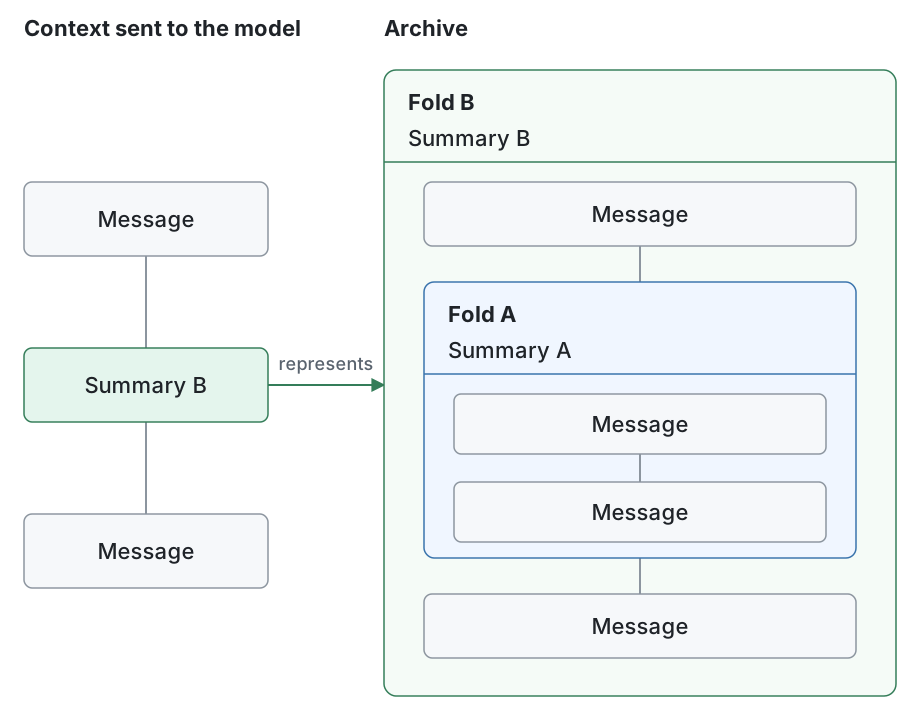
A fold groups messages under a summary. The model sees the summary instead of those messages; the originals stay in the archive. Folds can contain earlier folds, as Fold B contains Fold A above. The agent can search and read the archive without unfolding it. Pi's chat history stays unchanged.
Tools
| Tool | What it does |
|---|---|
context_fold |
Groups consecutive messages or folds under a new summary. |
context_map |
Lists top-level messages and folds, or the direct contents of one fold. |
context_search |
Searches original messages and fold summaries using regular expressions. |
context_peek |
Reads one original message or fold summary by ID, with an optional line range. |
Map and search results provide the IDs to read next.
Context reminders
When Pi estimates that context holds at least 150k tokens or 75% of the model's window (whichever comes first), the extension reminds the agent during tool work to fold what later work no longer needs while keeping the thread (instructions, the active request, open decisions), once that frees about 15k tokens or little room is left. It reminds again every 15k tokens as usage rises (closer together when little room remains).
Optional file ~/.pi/agent/infinite-context/settings.json (inside Pi's configured agent directory) changes the limits; missing or invalid values use the defaults, and changes apply after restarting Pi:
{ "nudgeAtTokens": 150000, "nudgeAtPercent": 75 }nudgeAtTokens can also be a range, [100000, 300000], to measure how the limit affects cost: each session then draws one limit uniformly from the range and keeps it when resumed, reloaded or forked. A changed range draws anew.
The session records the effective limits as a custom entry of type infinite-context:settings whenever they change (with nudgeAtTokensRange when the limit was drawn), and each reminder carries its token count, window, threshold and step in details.
The agent chooses what to fold and writes the summaries. Reminders do not fold anything themselves.
Pi's own compaction, including /compact, is blocked. If the agent does not fold enough, the context can still overflow.
Prefix caching
Providers cache the start of a prompt and charge about 20× less for cached tokens. A fold changes the prompt from the folded messages onward, so the first request after a fold is mostly uncached. After that, the new prompt is cached again.
Measured on the author's sessions: 89,000 requests, 92 sessions with 502 folds, mixed models.
- 98% of input tokens came from the cache for requests less than 2 minutes apart. Sessions with folds: 98.0%. Sessions without folds: 98.3%.
- Only the first request after a fold misses: 50% cached instead of 98%. A fold happens about once per 56 requests.
- A fold shrinks the context from 121k to 47k tokens (median). The cache miss pays for itself after about 3 to 6 requests for folds that free 15k tokens or more. Folds that free less than 15k often never pay off, so the reminders ask for 15k or more.
- After 5 minutes idle, only 18% of input is cached.