pi-langgraph-workflow
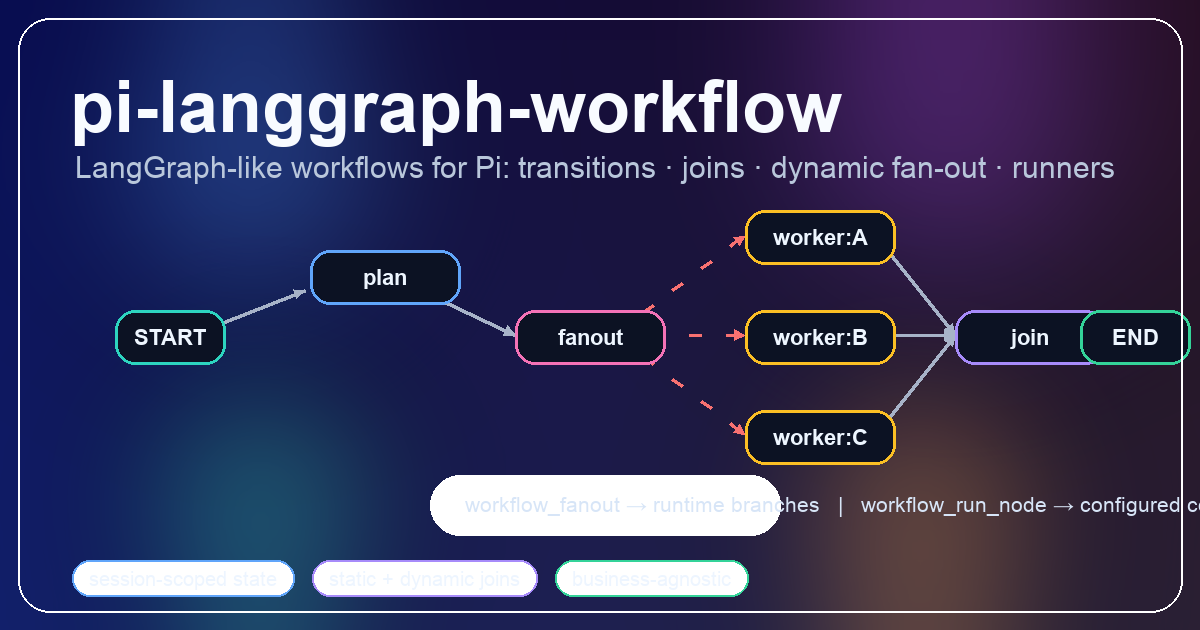
A generic Pi extension that implements LangGraph-like workflows with transitions, joins, dynamic fan-out, and configurable node runners.
Package details
Install pi-langgraph-workflow from npm and Pi will load the resources declared by the package manifest.
$ pi install npm:pi-langgraph-workflow- Package
pi-langgraph-workflow- Version
0.1.6- Published
- Jul 21, 2026
- Downloads
- 830/mo · 830/wk
- Author
- isaachan1984
- License
- MIT
- Types
- extension
- Size
- 33.7 KB
- Dependencies
- 0 dependencies · 2 peers
Pi manifest JSON
{
  "extensions": [
    "./extensions/workflow-guard.ts"
  ],
  "image": "https://raw.githubusercontent.com/isaachan/pi-langgraph-workflow/main/site/assets/workflow-cover.png"
}
Security note
Pi packages can execute code and influence agent behavior. Review the source before installing third-party packages.
README
pi-langgraph-workflow
A generic workflow guard extension for Pi that implements LangGraph-like workflows for coding-agent sessions.
It lets teams define project-local workflow graphs in JSON and then constrain the agent to move through those graphs with explicit transitions, joins, dynamic fan-out branches, and configurable node runners.
What it adds
Commands:
/workflow start <name>— start.pi/workflows/<name>.workflow.json/workflow status— show the current session's workflow state/workflow graph— show static and runtime graph edges/workflow goto <node>— manually set the current node/workflow reset— disable the workflow guard for the current session
Tools:
workflow_transition— move to an allowed next nodeworkflow_fanout— create runtime branch nodes, similar to LangGraphSendworkflow_run_node— run the current node with the command configured in the workflow file
Install
Global:
pi install npm:pi-langgraph-workflow
Project-local:
pi install -l npm:pi-langgraph-workflow
Then restart Pi or run:
/reload
Workflow files
Put workflows in your project:
.pi/workflows/<name>.workflow.json
Start one:
/workflow start <name>
Runtime state is session-scoped and stored under:
.pi/workflows/.state.<sessionId>.json
Add this to your project .gitignore:
.pi/workflows/.state*.json
Minimal workflow
{
  "entry": "build",
  "finish": ["done"],
  "runner": {
    "type": "command",
    "command": ["npm", "run", "workflow", "--", "{template}", "--run-dir", "{runDir}"],
    "itemArgs": ["--item", "{item}"]
  },
  "nodes": {
    "build": {
      "description": "Build the project",
      "allowedTools": ["workflow_run_node", "workflow_transition"],
      "next": ["done"]
    },
    "done": {
      "description": "Workflow complete",
      "allowedTools": ["workflow_transition"],
      "next": []
    }
  }
}
Example workflow
This package includes a safe example at:
examples/simple.workflow.json
Copy it into your project:
mkdir -p .pi/workflows
cp path/to/pi-langgraph-workflow/examples/simple.workflow.json .pi/workflows/simple.workflow.json
Start it:
/workflow start simple
Run the first node with workflow_run_node:
{
  "node": "discover",
  "runDir": "runs/simple-demo"
}
Then transition:
{
  "target": "plan",
  "reason": "discovery completed"
}
At fanout_items, create dynamic branches:
{
  "group": "items",
  "template": "process_item",
  "items": ["alpha", "beta", "gamma"],
  "join": "join_items"
}
This creates runtime nodes:
process_item:alpha
process_item:beta
process_item:gamma
After all branch nodes complete, join_items becomes available.
The example runner writes a log to:
runs/simple-demo/workflow.log
Runner placeholders
workflow_run_node expands these placeholders in runner.command, runner.itemArgs, and runner.cwd:
{node}— full current node, e.g.process_item:alpha{template}— template part before:, e.g.process_item{item}— dynamic item part after:, e.g.alpha{runDir}—runDirpassed toworkflow_run_node{cwd}— current project directory
Node-level runner overrides workflow-level runner.
Notes
This is a workflow guard, not a distributed executor. It enforces LangGraph-like control-flow semantics for a Pi session. Dynamic branches can be completed in any order, but Pi does not automatically spawn multiple workers for them.