pi-live-models
Live /v1/models discovery for pi — any OpenAI-compatible or Anthropic gateway, plus built-in provider catalog overrides. Config-driven filters, metadata merge ladder, credential reuse, offline cache.
Package details
Install pi-live-models from npm and Pi will load the resources declared by the package manifest.
$ pi install npm:pi-live-models- Package
pi-live-models- Version
0.3.3- Published
- Aug 30, 2026
- Downloads
- 597/mo · 597/wk
- Author
- wait4x
- License
- MIT
- Types
- extension
- Size
- 155.9 KB
- Dependencies
- 0 dependencies · 0 peers
Pi manifest JSON
{
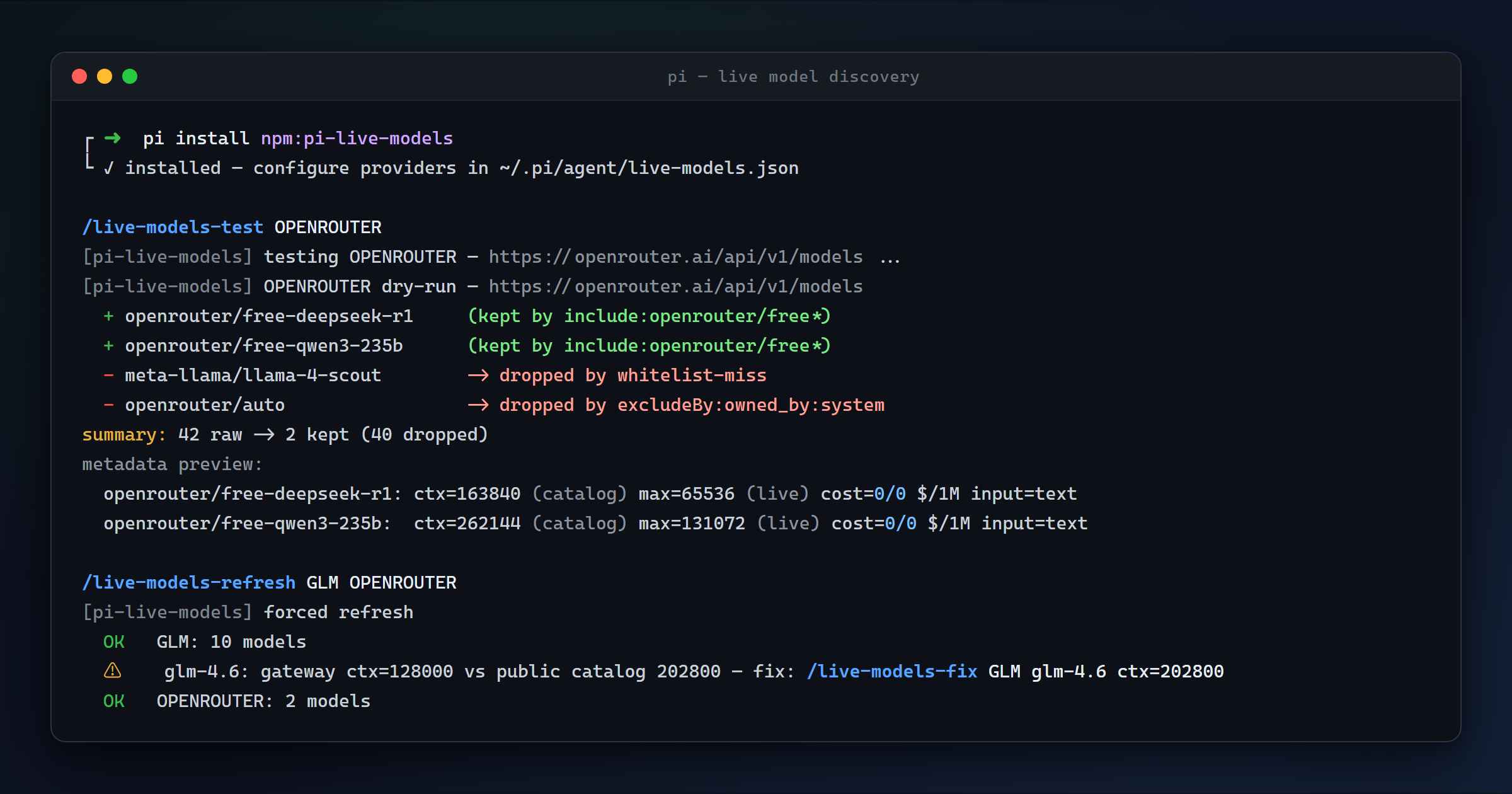
  "image": "https://raw.githubusercontent.com/wait4xx/pi-live-models/main/docs/preview.png",
  "extensions": [
    "./extensions"
  ]
}
Security note
Pi packages can execute code and influence agent behavior. Review the source before installing third-party packages.
README
pi-live-models


English · 简体中文
Live /v1/models discovery for pi — make every provider's model list reflect what the endpoint actually serves, refreshed every time you open /model.
Works with any OpenAI-compatible or Anthropic-protocol gateway (OpenRouter, relay services, vLLM, LiteLLM, LM Studio, cloud vendors, …), and overrides the static catalogs of pi's built-in providers — registerProvider() with the same id layers on top of the composed base, and a non-empty live list fully replaces it.
Contents
- Why
- Highlights
- Install
- Quick start
- Configuration reference
- Commands
- Offline cache & failure behavior
- Recipes
- Safety notes
- Development
- License
Why
| Pain | With pi-live-models |
|---|---|
Custom providers in models.json are static — new models appear only after hand-editing the file |
The list refreshes from GET /v1/models every time you open /model |
| Built-in provider catalogs go stale between pi releases | Same-id registerProvider overrides the built-in catalog with live truth |
| Gateway lists drift (models added, retired, renamed) | Your /model picker always mirrors the endpoint — filters decide what you see |
One config file, zero code, zero runtime dependencies.
Highlights
- 🚫 Zero filtering by default — the extension has no opinions about which models are "good". Every filter is yours: glob (
*audio*), regex (^glm-4\.), field-level rules (includeBy/excludeByon dotted paths into the live item, e.g.owned_by,architecture.input_modalities), and reusable presets. Exclude always wins; a non-empty include set acts as a whitelist. - 🔍 Filter observability —
/live-modelsshowsraw -> keptstatistics;/live-models-test <provider>dry-runs discovery and annotates every model with its keep/drop reason;/live-models-refresh [ids...]forces an immediate refresh bypassingrefreshIntervalMs. - 🔑 Credential reuse — discovery reuses the key you already have:
/loginstored credential → entryapiKey($ENV/${ENV}/!command/ literal) →models.json→<PROVIDER>_API_KEYenv. Keys never appear in logs or errors. - 🪜 Metadata merge ladder —
defaults< static definitions (models.json+models-store.json, by id) < live endpoint hints (context_length,max_completion_tokens, OpenRoutertop_provider.*andpricing.*cost) < public catalog (LiteLLM data, exact match only) <overrides[id]. New models get sane fallbacks instead of blank metadata.mergeStatic: "union"can additionally register static-only models the gateway forgot to list. - 🌐 Public metadata catalog — relays often misreport metadata (
context_length: 128000stamped on every model). Two community catalogs (LiteLLM + Models.dev) cross-check the gateway: exact-name matches correctcontextWindow/maxTokens, implausible live values are rejected by sanity windows, and suspicious patterns (≥4× divergence from the catalog, uniform placeholder values) are surfaced with a ready-made/live-models-fixhint. Cache-backed, background-refreshed, one flag to disable per provider. - 🛡️ Never empties your catalog — a refresh that yields 0 usable models throws and pi keeps the previous list; network failures fall back to a persisted last-good cache (raw items re-filtered and re-merged with your current rules), so a gateway outage never blanks
/modelafter a restart. - 📦 Zero runtime dependencies · TypeScript · unit-tested · CI on Windows + Ubuntu.
Install
pi install npm:pi-live-models
# or from git:
pi install git:github.com/wait4xx/pi-live-models
Then create ~/.pi/agent/live-models.json (see below) and restart pi. Already have providers in models.json? Run /live-models-init in pi — it writes a stub entry for every models.json provider (idempotent, existing entries untouched), or just declare ids and let them inherit (below).
Quick start
// ~/.pi/agent/live-models.json
{
  "providers": {
    "MYGATEWAY": {
      "baseUrl": "https://gw.example.com",
      "api": "openai-completions",
      "apiKey": "$MYGATEWAY_API_KEY",
      "filters": { "exclude": ["*embedding*", "*rerank*"] }
    }
  }
}
Open /model in pi — the list now mirrors GET https://gw.example.com/v1/models, minus your excluded patterns. Check status with /live-models, tune filters with /live-models-test MYGATEWAY.
An entry may omit baseUrl to inherit it from the same-id provider in models.json (credentials already resolve from models.json):
{ "providers": { "MYGATEWAY": { "filters": { "exclude": ["*embedding*"] } } } }
Configuration reference
File: ~/.pi/agent/live-models.json (respects $PI_CODING_AGENT_DIR). Validation is field-precise with graceful degradation: an invalid field is warned and ignored; only entries without a usable baseUrl — explicit or inherited from the same-id models.json provider — are skipped. Config typos never crash pi startup.
Top level
| Field | Type | Description |
|---|---|---|
presets |
object | Named reusable filter specs, e.g. "chat-only": { "excludeRegex": ["-embedding$"] }. Referenced via filters.use / defaultFilters.use; flattened (unioned per field) during parsing. See Presets. |
defaultFilters |
object | Global filters — blacklists only (exclude, excludeRegex, excludeBy), unioned with every provider's excludes. A global whitelist is intentionally not offered: include-style fields (written directly or contributed by a preset) are warned + ignored. |
providers |
object | Map of provider id → entry. The id must match the provider you want to register/override (the models.json key or a built-in provider id). |
Provider entry
| Field | Required | Description |
|---|---|---|
baseUrl |
✅* | API root. Models endpoint is derived: ends with a version segment (/v1, /v2, …) → {base}/models, otherwise → {base}/v1/models. May be omitted to inherit from the same-id models.json provider; a value that is present but invalid is never inherited. |
modelsUrl |
— | Explicit models-endpoint override when the derivation rule does not fit. |
api |
— | openai-completions / openai-responses / anthropic-messages. Can be omitted when overriding a built-in provider (the definition is inherited). |
name |
— | Display name. |
apiKey |
— | Credential for the discovery request: "$ENV", "${ENV}", "!shell command", or literal. See Auth chain. |
headers |
— | Extra request headers for the discovery request. |
timeoutMs |
— | Discovery fetch timeout, default 10000. |
refreshIntervalMs |
— | Throttle real fetches to at most one per interval. 0 (default) = fetch on every /model open. |
compat |
— | Provider-level compat fallback for models without one (e.g. {"thinkingFormat":"qwen"}). |
filters |
— | See Filters. |
costFromLive |
— | Live pricing fill strategy (OpenRouter-style pricing.*, $/token → $/1M): "fill-zero" (default) / "always" / "off". Details in the merge ladder. |
catalog |
— | true (default) / false — opt out of the public metadata catalog for this provider. See Public metadata catalog. |
mergeStatic |
— | "live" (default) or "union" — also register static-only models from models.json/models-store.json. |
defaults |
— | Metadata fallback for all models: reasoning, input, contextWindow, maxTokens, cost. |
overrides |
— | Per-model-id metadata overrides: {"qwen3.8-max":{"contextWindow":1000000}}. |
Filters
"filters": {
  "include":      ["*glm*"],            // glob whitelist on id, case-insensitive
  "exclude":      ["*audio*", "*tts*"], // glob blacklist on id
  "includeRegex": ["^glm-[\\d.]"],      // regex whitelist on id, case-sensitive
  "excludeRegex": ["^gpt-5\\.6$"],
  "includeBy":    { "owned_by": ["openai"] },                     // field whitelist (AND across fields)
  "excludeBy":    { "architecture.input_modalities": ["*image*"] }, // field blacklist (OR)
  "use":          ["chat-only"]         // preset references, see below
}
Semantics (pinned by unit tests):
| Rule | Behavior |
|---|---|
| Nothing configured | Every model passes. Zero filtering is the default. |
exclude / excludeRegex / excludeBy |
A match on any exclude rule (entry-level or global defaultFilters, unioned) drops the model. |
| Exclude precedence | Exclude always wins — an excluded model cannot be rescued by any include rule. |
| Whitelist | If any include rule exists, a model must satisfy all of them: match ≥1 id pattern (include/includeRegex, unioned) and hit every includeBy field (AND). |
Field rules (*By) |
Dotted paths into the live /v1/models item. String values match case-insensitive globs; array values match if any element hits; missing fields / non-string values never match excludes and always fail includes (includeBy-miss:<field>). v0.2 is string-glob only — no numeric ranges. |
| Case | Globs case-insensitive; regexes case-sensitive (use (?i) if needed). |
| Invalid regex | Reported at startup with its config location, then ignored — never breaks the config. |
| Everything filtered out | The refresh throws (pi keeps the previous catalog) and the error names the rules responsible. |
Presets
Define once at the top level, reuse everywhere (filters.use, defaultFilters.use). Preset lists are unioned with the spec's own lists during parsing; a preset referenced by defaultFilters contributes blacklists only:
{
  "presets": {
    "chat-only": { "excludeRegex": ["-embedding$", "-rerank$", "-tts$", "-realtime$"] },
    "no-legacy": { "excludeRegex": ["^glm-4\\."] }
  },
  "providers": {
    "GLM": {
      "baseUrl": "https://gw.example.com",
      "filters": { "use": ["no-legacy"], "include": ["*glm*"] }
    }
  }
}
Presets cannot reference other presets; unknown preset names are warned + ignored — same graceful degradation as every other config field.
Auth chain (discovery request)
/loginstored credential (pi passes it in the refresh context)- entry
apiKeyspec —$ENV/${ENV}/!command/ literal ~/.pi/agent/models.json→providers[id].apiKey(same spec syntax)- env
<PROVIDER_ID>upper-cased, non-alnum →_, suffixed_API_KEY
⚠️ The !command form executes a shell command — only use it if you understand what it runs. Keys never appear in logs or errors; the cache file stores model metadata only, never credentials.
Public metadata catalog
Many relay gateways stamp every model with the same context_length (usually 128000), or omit metadata entirely. The public catalog is an independent cross-check built from two community-maintained sources: LiteLLM's model_prices_and_context_window.json (~2500 chat models) and Models.dev's api.json (~7300 entries from 200+ providers, indexed from official documentation — fast coverage of new releases).
How it works
- Sources: two independent catalogs, each with its own fetch path, disk cache, staleness clock and failure backoff — one source being down never affects the other. LiteLLM is fetched via jsDelivr CDN with a raw.githubusercontent.com fallback; Models.dev is a single CDN URL. Both are fetched in the background, never blocking discovery. On failure, discovery proceeds without the catalogs and retries after a 30-minute backoff.
- Cache:
~/.pi/agent/live-models-catalog.json(LiteLLM) and~/.pi/agent/live-models-catalog-modelsdev.json(Models.dev), each refreshed in the background after 7 days./live-models-catalog-refreshforces a refetch of both (a partial failure still applies the successful one). - Matching: exact model-name match only — no fuzzy matching, ever.
provider/prefixes,:suffixtags (:free,:latest) and date suffixes (gpt-4o-2024-11-20) are normalized for the lookup; an exact catalog entry always beats a normalized one. - Arbitration (normalized keys only): the same model deployed by several providers routinely carries deployment-specific limits, so candidates are arbitrated in tiers — the vendor's own LiteLLM entry wins (a two-segment
vendor/modelkey whoselitellm_providermatches, e.g.zai/glm-4.6); multiple vendor entries must agree within a 5% tolerance (rounding differences between catalogs are not disagreements — the merged value is the conservative minimum); with no vendor entry, independent sources must agree within the same tolerance; disagreement abstains — the model falls back to the static/live ladder and a warning shows the top competing values with a/live-models-fixhint. A lone third-party deployment is silently skipped as unverified. Models.dev entries never claim vendor status: its 200+ namespaces include many resellers listing the same bare ids as the vendor's own (vancine/glm-5.3-flashvszai/glm-5.3-flash) and nothing in the data distinguishes them — so Models.dev contributes consensus/divergence signals and new-model coverage, never unvetted authority./live-models-catalogshows both sources and the arbitration totals. - Scope: chat-mode entries (entries without a
modefield are kept); values must pass sanity windows (context 1,024–10,000,000 tokens, max output 128–10,000,000).
What it changes
- The ladder gains a layer between live hints and your overrides — a trusted catalog value beats the gateway's claim (see merge ladder).
- Implausible live values are quarantined: a live
context_lengthof0,100or10¹²no longer poisons metadata — sanity windows reject it before it can win. - Suspicious patterns are surfaced by
/live-models-testand/live-models-refresh:- gateway context diverges ≥4× from the catalog (either direction) → warning with a ready-made
/live-models-fix <provider> <model> ctx=<catalog value>command; - ≥3 models sharing one identical live context value → uniform-placeholder warning (classic relay stamp).
- gateway context diverges ≥4× from the catalog (either direction) → warning with a ready-made
Don't want any of this? One field: "catalog": false on the provider entry — no catalog lookups, no catalog warnings. (The sanity windows on live values stay on: an implausible context_length never wins regardless.)
Metadata merge ladder (low → high)
entry.defaults < static definitions (models.json entry + models-store.json cache, matched by id) < live endpoint hints (context_length, context_window, max_model_len, max_completion_tokens, max_tokens, OpenRouter top_provider.*) < public catalog (exact match, see above) < entry.overrides[id]
Live values must pass sanity windows before they can win a layer: context integer 1,024–10,000,000 tokens, max output 128–10,000,000. A rejected live value falls through to the next layer instead of propagating. /live-models-test annotates the preview with the winning source for each field (ctx=202800 (catalog), max=… (live)).
Cost follows the same ladder, moderated by costFromLive:
| Policy | Behavior |
|---|---|
"fill-zero" (default) |
Live pricing.* hints (converted $/token → $/1M) fill cost only when nothing else defines it — hand-written prices always win. |
"always" |
Live pricing beats static/defaults key by key — a live entry reporting only pricing.prompt keeps static output prices. overrides[id].cost still wins on every key. |
"off" |
Live pricing ignored entirely. |
Explicit "0" (free tier) is a valid live cost; strict decimal strings only.
mergeStatic: "union" additionally registers models that exist in models.json/models-store.json but are missing from the gateway's live list (same filters apply, static def acts as the field source for *By rules). A zero-model live result still throws — union supplements, never papers over a broken gateway.
Live-only models fall back to defaults, then to pi-safe values (reasoning: true, input: ["text"], contextWindow: 128000, maxTokens: 32768, zero cost).
Commands
| Command | Purpose |
|---|---|
/live-models |
Configured providers, models endpoint, filter summary, last discovery result (raw -> kept statistics). |
/live-models-reload |
Re-read the config file and re-register immediately (no restart). |
/live-models-init |
Bootstrap live-models.json: write a { baseUrl } stub for every models.json provider not yet configured (idempotent, existing entries untouched, broken config files are never clobbered), then re-register immediately. |
/live-models-test <provider> |
Dry-run one discovery: per-model kept by … / dropped by … annotation plus a metadata preview (context window, cost, input types). |
/live-models-refresh [ids...] |
Force an immediate live refresh, bypassing refreshIntervalMs (no argument = all providers). Updates the in-memory catalog and the persisted cache; failures are shown verbatim (no cache fallback for manual actions). |
/live-models-catalog |
Show public-catalog status: both sources (entries, fetch time), merged count, arbitration totals, cache paths. |
/live-models-catalog-refresh |
Force a blocking refetch of the public metadata catalog. |
/live-models-fix <provider> <model> ctx=<n> [max=<n>] |
Write a metadata correction into overrides in live-models.json (atomically, preserving the rest of the file), then run /live-models-reload to apply. Validates against the sanity windows and the provider's known model ids. |
Offline cache & failure behavior
| Situation | Behavior |
|---|---|
| Refresh succeeds | Models update; the raw endpoint items are persisted to ~/.pi/agent/live-models-cache.json (format v2). |
| Network / HTTP / JSON failure | Falls back to the last-good cache — rebuilt through the full pipeline (current filters, merge ladder, union) from the raw items, so config changes are honored mid-outage. v1 caches (pre-0.2) are still readable and used best-effort (id-only re-filter) until the next successful refresh upgrades them. |
| Filters drop everything (0 models) | Config intent error — the refresh throws, pi keeps the previous catalog, and the error names the responsible rules. Never silently serves stale models. |
| Live endpoint returns 0 models | Same as above — mergeStatic: "union" is a supplement, not a fallback. |
Caller aborts (list mode, /model closed mid-flight) |
Rethrown as-is — no warnings, no cache fallback. |
Manual /live-models-refresh fails |
Verbatim error report — manual actions never mask failures with cached data. |
| Catalog fetch fails | Discovery proceeds without it; a background retry happens after a 30-minute backoff (or force it with /live-models-catalog-refresh). |
Recipes
OpenRouter (free models only):
"OPENROUTER": {
  "baseUrl": "https://openrouter.ai/api/v1",
  "api": "openai-completions",
  "filters": { "include": ["openrouter/free"] },
  "compat": { "thinkingFormat": "openrouter" }
}
Relay gateway with known-bad legacy line (drop old glm-4.*, audio/realtime variants):
"GLM": {
  "baseUrl": "https://gw.example.com",
  "api": "anthropic-messages",
  "filters": {
    "includeRegex": ["^glm-[\\d.]"],
    "excludeRegex": ["^glm-4\\."]
  }
}
Override a built-in provider's stale catalog:
"qwen-token-plan-cn": {
  "baseUrl": "https://token-plan.example.com/compatible-mode/v1",
  "api": "openai-completions",
  "exclude": ["qwen-audio-*", "wan*"],
  "compat": { "thinkingFormat": "qwen", "supportsDeveloperRole": false }
}
Gateway list is incomplete (models defined in models.json missing from /v1/models):
"GLM": {
  "baseUrl": "https://gw.example.com",
  "api": "anthropic-messages",
  "mergeStatic": "union"   // static-only models are registered too (same filters apply)
}
Let OpenRouter pricing fill the cost fields instead of hand-writing overrides:
"OPENROUTER": {
  "baseUrl": "https://openrouter.ai/api/v1",
  "api": "openai-completions",
  "costFromLive": "always",   // default "fill-zero" only fills models with no cost source
  "filters": { "use": ["chat-only"] }
}
Gateway misreports context windows (every model stamped context_length: 128000): nothing to configure — the public catalog corrects exact matches automatically, and /live-models-test flags the mismatches. For a model the catalog doesn't know (or to pin your own value), write an override from the terminal:
/live-models-fix GLM glm-4.6 ctx=202800
/live-models-reload
Safety notes
- The extension performs
GETrequests only against URLs you configure, plus the two optional public-catalog reads (LiteLLM via jsDelivr/raw.githubusercontent, Models.dev — no query parameters, no credentials); no bundled endpoints, no telemetry. - The cache files store model metadata only — never credentials.
- Catalog data is community-maintained and matched exactly; it can be wrong or missing, and overrides always take precedence.
- Invalid config fields degrade gracefully (warned and ignored); config typos never crash pi startup.
Acknowledgments
Model metadata comes from community-maintained catalogs — this project would be much poorer without them:
- LiteLLM — the
model_prices_and_context_window.jsoncatalog: the broadest provider/pricing/metadata dataset in the ecosystem, and the source of the vendor-namespace truth this extension arbitrates on. - Models.dev — the
api.jsoncatalog: structured per-provider model specs indexed from official documentation, with remarkably fast coverage of new releases.
Thank you to both teams and their contributors. This extension is an independent consumer and is not affiliated with either project.
Development
npm install
npm run typecheck   # tsc --noEmit
npm test            # node:test via tsx (77 tests)
npm run smoke       # register against the real config (no TUI)
npx tsx scripts/smoke.ts GLM   # + one live refreshModels pass for GLM
CI: Windows + Ubuntu × Node 22/24.
License
MIT © wait4xx