pi-model-replacements
Model alias/tier (low/medium/high) replacement extension for pi coding agent
Package details
Install pi-model-replacements from npm and Pi will load the resources declared by the package manifest.
$ pi install npm:pi-model-replacements- Package
pi-model-replacements- Version
0.3.1- Published
- Jun 9, 2026
- Downloads
- not available
- Author
- fractiunate
- License
- MIT
- Types
- extension
- Size
- 1.6 MB
- Dependencies
- 0 dependencies · 0 peers
Pi manifest JSON
{
  "extensions": [
    "./index.ts"
  ],
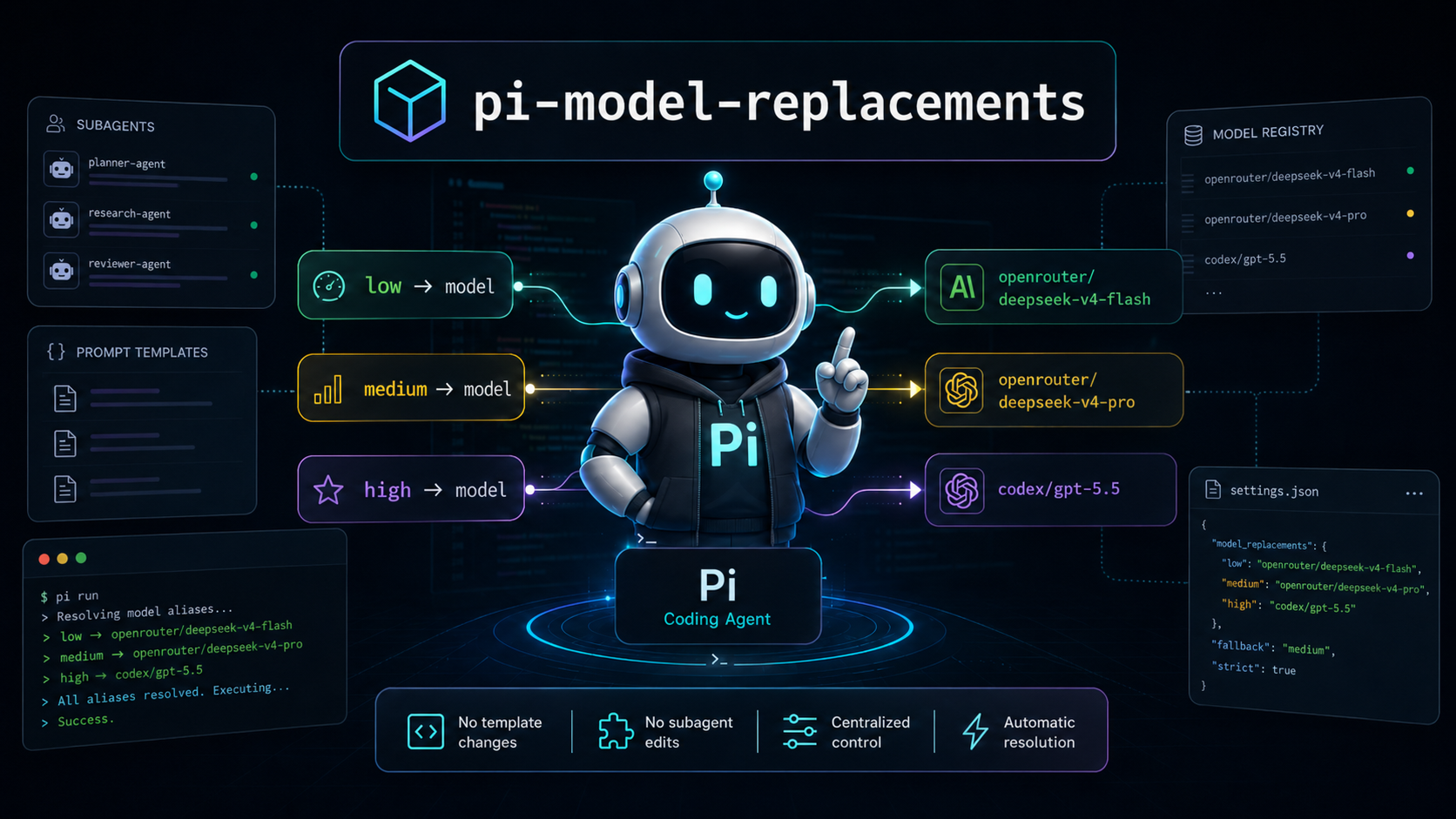
  "image": "https://raw.githubusercontent.com/fractiunate/pi-model-replacement/main/hero-image.png"
}
Security note
Pi packages can execute code and influence agent behavior. Review the source before installing third-party packages.
README
pi-model-replacements
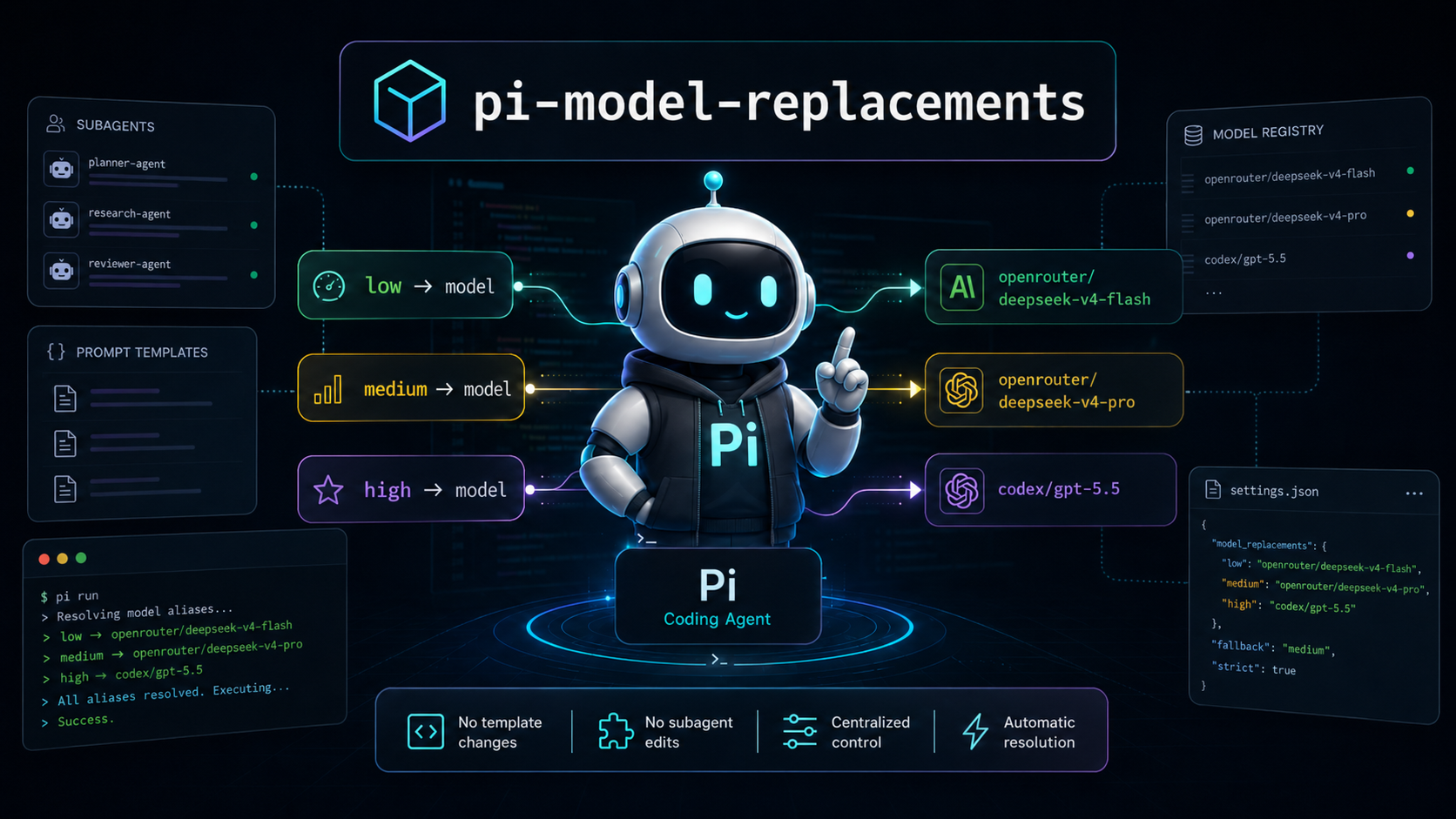
A standalone pi extension that lets
agents, subagents, and prompt templates reference abstract model tiers (low /
medium / high, or any alias name) instead of hard-coding provider/model-id. A single
change in settings.json re-points every template and subagent.
How it works
Add a model_replacements map to the active agent dir's settings.json (the dir selected
by PI_CODING_AGENT_DIR, e.g. ~/.pi/agent/settings.json):
{
  "model_replacements": {
    "low": "github-copilot/claude-haiku-4.5",
    "medium": "github-copilot/claude-sonnet-4.6",
    "high": "github-copilot/claude-opus-4.8"
  }
}
Now any model: low in a prompt-template frontmatter, an agent definition, or a
subagent tool call resolves to the concrete model — no file writes, no edits to other
extensions.
Mechanism
session_start— each alias is injected into the live model registry as a synthetic model cloned from its concrete target (grouped per provider, idempotent across/reload). Unresolvable targets warn once and are skipped.model_select+ initial swap — when an alias becomes the active model, it is swapped to the concreteModelobject viapi.setModel. Self-terminating (the target is never an alias key, so no loop).tool_call— an explicitsubagentmodel: "high"argument is rewritten in place to the concreteprovider/model-idbefore the child process spawns.before_agent_start— a per-turn safety net that swaps any still-active alias immediately before the API call (covers the agent-frontmatter path and child startup ordering). The same extension code runs fresh inside subagent child processes.
Configuration resolution
PI_CODING_AGENT_DIR is honoured exactly like pi-subagents:
~ / ~/... are expanded; otherwise the literal value is used; default is ~/.pi/agent.
Reading is fail-soft — a missing or malformed settings.json, or absent
model_replacements, yields no aliases (extension is a no-op).
Installation
Install via pi:
pi install npm:pi-model-replacements
Development
Setup
npm install
Testing
npm test # tsx --test *.test.ts
Works well with
- pi-prompt-template-model — Abstract model tiers in your prompt templates.
- pi-subagents — Delegate work to subagents with model-tier overrides in
subagenttool calls.
Contracts and limitations
Thinking-suffix handling
pi-model-replacements resolves aliases by exact key match. A suffixed string
such as "high:thinking" does not match alias key "high" directly, so the
tool_call handler splits the trailing :thinking suffix, resolves the base alias
("high") to its concrete target, and re-attaches the suffix — producing e.g.
"github-copilot/claude-opus-4.8:thinking".
This is required because pi-subagents' resolveModelCandidate() only matches the
base model id against the live registry. Since pi-model-replacements injects each
alias as a synthetic registry entry, passing "high:thinking" through unresolved
would make pi-subagents select the synthetic alias id ("github-copilot/high"),
which is not a real API model and fails with 400 model not supported. The alias
must therefore be resolved to its concrete target here, before the child spawns.
This behaviour is locked by a regression test in tool-call.test.ts
("subagent tool_call: suffixed alias ('high:thinking') resolves base alias and re-attaches suffix").
Unsupported: alias chaining
A configuration like { "low": "medium", "medium": "provider/model" } — where an
alias target is itself another alias key — is not supported. buildAliasMap
detects chained entries at map-build time, emits a console.warn, and skips them.
Only direct alias → "provider/model-id" mappings are accepted.
Code note: getAgentDir() duplication
alias-resolver.ts:getAgentDir() is a character-for-character copy of
pi-subagents/src/shared/utils.ts:getAgentDir(). Both are intentionally kept
separate to avoid cross-package coupling. Any future change to path-expansion
logic (e.g., Windows normalisation) must be applied to both files.
Made with ♥ by fractiunate