pi-peak-hours
Peak/off-peak billing-hours indicator for LLM APIs (DeepSeek, GLM Coding Plan) in the pi coding agent.
Package details
Install pi-peak-hours from npm and Pi will load the resources declared by the package manifest.
$ pi install npm:pi-peak-hours- Package
pi-peak-hours- Version
1.0.3- Published
- Aug 29, 2026
- Downloads
- 572/mo · 35/wk
- Author
- oglenyaboss
- License
- MIT
- Types
- extension
- Size
- 69.5 KB
- Dependencies
- 0 dependencies · 0 peers
Pi manifest JSON
{
  "extensions": [
    "./src/index.ts"
  ],
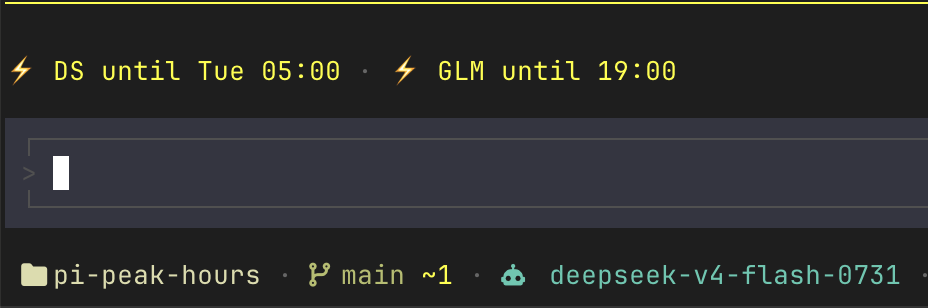
  "image": "https://raw.githubusercontent.com/oglenyaboss/pi-peak-hours/main/docs/screenshots/peak.png"
}
Security note
Pi packages can execute code and influence agent behavior. Review the source before installing third-party packages.
README
pi-peak-hours
Peak/off-peak billing-hours indicator for LLM APIs in the pi coding agent.
Some LLM providers bill peak hours at up to 2× the off-peak rate. This extension shows — right above your editor — when the model you're paying for is currently expensive, and how long until it gets cheap.
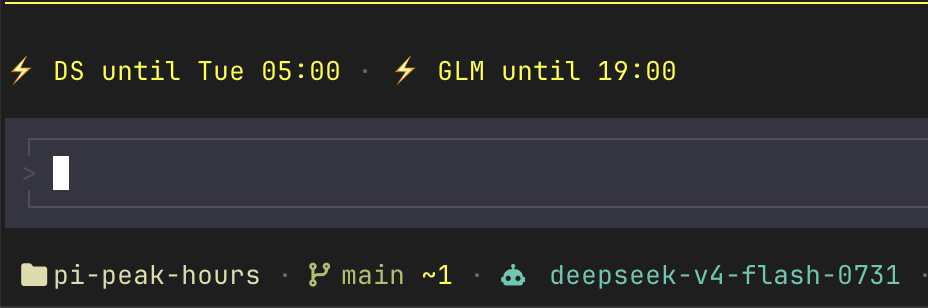
- Silent when off-peak. No news, no noise — the widget is hidden entirely.
- One line during peak. Names the providers that are in peak and when it ends, in your local timezone.
/peak— the full picture on demand: current phase, windows in your timezone, next flip, sources.
Providers
| Provider | Peak windows (billing calendar, UTC+8) | Off-peak |
|---|---|---|
| DeepSeek API | Mon–Fri 09:00–12:00, 14:00–18:00 | 50% of peak; weekends fully off-peak (since Aug 23, 2026) |
| GLM Coding Plan (Z.AI) | Mon–Fri 14:00–18:00 | Legacy V2: quota burns 3× at peak vs off-peak (GLM-5.3 1×/3×, Flash 0.4×/1.2×); new credit plans: off-peak = 50% of the standard credit rate |
Rules are data, not code (src/schedules.ts), each with its source URL and a "verified on" date. The DeepSeek logic is tested against the CC0 conformance vectors from xyzs996/deepseek-peak-hours, including the two subtleties most implementations get wrong: the weekday axis is read on the billing calendar (UTC+8), not on UTC, and the weekend rule is gated on its effective date so historical instants classify as they were actually billed.
Install
pi install npm:pi-peak-hours        # from npm
pi install /path/to/pi-peak-hours   # or a local checkout
pi -e /path/to/pi-peak-hours        # or try it for one run without installing
Config
Read once at startup from ~/.pi/agent/settings.json under the peakHours key (/reload to apply). All keys optional; these are the defaults:
{
  "peakHours": {
    "enabled": true,
    "timezone": "auto",
    "show": "peak",
    "providers": ["deepseek", "glm"]
  }
}
| Key | Values | Meaning |
|---|---|---|
enabled |
true / false |
Turn the extension off entirely |
timezone |
"auto", "UTC", or an IANA name ("Asia/Yekaterinburg") |
Display timezone. auto uses the system clock's zone; override on servers set to UTC |
show |
"peak" / "always" |
Hide the widget off-peak (default), or always show both phases |
providers |
array of schedule ids | Which rules to track |
/peak output
LLM peak/off-peak — local time Asia/Yekaterinburg
⚡ DeepSeek         PEAK until 15:00 · peak 06:00-09:00, 11:00-15:00 Mon-Fri on UTC+08:00
  GLM Coding Plan  off-peak until 15:00 · peak 11:00-15:00 Mon-Fri on UTC+08:00
DeepSeek: off-peak = 50% of peak rates; weekends fully off-peak since Aug 23, 2026. https://api-docs.deepseek.com/quick_start/pricing/
GLM Coding Plan: off-peak usage is charged at 50% of the standard credit rate. https://docs.z.ai/devpack/overview
Notes
- Times come from the system clock; nothing is fetched at runtime.
- The widget lives above the editor, not in the footer. Footer replacements (e.g. pi-archimedes) hide
setStatus()items, while widgets stack independently — so this coexists with any footer. - Billing windows apply to official provider APIs. Proxies/aggregators set their own flat prices; off-peak discounts generally do not pass through them.
- Rules change. If a provider moves its windows, edit
src/schedules.ts— and please open an issue or PR here.
Adding a provider
Add an entry to SCHEDULES in src/schedules.ts:
{
  id: "myprovider",
  label: "My Provider",
  shortLabel: "MP",
  calendarOffsetMinutes: 480,          // billing calendar = fixed UTC+8
  windows: [{ start: "14:00", end: "18:00" }],  // wall time on that calendar
  peakWeekdays: [1, 2, 3, 4, 5],       // ISO weekdays on that calendar
  weekendOffPeakFrom: null,            // or "2026-08-22T16:00:00Z"
  offPeakMultiplier: 0.5,
  offPeakNote: "off-peak = 50%",
  source: "https://...",
}
Development
npm install
npm run check   # typecheck + tests + selfcheck
MIT — see LICENSE.