pi-protokoll
Pi extension: a running per-turn protocol replaces summarizing compaction – fast, bounded compaction for very long sessions with local models
Package details
Install pi-protokoll from npm and Pi will load the resources declared by the package manifest.
$ pi install npm:pi-protokoll- Package
pi-protokoll- Version
0.9.10- Published
- Nov 8, 2026
- Downloads
- 654/mo · 654/wk
- Author
- sebion7125
- License
- MIT
- Types
- extension
- Size
- 216.1 KB
- Dependencies
- 0 dependencies · 3 peers
Pi manifest JSON
{
  "image": "https://raw.githubusercontent.com/sebion7125/pi-protokoll/main/docs/preview.png",
  "extensions": [
    "./src/index.ts"
  ]
}Security note
Pi packages can execute code and influence agent behavior. Review the source before installing third-party packages.
README
pi-protokoll
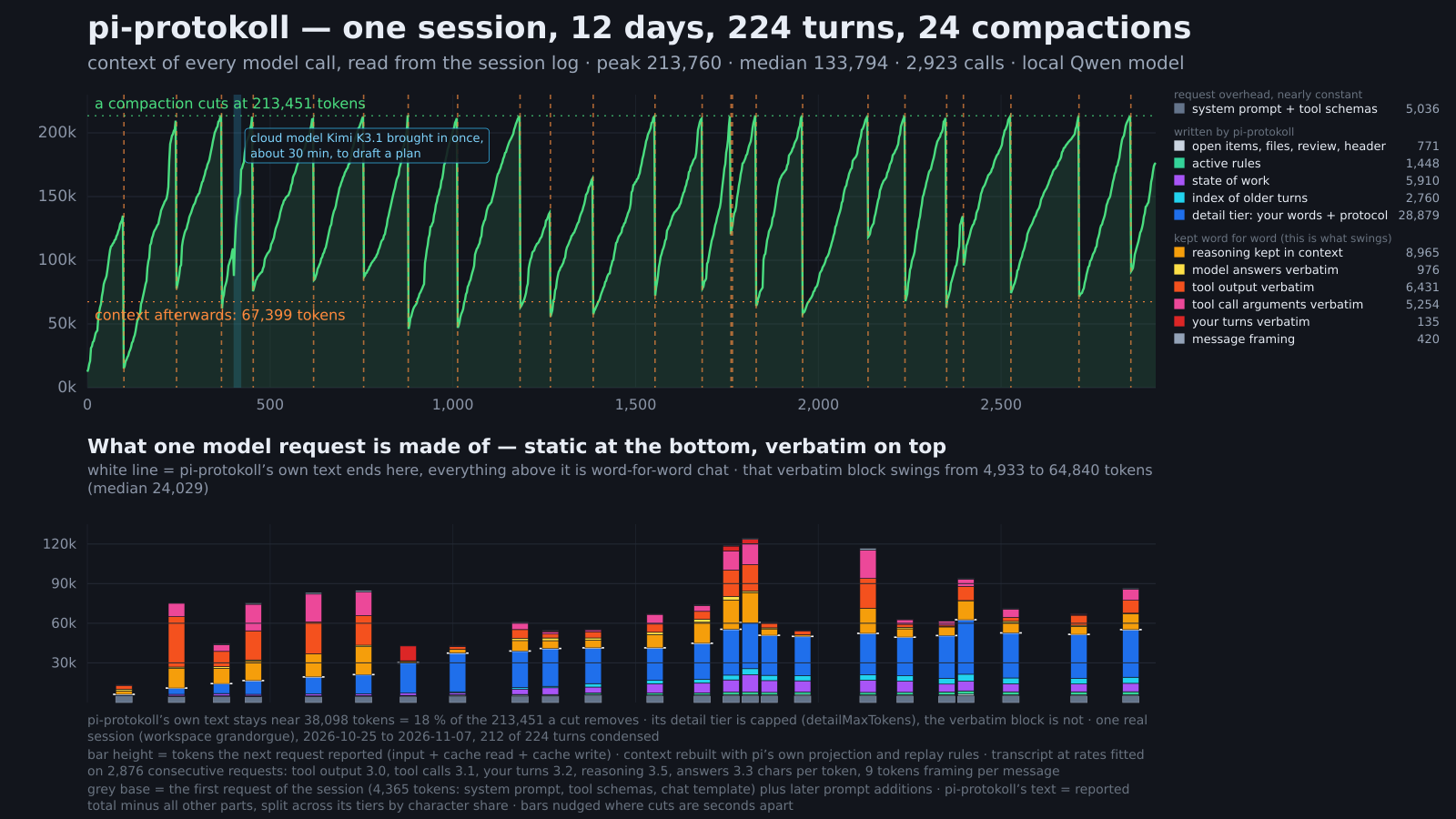
A Pi extension that makes very long sessions possible with local models: the model writes a short protocol at the end of every turn, and compaction builds a bounded, tiered summary from those protocols instead of re-reading and summarizing the whole history.
Deutsche Fassung: README.de.md
Why
Pi's built-in compaction sends the old history to the model and waits while it writes a summary. With a local model that is slow (minutes on a long session), and the summary is written after the fact from an overfull context.
Here the expensive part happens while working: each final answer ends with a protocol block, written while the model still has the full turn in view. At compaction time almost everything is ready; code assembles the summary and the model only updates a short overview.
Measured in one session with Qwen3.x on a local OpenAI-compatible server (2× RTX 3090, 262k context window):
- 22 compactions over 118 turns, each about 213,000 → 35,000 tokens in about 30 s
- resuming the session reads about 36,000–44,000 tokens
- every earlier turn stays reachable through tools
In the 12-day session shown in the chart above, also with a local Qwen model, a cut takes the context from about 213,000 tokens to a median of about 67,000 in the next request; about 38,000 of those are the summary, the rest is the system prompt and what stays word for word. Between cuts the server's prefix (KV) cache holds: in the median request 99.8 % of the prompt tokens came from it. The request right after a cut has only the system prompt cached and re-reads about 62,000 tokens once. What the extension saves is the re-summarization pass, not that re-read.
Practical example: 64kdemo, a procedural forest landscape in C and OpenGL, with screenshots, a camera flight and the story of how it came about. Its first ten sessions ran without the extension and kept ending in context poisoning; with the extension, from the tree system on, it stayed a single session, the one measured above.
How it works
A turn is one agent run: your message with all tool rounds up to the final answer. Messages you send while the model is working belong to the running turn.
System prompt. A fixed section asks the model to end every final answer with a
<protocol>block:result,decision,files,open,rule,revoke,index,tags. The text never changes, so the server's prefix cache stays valid. It also states once what the model can and cannot know about the length of a session (see Known limits).Answer done. The block is cut out of the answer and stored as a session entry, shown collapsed (
▸ protocol turn 7: …). A block written early keeps the text after it in the answer; a tag quoted inside code or inside a sentence is left alone. The extension numbers the turns, not the model.Block missing. The extension asks once more with the unchanged context plus a short instruction. The prompt starts like the one just run, so a prefix cache only reads the new tokens. Only the block is kept, not the exchange. If the model ignores the request, the block is written from the turn's transcript right away.
Turn interrupted (Esc, error, output limit). Before your next message goes out, the protocol of the interrupted turn is written: what was done, what is still open. Tool calls the model makes out of habit are answered with "tools unavailable" and not executed. If that fails, a second attempt works from the turn's transcript.
Compaction. Pi triggers it as usual. The summary has tiers, each with a hard limit:
Tier Content Limit verbatim the last turns as they are keepRecentTurns, at mostkeepRecentPercent% of the windowdetail the next older turns: your message verbatim + protocol; pinned turns in full; turns without protocol as a shortened transcript detailMaxTokensstatus everything older statusMaxTokensThe status consists of:
- an index, one line per older turn: the
indexline the model wrote with that turn. Code assembles it again at every compaction from the stored protocols, so it cannot drift. When it no longer fits, the oldest turns are grouped into range lines built from theirtags([T1–T20] leaf palette (T14, T16); DEMO_LEAFPAL (T14); impostor atlas (T18–T19)); - the active rules (
ruleminusrevoke), open items and files touched, all taken from the protocols by code; - a state of work, the only part the model rewrites: it gets the previous state and the
protocols of the turns now leaving the detail tier. Long backlogs are folded in chunks of
foldChunkTokens.
A review step lets the model clean up rules and open items. It can only choose entries by number (
RULES: R1, R4), so it cannot reword or invent anything.If anything fails, or the result would not free enough space, the extension steps back and Pi compacts in its own way. The chat never blocks.
- an index, one line per older turn: the
Lookup tools for the model:
protocol_read("12, 40-44")returns the full stored protocols plus your message,protocol_search(query)finds turns by keywords (tags count double),protocol_turn(n)returns the original transcript of one turn.
Switching inside a session.
/protokoll offleaves the system prompt and the tool list byte-identical and inserts one message at the current position that withdraws the rules; the threeprotocol_*tools stay declared and answerpi-protokoll is disabled. That is what keeps the server's prefix cache./protokoll onbrings it back: the section is still in the prompt, so a short note applies it again. A session that ran without protokoll from the start never had the section in its prefix – enabling does not add it there either, it brings the rules once as a message, so the prefix stays untouched. Older turns have no protocols and are compacted as shortened transcripts;/protokoll repairwrites theirs. The hard variant/protokoll off --stripreally removes the section and unregisters the tools; the next request then reads the whole context again (once). Pi copies the system message of the branch onto the compaction entry, so the prompt (section included) outlives a compaction while a note can be cut away by it. At the first settle boundary after a compaction the extension retires notes that now contradict the state (context_editwith an empty replacement); if a needed withdrawal was cut away, the section leaves the prompt instead.
Progress is shown above the editor during compaction and backfills. Afterwards a widget shows the new context size; it stays until the next message, because Pi redraws the chat after compaction.
Every compaction additionally stores its own status entry (protokoll-compact): how it ended,
how long it took in total, the time of every step and the notification lines of the pass. The
duration is therefore readable long after the widget is gone – in the console and in anything
that renders session entries, a web view for example. /protokoll export lists the time of
every compaction.
While a pass runs, every step is also published on Pi's shared extension bus (channel
pi-protokoll:progress, see ProgressEvent in src/core.ts), so another extension can show the
running steps live. Each report carries the whole run: for every step its state, its own time, how
many characters the model has sent and whether it is thinking or writing — the same status the
console widget shows. Those lines are never stored in the session — one status entry per pass stays
the record.
Install
pi install git:github.com/sebion7125/pi-protokollor from a local checkout:
pi install ./pi-protokollRestart Pi (or /reload) and run /protokoll status.
Configuration is optional. Copy protokoll.example.json to ~/.pi/agent/protokoll.json and
adjust it; a project can override values in <project>/.pi/protokoll.json.
Upgrading from the manual install (~/.pi/agent/extensions/protokoll/): delete that folder,
otherwise the extension loads twice. Your protokoll.json and all session data stay as they are.
Requirements and scope
- Pi ≥ 1.1. Used daily with 1.1.0; typechecked, unit-tested and run end to end (stub model) with 1.4.0.
- Built and tested with local models behind an OpenAI-compatible server (Qwen3.x).
Thinking levels for the extension's own requests are written directly into the request
(
reasoning_effort,chat_template_kwargs.enable_thinking). This works for that kind of server only. - Other providers and models are untested. The extension should work with any model that follows the block format, but cache behaviour and thinking control may differ.
Commands
| Command | Effect |
|---|---|
/protokoll or /protokoll status |
state, turns, protocols, pinned turns, coverage of the state of work, compaction count |
/protokoll show |
preview of the summary (no model call; turns not yet folded appear as single lines) |
/protokoll export [file] |
the same as a Markdown file, plus a diagnostics part: effective configuration, all compactions, the stored state with reviewed rules, a table of all turns and all protocols in full |
/protokoll pin N / unpin N |
keep turn N verbatim at compaction |
/protokoll on / off |
enable or disable for this session. off keeps prompt and tool list byte-identical and withdraws the rules with one message (prefix cache stays); the protocol tools answer pi-protokoll is disabled |
/protokoll off --strip |
hard off: the section leaves the system prompt and the protocol tools are unregistered, so the next request reads the whole context again (once). Needs no withdrawal message |
/protokoll reload |
reread protokoll.json |
/protokoll rebuild |
rebuild the state of work from all protocols at the next compaction instead of updating it (against drift; takes longer) |
/protokoll repair |
bring an older session up to date: turns without protocol get one from their transcript, protocols without index/tags get both (8 turns per request), then compacts with a rebuild. Never replaces what the model wrote itself; running it again continues where it stopped |
The German command names of earlier versions (zeigen, anheften, lösen, an, aus,
neu-laden, stand-neu, heilen) still work.
Configuration
| Key | Default | Meaning |
|---|---|---|
enabled |
true |
master switch (per session: /protokoll on|off) |
tag |
"protocol" |
name of the block |
maxWords |
250 |
length guide for the block in the system prompt (changing it invalidates the prefix cache once) |
strip |
true |
remove the block from the stored answer |
inline |
true |
true: the system prompt asks the model to end each final answer with the block. false: afterwards-only mode – nothing about the protocol goes into the system prompt, the model never sees the format while it works; after every final answer the extension sends one extra request (the unchanged chat context plus one instruction carrying the format). Costs one request per turn, which a prefix cache answers by reading only the new tokens. Switching the mode in a running session changes the prompt once (prefix cache miss) |
followUp |
true |
ask for a missing block right away (always on when inline is false) |
followUpReasoning |
"off" |
thinking level of requests without chat context (transcript backfill, state of work, index repair). Requests that repeat the chat context always use the chat's level, otherwise the prefix cache misses |
consolidateReasoning |
"low" |
thinking level of the review; comparing each rule with the later ones works much better with some thinking |
followUpMaxTokens |
16384 |
output limit of requests with chat context; thinking counts against it |
followUpTimeoutMs |
600000 |
time limit per request with chat context |
auxiliaryModel |
"" |
model for the extension's own requests as "provider/model"; empty uses the session model. Never changes the model of the normal chat |
compaction |
"protocol" |
"default" leaves compaction entirely to Pi |
consolidate |
true |
run the review of rules and open items |
stateOfWork |
true |
false: no state of work, so no fold requests at compaction (the slowest step) and nothing the model rewrites. The index takes the status budget the text would have had and keeps single lines for more turns; older turns stay reachable through the index and the lookup tools. Earlier summaries written by Pi itself are not merged then. Switching it back on folds the turns that left the detail tier in the meantime |
keepRecentTurns |
3 |
keep this many last turns verbatim … |
keepRecentPercent |
10 |
… but at most this share of the context window |
keepUserMessages |
true |
your messages verbatim in the detail tier |
userMessageMaxChars |
4000 |
longer messages (pasted logs) are shortened there |
lookupTool |
true |
offer protocol_turn and protocol_read; like protocol_search they are declared only once the session holds a compaction, because before that every turn is still in the context |
lookupMaxTokens |
8000 |
output limit of those tools |
pinnedMaxTokens |
8000 |
size limit per pinned turn |
digestMaxTokens |
1500 |
size limit per turn without protocol |
detailMaxTokens |
30000 |
hard limit of the detail tier |
statusMaxTokens |
8000 |
hard limit of the status (at least 800): index ≤ 35 %, rules ≤ 25 %, open items ≤ 15 %, files ≤ 5 %; the state of work gets what they leave, at least 20 %. Too long a state is shortened twice evenly, then cut in the middle, never at the end |
foldChunkTokens |
12000 |
input size per call when folding turns into the state |
searchTool |
true |
offer protocol_search |
searchMaxResults |
10 |
maximum hits |
backfill |
true |
write protocols of interrupted turns |
backfillMaxPerCompaction |
8 |
at most this many backfills per compaction |
backfillTranscriptTokens |
12000 |
transcript size per backfill (at least 2000) |
backfillMaxTokens |
4096 |
output limit per backfill |
The whole summary is at most about detailMaxTokens + statusMaxTokens + 400 tokens, about
38,000 with the defaults.
When to compact is still Pi's decision: context > contextWindow − compaction.reserveTokens
(~/.pi/agent/settings.json). Make sure contextWindow in models.json matches your server.
Auxiliary model
auxiliaryModel applies to the extension's own requests only: follow-up, transcript backfill,
folding the state of work, the review of rules and repair. The model of your chat stays exactly as
it is.
{
  "auxiliaryModel": "openai/gpt-4.1-mini"
}
Pi's Cursor path has no session mapping for the kind of direct request the extension makes, so
asking a Cursor model directly does not work. When your session model is a Cursor model
(provider: "cursor" or api: "cursor-sdk") and no auxiliary model is configured, the extension
sends no request at all: it says so once per session, treats the protocol as missing and leaves
compaction and everything else working. Set auxiliaryModel to a model from another provider to get
the follow-up, backfill and review back. A malformed or unknown reference is reported and the request
is skipped – it never silently falls back to the session model. Note that a request which repeats the
chat context has to fit the auxiliary model's context window.
Development
npm install
npm run check   # typecheck, lint, tests
npm run e2e     # real Pi CLI from node_modules + stub model: install, nine turns, compaction
The tests (tests/) drive the extension through a stand-in for Pi's extension API with a
scripted model. They check the wiring and the pure logic, not Pi itself.
Known limits
- The model must write the block. Qwen3.x forgets it in roughly half of the long tool-heavy turns; the follow-up request fixes that at the cost of a few seconds.
- The model cannot see how full its context window is, yet occasionally invents a fill level
(
Context left: 12 %,Context exhausted) and advises a fresh chat. Nothing in Pi, in this extension or in any installed package prints such lines – the numbers are made up. The system prompt section states the facts instead: without a fill level given in the current turn the model says nothing about the window, and it suggests a fresh session only on a concrete verifiable reason. This softens it; measured effect: none yet. The text is fixed from here on so the prefix cache stays valid. - Whether a model follows a withdrawal note at the end of a long transcript is model-dependent. If
it keeps writing protocol blocks after
/protokoll off, use/protokoll off --strip. - The context rule assumes pi-protokoll does the compaction. With other compaction extensions it is untested. A fill level another extension hands over in the current turn is deliberately not denied – such a number is information the model may use.
- A soft
/protokoll offkeeps the three protocol tools declared, because the tool list is part of the prefix. A model can still call them and getspi-protokoll is disabledback. /compact <instructions>is not yet passed on to the state of work.- The state of work is the one part the model rewrites, so it can drift; the index, the lists
and the stored protocols cannot.
/protokoll rebuildrebuilds it from scratch.
License
MIT