pi-quota-tui
Your AI subscription quotas as an ANSI list in the pi panel
Package details
Install pi-quota-tui from npm and Pi will load the resources declared by the package manifest.
$ pi install npm:pi-quota-tui- Package
pi-quota-tui- Version
0.4.1- Published
- Nov 3, 2026
- Downloads
- 463/mo · 463/wk
- Author
- gsuzeda
- License
- MIT
- Types
- extension
- Size
- 77.1 KB
- Dependencies
- 0 dependencies · 3 peers
Pi manifest JSON
{
  "image": "https://raw.githubusercontent.com/GabrielUzeda/pi-quota-tui/main/assets/preview.svg",
  "extensions": [
    "./src/index.ts"
  ]
}Security note
Pi packages can execute code and influence agent behavior. Review the source before installing third-party packages.
README
pi-quota-tui — AI subscription quotas inside pi
A panel with the quotas of your AI subscriptions, as plain ANSI text, inside pi. Works in any terminal: no images, no animation, no font or graphics protocol required. It never sends prompts and never calls a model: it only reads each account's usage state.
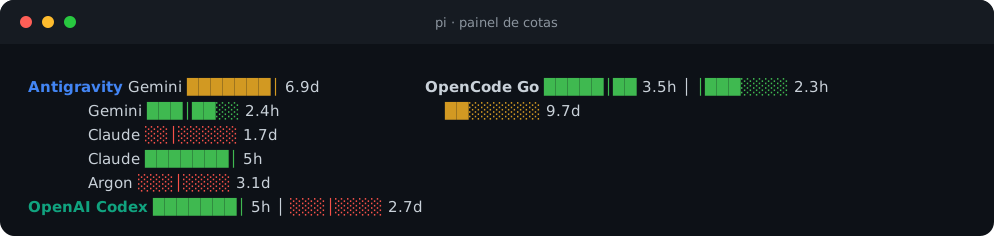
Providers: OpenCode Go, Antigravity (straight to Google, no local proxy), Claude Code and CommandCode. OpenAI Codex too, but it needs the codex CLI (see below).
Install
pi install npm:pi-quota-tuiOr straight from the repository:
pi install git:github.com/GabrielUzeda/pi-quota-tuiTo remove it: pi remove npm:pi-quota-tui.
The panel shows up by itself when pi opens, as a list below the editor. Data refreshes every 2 minutes.
Layout
Provider name followed by its quota windows separated by │, each with a balance bar and the time until it renews.
Two providers share a row when there is room.
Antigravity Gemini ████████ 6d │ Gemini ████████ 6h        OpenCode Go ███░░░░░░ 3.2h
            Claude ░░░░░░░░ 2d │ Argon ░░░░░░░░ 2d         OpenAI Codex ████████ 2.8h
CommandCode ██░░░░░░ 45m
Expired: Antigravity Argon 6d │ CommandCode 12.2d- The bar shows the remaining balance; the
│inside it is the pace mark (where the balance should be for it to last until renewal). - The bar's color is pace, not balance: green with slack, yellow 3 to 10 points ahead, red above that. Without a known reset/duration it falls back to balance (blue, yellow from 75% used, red from 90%).
- When the windows do not fit, the row wraps with an indent aligned under the first window.
- An exhausted window (100% used) hides itself and the ones below it in the monthly > weekly > 5-hour hierarchy, within the same group. Monthly at zero removes the provider from the panel; weekly at zero leaves only the monthly. Windows without a rank (Antigravity's "Limite") never disappear.
- Whatever exhausted comes back in a final
Expired:row with the time until it renews. Per group the governing window is the one that blocks the ones below it; rows are sorted from the soonest return to the latest. The tag is a fixed strong red and the time sits on a continuous green → yellow → red ramp, weighed against the window's own cycle: 18h of a weekly is green, 12d of a monthly is not. A provider whose only group is exhausted stays on screen through this row instead of vanishing. - The wait ramp has no fixed thresholds: it interpolates between
#3fb950,#d29922and#f85149in sRGB, easing from 15% of the cycle (fully green) to 60% (fully red). Without a known cycle, the fallback scale is 1h..1d. - The panel writes no status words: no
OUTDATED, noTIGHT. Diagnostics live in/quota. - Name colors follow each brand: Antigravity blue, OpenAI green, Claude orange; OpenCode and CommandCode use the default text color, which follows light and dark themes. Without truecolor, colors fall back to 256 colors automatically.
Commands and tool
| Command | What it does |
|---|---|
/quotas |
Shows or hides the panel |
/quota [all|opencode|agy|commandcode] |
Text report in the chat (never enters the model context) |
/usage |
Alias of /quota |
/quota-login |
Imports the Antigravity accounts from AGY or runs the Google login inside the extension |
The get_quotas tool hands the same report to the model when you ask for it.
Configuration
Each provider only appears if it is configured and has at least one quota window. A provider without configuration, or without any reading, stays out of the panel; /quota shows why.
| Provider | How to configure it |
|---|---|
| OpenCode Go | opencode-go entry in ~/.pi/agent/auth.json; without it, the OPENCODE_GO_KEY env var |
| CommandCode | commandcode entry in auth.json; without it, COMMAND_CODE_API_KEY (or COMMANDCODE_API_KEY) |
| Antigravity | Account list in ~/.local/share/pi-quota-tui/agy-accounts.json ([{ email, projectId, refreshToken }], mode 600), created by /quota-login. AGY's accounts.json is only a fallback and PI_QUOTA_TUI_AGY_ACCOUNTS overrides both. No proxy required. |
| OpenAI Codex | Required to pull its quotas: the codex CLI installed and on PATH (quotas are read through codex app-server). Without the CLI the provider simply does not show up. |
| Claude Code | Desktop app history (plan-usage-history.json) and, without it, the subscription OAuth (/login Claude Pro/Max in pi). The first source with data wins; with neither, the provider stays out of the panel |
auth.json is only read when its permissions are 600 (no group or other access). It takes priority; env vars are the fallback when the section is missing, empty, or the file is rejected.
Optional env var: PI_QUOTA_TUI_AGY_PAID, a hint to pick the paid Antigravity account.
What each provider needs to work
Nothing below is installed by the extension: it only reads what already exists on the machine and talks to the network. If a prerequisite is missing, the provider leaves the panel and /quota shows why.
| Provider | Credential | External file or binary | Network |
|---|---|---|---|
| OpenCode Go | opencode-go section of auth.json, or OPENCODE_GO_KEY |
— | GET opencode.ai/zen/go/v1/usage |
| CommandCode | commandcode section of auth.json, or COMMAND_CODE_API_KEY/COMMANDCODE_API_KEY |
— | GET api.commandcode.ai/alpha/billing/credits and /usage/summary |
| Antigravity | refreshToken of each Google account (Antigravity CLI OAuth client, embedded in the code) |
none: /quota-login keeps the file at mode 600 (see below) |
Google OAuth + v1internal:retrieveUserQuotaSummary |
| OpenAI Codex | the codex login itself (the extension does not use auth.json for it) |
codex binary on PATH, accepting codex app-server --stdio |
no HTTP call: it speaks JSON-RPC with the subprocess |
| Claude Code | desktop app history, or an anthropic token of type oauth in auth.json (/login Claude Pro/Max) |
plan-usage-history.json (optional) |
GET api.anthropic.com/api/oauth/usage (OAuth fallback only) |
/quota-login: where the Antigravity accounts come from
/quota-login keeps ~/.local/share/pi-quota-tui/agy-accounts.json (mode 600) and resolves the accounts in three steps:
- A valid file of its own — refreshes each account's token; if all pass, it does nothing else.
- Import from AGY once — reads
~/.local/share/agy-local-proxy/accounts.json(the file of AGY Local Proxy, a third-party Node proxy at~/.local/share/agy-local-proxy/server.mjsthat serves Antigravity as an OpenAI endpoint on127.0.0.1:20128; the proxy only reads that file, it has no write or login route, so it was born from manual editing). Accounts whoserefreshTokenGoogle still refreshes are copied into the extension's own file. - Login inside the extension — with no valid token to import, it opens an OAuth loopback (
127.0.0.1:<port>+ PKCE) with the Antigravity CLI client, shows the URL in the panel and stores the returnedrefreshToken. The account enters without aprojectId, so collection uses the Cloud Code default project; to pin another one, edit the JSON and addprojectId.
After that the extension is self-contained: the file is its own, AGY can be uninstalled, and PI_QUOTA_TUI_AGY_ACCOUNTS still points to another path. The coupling that remains is the credential: the refreshToken must have been issued to the Antigravity CLI OAuth client (the client_id/client_secret embedded in the code); a token from another client is refused on refresh.
How the data is read
- Requests time out after 25 s. Responses are capped at 2 MiB and redirects are not followed.
- HTTP is only accepted on
127.0.0.1. Errors surface as short messages, without URL, headers or response body. - If a request fails, the panel keeps the last reading; the reason shows up in
/quota. - Antigravity refreshes the token with Google and queries
v1internal:retrieveUserQuotaSummarydirectly, with no local process. Accounts come from a file (see Configuration); families appear separately (Gemini, Claude/GPT, Gemini 4 Argon) and different accounts are neither summed nor averaged. The access token lives in memory only.
Limitations
- Antigravity (embedded credential): token refresh uses the Antigravity CLI OAuth client, published in the code by the author's decision. If Google revokes or restricts that client, the provider stops working and needs a client of its own again (
PI_QUOTA_TUI_AGY_CLIENT_ID/_SECRETwould be the path). Per-model cooldowns are not read: they only existed in the proxy. - Tested on Linux.
- Claude Code (debt): the desktop history and the OAuth fallback are wired up, but the OAuth path (
GET https://api.anthropic.com/api/oauth/usage, headeranthropic-beta: oauth-2025-04-20,anthropictoken withtype: "oauth"fromauth.json) has no integration test — it needs a real Claude Pro/Max login. OnlyparseOauthUsageis tested; cover network/401 once a test credential exists.
Development
npm install
npm test          # unit tests plus the extension smoke test
npm run typecheck
Changes
CHANGELOG.md records what changed in each version, and every release is a git tag
vX.Y.Z plus a GitHub release. Note that npm shows no changelog of its own: npmjs.com renders this
README for the published version and lists publish dates only.
pi package
This repository is published on npm as pi-quota-tui with the pi-package keyword, which makes it eligible for the pi package catalog. The pi.extensions field points to ./src/index.ts and pi.image to the preview above.
Note: the panel and /quota report itself are still written in Portuguese; this README is the English entry point.
License
MIT. See LICENSE.