pi-render-btw
A pi extension for parallel side conversations with /btw — with markdown rendering in the floating window
Package details
Install pi-render-btw from npm and Pi will load the resources declared by the package manifest.
$ pi install npm:pi-render-btw- Package
pi-render-btw- Version
0.6.10- Published
- Jul 18, 2026
- Downloads
- 466/mo · 82/wk
- Author
- esso0428
- License
- MIT
- Types
- extension
- Size
- 393.6 KB
- Dependencies
- 0 dependencies · 3 peers
Pi manifest JSON
{
  "extensions": [
    "./extensions/btw.ts"
  ],
  "skills": [],
  "image": "https://raw.githubusercontent.com/ESSO0428/pi-render-btw/main/docs/btw-overlay.png"
}
Security note
Pi packages can execute code and influence agent behavior. Review the source before installing third-party packages.
README
pi-render-btw
Fork of pi-btw with markdown rendering in the floating window.
A pi extension that adds a /btw side conversation channel
with full markdown rendering (syntax highlighting, bold, code blocks, lists, etc.) inside the overlay.
/btw opens a real pi sub-session with coding-tool access, and it runs immediately even while the main agent is still busy.
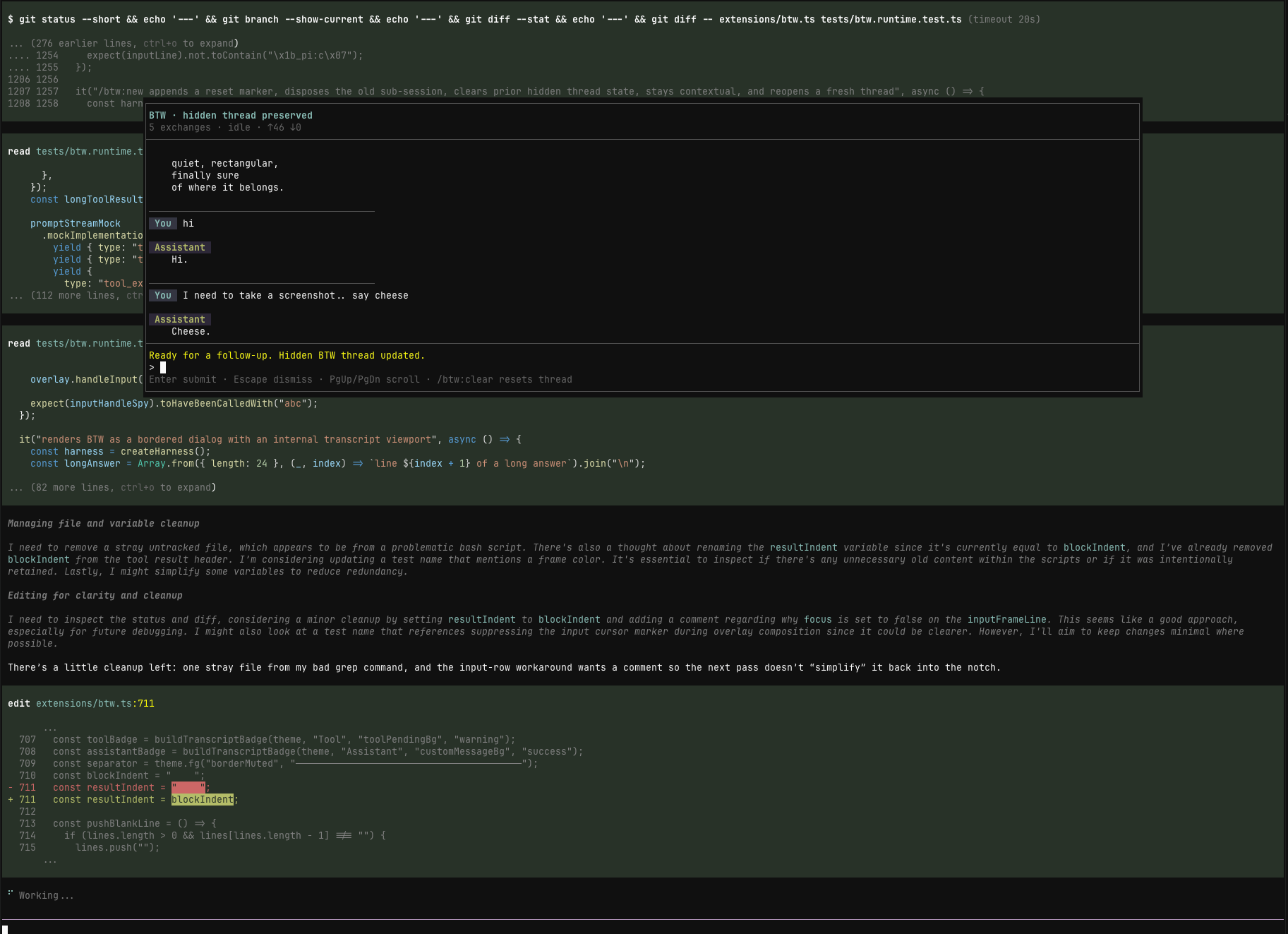
What it does
- opens a parallel side conversation without interrupting the main run
- runs that side conversation as a real pi sub-session with
read/bash/edit/writetool access - keeps a continuous BTW thread by default
- supports
/btw:tangentfor a contextless side thread that does not inherit the current main-session conversation - opens a focused BTW modal shell with its own composer and transcript
- keeps the BTW overlay open while you switch focus back to the main editor with
Alt+/ - keeps BTW thread entries out of the main agent's future context
- supports BTW-only model and thinking overrides without changing the main thread settings
- lets you inject the full thread, or a summary of it, back into the main agent
- optionally saves an individual BTW exchange as a visible session note with
--save - includes an internal Peek mode for browsing the current BTW side thread
✨ Markdown rendering
Unlike the original pi-btw, pi-render-btw renders assistant responses inside the floating
window using pi TUI's built-in Markdown component. This means:
- Bold, italic,
strikethrough,inline code, andcode blockswith syntax highlighting - Lists (ordered & unordered), blockquotes, horizontal rules
- Headings and links
- Cached rendering for performance — markdown is only re-rendered when the content or terminal width changes
- Streaming responses fall back to plain text for speed; completed turns are rendered as markdown
Install
From npm
pi install npm:pi-render-btw
From git
pi install git:github.com/ESSO0428/pi-render-btw
Then reload pi:
/reload
From a local checkout
pi install /path/to/pi-render-btw
Usage
/btw what file defines this route?
/btw how would you refactor this parser?
/btw --save summarize the last error in one sentence
/btw:new let's start a fresh thread about auth
/btw:tangent brainstorm from first principles without using the current chat context
/btw:model openai gpt-5-mini openai-responses
/btw:thinking low
/btw:inject implement the plan we just discussed
/btw:summarize turn that side thread into a short handoff
/btw:peek browse the current BTW side thread
/btw:clear
Commands
/btw [--save] <question>
- runs right away
- works while pi is busy
- creates or reuses a real BTW sub-session instead of a one-off completion call
- continues the current BTW thread
- opens or refreshes the focused BTW modal shell with markdown rendering
- streams into the BTW modal transcript/status surface
- persists the BTW exchange as hidden thread state
- with
--save, also saves that single exchange as a visible session note
Overlay controls
Alt+/toggles focus between BTW and the main editor without closing the overlayCtrl+Alt+Wis a fallback focus toggle for terminals that do not deliverAlt+/as a usable shortcutCtrl+Gopens the current BTW draft in$VISUAL/$EDITOR(falling back tonano) and reads it back when the editor exits successfully- the composer uses Pi's native editor behavior for undo, paste, prompt history, and Tab file-path completion (including
@prefixes) relative to the BTW working directory Escstill dismisses BTW immediately while the overlay is focused- BTW opens top-centered so the main session remains visible underneath it
/btw:new [question]
- clears the current BTW thread
- starts a fresh thread that still inherits the current main-session context
- optionally asks the first question in the new thread immediately
- if no question is provided, opens a fresh BTW modal ready for the next prompt
/btw:tangent [--save] <question>
- starts or continues a contextless tangent thread
- does not inherit the current main-session conversation
- if you switch from
/btwto/btw:tangent(or back), the previous side thread is cleared so the modes do not mix - opens or refreshes the same focused BTW modal shell
- with
--save, also saves that single exchange as a visible session note
/btw:peek
- switches the BTW overlay into Peek mode for the current side thread
Ctrl+Penters Peek mode from the BTW composer, even when it contains a draftj/kscroll one message,J/Kjump to the next/previous message, andg/Ggo to the top/bottom/searches with smartcase;n/Nmoves between matchesttoggles tool messagesMcopies the selected message;oopens it read-only in nvimEsc,q, orCtrl+Creturns to the BTW composer; pressEscagain in the composer to dismiss BTW
/btw:clear
- dismisses the BTW modal/widget
- clears the current BTW thread
/btw:inject [instructions]
- sends the full BTW thread back to the main agent as a user message
- if pi is busy, queues it as a follow-up
- clears the BTW thread after sending
/btw:summarize [instructions]
- summarizes the BTW thread with the current effective BTW model
- always runs summarize with thinking off, even if BTW chat is using a thinking override
- injects the summary into the main agent
- if pi is busy, queues it as a follow-up
- clears the BTW thread after sending
/btw:model [<provider> <model> <api> | clear]
- with no args, shows the current effective BTW model and whether it is inherited or overridden
- with values, sets a BTW-only model override
clearremoves the override and returns BTW to inheriting the main thread model- if the configured BTW model has no credentials, BTW warns and falls back to the main thread model
/btw:thinking [<level> | clear]
- with no args, shows the current effective BTW thinking level and whether it is inherited or overridden
- with a value, sets a BTW-only thinking override for normal BTW chat
clearremoves the override and returns BTW to inheriting the main thread thinking level- changing
/btw:modelor/btw:thinkingdisposes the current BTW sub-session and applies the new settings on the next BTW prompt while preserving the hidden thread
Behavior
Real sub-session model
BTW is implemented as an actual pi sub-session with its own in-memory session state, transcript events, and tool surface.
- contextual
/btwthreads seed that sub-session from the current main-session branch while filtering out BTW-visible notes from the parent context /btw:tangentstarts the same BTW UI in a contextless mode with no inherited main-session conversation- BTW can inherit the main thread model/thinking settings or use BTW-only overrides via
/btw:modeland/btw:thinking /btw:summarizeuses the current effective BTW model but keeps thinking off- the overlay transcript/status line is driven from sub-session events, so tool activity, streaming deltas, failures, and recovery are all visible without scraping rendered output
- handoff commands (
/btw:injectand/btw:summarize) read from the BTW sub-session thread rather than maintaining a separate manual transcript model
In-modal slash behavior
Inside the BTW modal composer, slash handling is split at the BTW/session boundary:
/btw:new,/btw:tangent,/btw:clear,/btw:model,/btw:thinking,/btw:inject, and/btw:summarizestay owned by BTW because they control BTW lifecycle, configuration, or handoff behavior- any other slash-prefixed input is routed through the BTW sub-session's normal
prompt()path - this means ordinary pi slash commands like
/helpare handled by the sub-session instead of being rejected by a modal-only fallback - if the sub-session cannot handle a slash command, BTW surfaces the real sub-session failure through the transcript/status state instead of inventing an "unsupported slash input" warning
This keeps BTW-owned lifecycle commands explicit while giving the side conversation the same slash-command surface as the underlying sub-session.
Hidden BTW thread state
BTW exchanges are persisted in the session as hidden custom entries so they:
- survive reloads and restarts
- rehydrate the BTW modal shell for the current branch
- preserve whether the current side thread is a normal
/btwthread or a contextless/btw:tangent - preserve the current BTW-only model and thinking overrides for that session history
- stay out of the main agent's LLM context
Visible saved notes
If you use --save, that one BTW exchange is also written as a visible custom message in the session transcript.
Why
Sometimes you want to:
- ask a clarifying question while the main agent keeps working
- think through next steps without derailing the current turn
- explore an idea, then inject it back once it's ready
Development
The extension entrypoint is:
extensions/btw.ts
To use it without installing:
pi -e /path/to/pi-render-btw
Differences from pi-btw
| Feature | pi-btw | pi-render-btw |
|---|---|---|
| Markdown rendering in overlay | ❌ Plain text only | ✅ Full markdown with syntax highlighting |
| Cached markdown lines | — | ✅ Per-entry cache, cleared on theme change |
| Streaming fallback | — | ✅ Plain text during streaming for speed |
invalidate() on theme change |
❌ No override | ✅ Clears markdown cache for proper theme refresh |
License
MIT — see LICENSE.