pi-render-cache
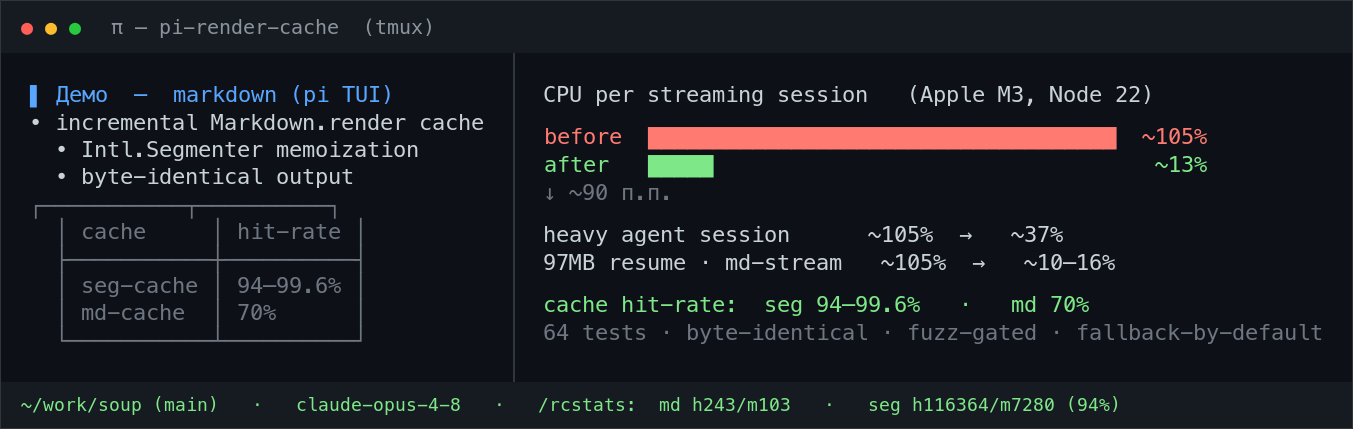
Cuts pi coding-agent TUI CPU during streaming from ~105% of a core to ~10-16% by memoizing Intl.Segmenter (ICU grapheme segmentation) and incrementally caching Markdown.render
Package details
Install pi-render-cache from npm and Pi will load the resources declared by the package manifest.
$ pi install npm:pi-render-cache- Package
pi-render-cache- Version
1.0.4- Published
- Jul 23, 2026
- Downloads
- 636/mo · 90/wk
- Author
- axel.baum.listo
- License
- MIT
- Types
- extension
- Size
- 31.7 KB
- Dependencies
- 0 dependencies · 2 peers
Pi manifest JSON
{
  "extensions": [
    "./extensions/index.ts"
  ],
  "image": "https://raw.githubusercontent.com/axelbaumlisto/pi-render-cache/main/assets/screenshot.png"
}
Security note
Pi packages can execute code and influence agent behavior. Review the source before installing third-party packages.
README
pi-render-cache
Stops a pi coding-agent session from pinning a full CPU core while the model streams.
A long-running interactive pi session burns ~100% of one core per streaming
turn — several open sessions saturate the machine and push it into swap. This
extension brings a heavy streaming session down to ~10–16% of a core with
zero visible change to the rendered output.
Pure monkey-patch, loaded into pi's own process. No pi-tui fork, no config.

The problem (measured, not guessed)
A spindump of a session stuck at 100% CPU shows the hot path is not the LLM
or the network — it is the terminal re-render:
uv__run_timers → Environment::RunTimers            (pi-tui render timer, ≤60 fps)
  → Markdown.render → line wrap/truncate
    → Intl.Segmenter grapheme iteration → ICU BreakIterator   ← the fire
Two independent causes stack up:
Intl.Segmenterhas no cache. pi-tui measures text width by iterating Unicode grapheme clusters through ICU on every wrap/truncate call. Any non-ASCII content (Cyrillic, Thai, emoji — and the box-drawing chars in pi's own UI) misses the ASCII fast-path and re-segments from scratch each frame.- The streaming message is cold-rebuilt every chunk.
AssistantMessageComponent.updateContent()callsclear()+new Markdown(...)on everymessage_update(i.e. every token delta), throwing away pi-tui's own per-instancecachedLines. So the entire message-so-far is re-lexed, re-wrapped and re-segmented up to 60×/second — cost grows linearly with the answer length.
What it does
Two surgical patches, each independently useful, each falling back to the original renderer on any doubt:
| Patch | Target | Effect |
|---|---|---|
| seg-cache | Intl.Segmenter.prototype.segment |
Memoizes grapheme/word segmentation (LRU by locale∙granularity∙string, char-budgeted). Spread-of-native records → exact per-granularity shape; ASCII fast-path; containing() delegation. |
| md-cache | Markdown.prototype.render |
Splits the streaming text into a settled prefix (stable across frames) + a growing tail; caches prefix lines globally by (prefix, width, paddingX, themeFingerprint, hyperlinks) and only re-renders the tail. Neutralizes the cold-rebuild. |
Metrics
Measured on Apple M3, Node 22.23, real sessions with the extension loaded vs. an identical un-patched session running side by side.
CPU during streaming (per session)
| Scenario | Baseline | With extension |
|---|---|---|
| Heavy agent session (subagents streaming) | ~105% of a core | ~37% |
| 97 MB resumed session, long-markdown stream (opus, fast small chunks) | ~105% | ~10–16% |
| Same, large-chunk model (gpt-5.5) | ~105% | ~8–10% |
~65–90 percentage-point drop. Idle sessions were already ~0% and stay ~0%.
Cache hit-rates (live /rcstats)
| Cache | Hit-rate | Notes |
|---|---|---|
| seg-cache | 94–99.6% | e.g. 3,902,590 hits / 17,177 misses in one session — the dominant win, exactly the spindump hotspot. |
| md-cache | 70% on fast-streaming models (opus) | Dormant on models that stream in large infrequent chunks — seg-cache alone already covers those. |
Correctness
- 64 automated tests, byte-for-byte: patched
render()output===the original on a markdown corpus × widths[20, 24, 47, 80], plus an adversarial corpus (reference-link defs across the split, unclosed HTML blocks,<a>autolink-state leaks, list-continuation, fenced code, CRLF, RU/Thai/emoji). - Fuzz gate: 6,500+ random-document byte-diffs, 0 failures.
- The split is conservative by construction — any construct that could make
render(prefix)+render(tail) ≠ render(full)forces a full fallback to the original renderer. Worst case is lost speed-up, never wrong output.
Install
pi install npm:pi-render-cache
Project-local (writes to .pi/settings.json, shareable with your team):
pi install -l npm:pi-render-cache
It auto-loads on the next pi start. Verify with /rcstats.
Requires pi with @earendil-works/pi-tui (resolved automatically as a peer).
Usage
Nothing to configure — it installs both patches on load and self-checks.
/rcstats— one-line hit/miss/fallback counters for both caches.
Safety
- Same-process, same-prototype. pi-tui is imported via its bare specifier, which
pi's loader aliases to its own copy — the patch lands on the exact prototype pi
renders with. pi-tui is a
peerDependency, never bundled. - Idempotent across
/reloadand session switch (shared state on aSymbol.forslot, adopt-on-reinstall).uninstall()restores the original only if it still owns the method — never clobbers another extension's wrapper. - Version-drift guard. If pi's
Markdown.renderchanged underneath (pi upgrade), the extension detects the hash mismatch and refuses to install rather than stitch against an unknown renderer. - Event-gated self-check. If, after the first
message_update, the patch shows zero activity (e.g. a future pi stopped usingIntl.Segmenter), it self-disables and notifies — fail-safe, never silently wrong.
Upstream context
Both root causes are already known upstream and remain unfixed in the core (measured on pi 0.80.7):
- earendil-works/pi#4721 —
perf(tui): editor wrap/layout repeatedly re-segments lines and graphemes.
Same profile this extension targets (
JSSegmentIterator::Next~60%,CreateSegmentDataObject~52%). Auto-closed. → seg-cache addresses it. - earendil-works/pi#3758 —
Avoid rebuilding assistant message components during token streaming.
The cold-rebuild of the streaming
Markdowncomponent. Auto-closed. → md-cache addresses it.
pi's core is intentionally minimal and these live outside it, so this extension is the pragmatic fix: no fork, no core change, drop-in.
Limitations
- Thinking blocks stream through the fallback path (they carry a per-message text style), so thinking-heavy turns see a smaller md-cache win. seg-cache still applies.
- md-cache only helps models that stream in many small chunks; large-chunk models get their win almost entirely from seg-cache.
- The real long-term fix belongs upstream in pi-tui (don't cold-rebuild the streaming component; cache grapheme width). This extension is a zero-fork stop-gap that needs no changes to pi.
License
MIT © 2026 Alexander Prilipko