pi-rewind-hook
Rewind extension for Pi agent - automatic git checkpoints with file/conversation restore
Package details
Install pi-rewind-hook from npm and Pi will load the resources declared by the package manifest.
$ pi install npm:pi-rewind-hook- Package
pi-rewind-hook- Version
1.8.4- Published
- Apr 25, 2026
- Downloads
- 1,298/mo · 403/wk
- Author
- nicopreme
- License
- MIT
- Types
- extension
- Size
- 2.4 MB
- Dependencies
- 0 dependencies · 0 peers
Pi manifest JSON
{
  "extensions": [
    "./index.ts"
  ]
}
Security note
Pi packages can execute code and influence agent behavior. Review the source before installing third-party packages.
README
Rewind Extension
A Pi agent extension that records exact file-state rewind points, allowing restoration of file states during /tree navigation and across resumed and forked sessions
Rewind metadata lives in the session itself as hidden entries, so rewind history survives across forks, resumes, tree navigation, and compaction. Snapshot commits are kept reachable through a single git ref rather than one ref per checkpoint, and rewind points can be resolved across session lineage via parentSession links. Retention is optional and configurable; without it, exact history is kept indefinitely.
Screenshots
Requirements
- Pi agent v0.65.0+
- Node.js (for installation)
- Git repository
Installation
pi install npm:pi-rewind-hook
This will:
- Create
~/.pi/agent/extensions/rewind/ - Download the extension files
- Auto-discover the extension from the extensions directory (no
settings.jsonextension entry required) - Remove legacy hooks/explicit rewind extension entries from
settings.jsonif present - Clean up old
hooks/rewinddirectory (if present)
Works with pi-custom-compaction
Rewind works seamlessly with pi-custom-compaction. When pi-custom-compaction writes visible background-summary markers, it can ask Rewind to bind an exact file checkpoint to that marker’s own session-tree node. That means /tree can offer the normal Restore files to that point option directly on the custom compaction marker instead of falling back to a nearby parent node.
Install the companion extension with:
pi install npm:pi-custom-compaction
This is optional. Pi’s default compaction and Rewind’s native compaction checkpoints continue to work without pi-custom-compaction.
Configuration
Optionally add settings to ~/.pi/agent/settings.json. For example:
{
  "rewind": {
    "silentCheckpoints": true,
    "retention": {
      "maxSnapshots": 2000,
      "maxAgeDays": 30,
      "pinLabeledEntries": true
    }
  }
}
Settings
rewind.silentCheckpoints— hides footer/status and checkpoint notificationsrewind.retention.maxSnapshots— optional cap on unpinned unique snapshot commits kept reachablerewind.retention.maxAgeDays— optional age limit for unpinned snapshot commitsrewind.retention.pinLabeledEntries— when true, snapshot commits bound to labeled nodes in the Pi session tree are exempt frommaxSnapshotsandmaxAgeDayspruning (useful for bookmarking important rewind points you want to prevent getting garbage-collected)rewind.retention.scanMode— retention discovery mode:ancestor-only(default, follow current session lineage only) orrepo-sessions(scan discovered session roots)rewind.retention.startupBudgetMs— optional startup time budget for retention sweeps; if exceeded, startup sweep is skipped and deferred
If rewind.retention is omitted, Rewind keeps exact history with no automatic expiration. This can grow git object storage without bound over time.
Usage
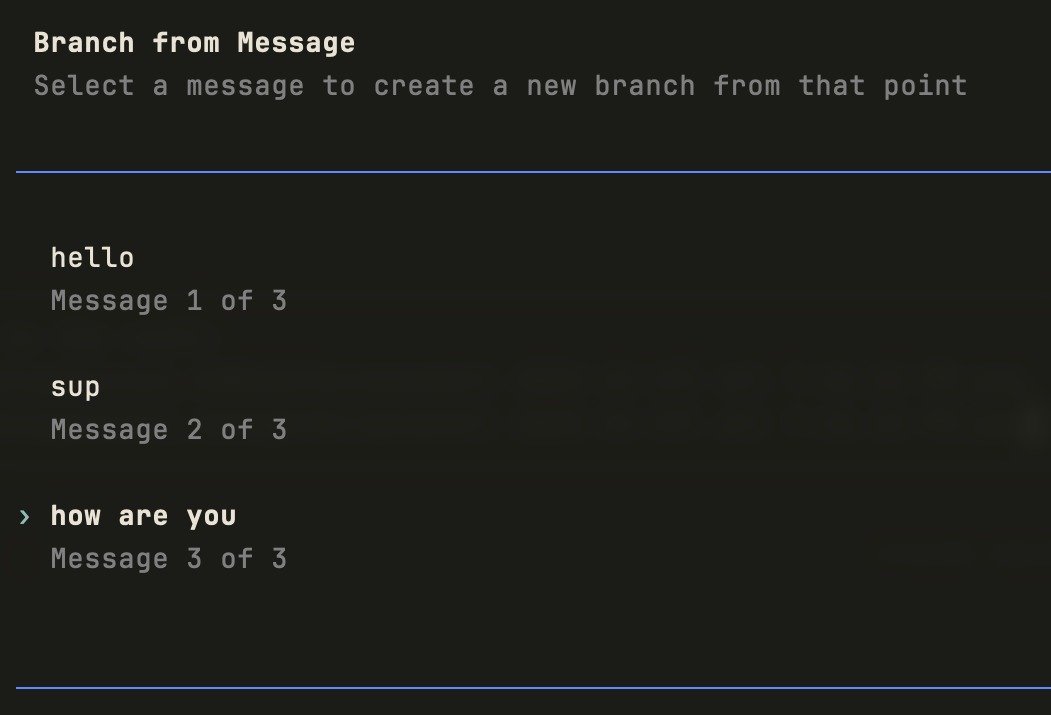
Rewinding via /fork
- Type
/forkin Pi - Select a message to branch from
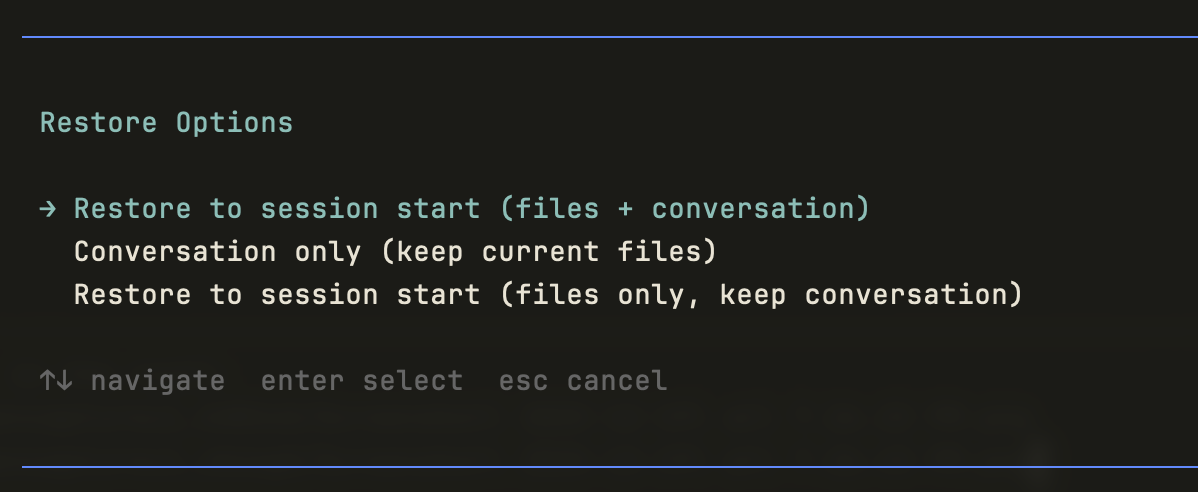
- Choose a restore option
Options:
| Option | Files | Conversation |
|---|---|---|
| Conversation only (keep current files) | Unchanged | Reset to that point |
| Restore all (files + conversation) | Restored | Reset to that point |
| Code only (restore files, keep conversation) | Restored | Unchanged |
| Undo last file rewind | Restored to before last rewind | Unchanged |
Restore all, Code only, and Undo last file rewind are only shown when an exact rewind point or undo snapshot is available for the selected message.
When you restore files during /fork, the undo snapshot is persisted in the new child session, because that is where you continue working.
Rewinding via /tree
- Press
Tabto open the session tree - Navigate to a different node
- Choose a restore option
Options:
| Option | Files | Conversation |
|---|---|---|
| Keep current files | Unchanged | Navigated to that point |
| Restore files to that point | Restored | Navigated to that point |
| Undo last file rewind | Restored to before last rewind | Navigated to that point |
If you navigate with Keep current files, Rewind still persists the resulting session position's exact current file baseline via rewind-op.current.
Examples
Undo a bad refactor:
You: refactor the auth module to use JWT
Agent: [makes changes you don't like]

You: /fork
→ Select "refactor the auth module to use JWT"
→ Select "Code only (restore files, keep conversation)"

Result: Files restored, conversation intact. Try a different approach.
Start fresh from an earlier point:
You: /fork
→ Select an earlier message
→ Select "Restore all (files + conversation)"

Result: Both files and conversation reset to that point.
How Rewind works
Rewind stores its ledger in hidden session custom entries:
rewind-turn— one per prompt, containing the triggering user-node snapshot plus any assistant-node snapshots produced during that promptrewind-op— sparse records for/fork,/tree, compaction aliases, summary aliases, and undo state
Snapshots are only considered at visible boundaries:
- the user pre-prompt boundary
- each assistant
turn_end - selected stateful session operations
Rewind does not create per-tool snapshots.
Canonical exact rewind points
Exact file restore is available for:
- user nodes
- assistant nodes
- compaction nodes aliased to the current exact state
- branch-summary nodes aliased during
/tree
Exact file restore is not offered for toolResult nodes.
Git storage model
Snapshot commits are kept reachable through a single repo-local ref:
refs/pi-rewind/store
That ref is only for git object reachability; the session ledger is authoritative.
Deduplication
Before creating a snapshot commit, Rewind captures the worktree tree SHA. If it matches the latest exact snapshot tree, Rewind reuses that existing snapshot commit instead of creating a new one.
Restore exactness and scope
Rewind restores the exact file state for the snapshot domain it owns:
- tracked files
- untracked, non-ignored files
- without staging the real git index during restore
Before restoring target contents, it deletes paths present in the current snapshot but absent from the target snapshot, then restores the target snapshot into the worktree only.
Out of scope:
- ignored files
- empty directories
- exact rewind points for
toolResultnodes - exact rewind points for
bashExecutionnodes
Lineage and resume behavior
Rewind resolves exact rewind points across session lineage by following parentSession links and reading rewind metadata from ancestor session files.
Rewind v2 uses only session-native rewind-turn/rewind-op metadata and does not read legacy checkpoint refs.
Retention
Retention only affects git reachability. Session JSONL metadata is append-only and is never compacted by Rewind.
When retention is enabled, Rewind keeps snapshot commits alive if they are referenced by:
- a
rewind-turnorrewind-opbinding in a discovered same-repo session - the latest
rewind-op.currentfor a discovered same-repo session - the latest
rewind-op.undofor a discovered same-repo session - a labeled bound entry when
pinLabeledEntriesis enabled
If a snapshot commit has been pruned, Rewind validates commit existence before offering restore.
If retention discovery yields an empty live set, Rewind preserves the existing refs/pi-rewind/store ref rather than deleting it.
Viewing storage
Show the store ref head:
git rev-parse refs/pi-rewind/store
Show the hidden rewind ledger in a session file:
grep '"customType":"rewind-' ~/.pi/agent/sessions/**/*.jsonl
Uninstalling
Remove the extension directory:
rm -rf ~/.pi/agent/extensions/rewindRemove any
rewindkey from~/.pi/agent/settings.jsonif you added oneOptionally, clean up the git reachability ref in each repo where you used the extension:
git update-ref -d refs/pi-rewind/store
Limitations
- Only works in git repositories
- Session metadata grows append-only; retention only trims git reachability
- Discovery for retention is best-effort across discovered Pi session roots and explicit
parentSessionancestors - Ignored files and empty directories are outside the snapshot model