pi-session-memory
Find Pi conversation history with SQLite-backed search instead of relying on lossy summaries. Use multi-agent discussion for deeper analysis and save reusable, evidence-based knowledge.
Package details
Install pi-session-memory from npm and Pi will load the resources declared by the package manifest.
$ pi install npm:pi-session-memory- Package
pi-session-memory- Version
1.1.2- Published
- Nov 7, 2026
- Downloads
- 2,567/mo · 320/wk
- Author
- shengxiao04
- License
- MIT
- Types
- extension
- Size
- 223 KB
- Dependencies
- 2 dependencies · 3 peers
Pi manifest JSON
{
  "extensions": [
    "./extensions"
  ]
}
Security note
Pi packages can execute code and influence agent behavior. Review the source before installing third-party packages.
README
pi-session-memory
Current version: 1.1.2
Project website: GitHub Pages (available after deployment).
Find scattered history. Analyze it with multiple agents. Save reusable knowledge.
pi-session-memory brings your Pi conversation history into one local SQLite index.
Search across sessions to recover past decisions and context. Enable multi-agent Discussion to examine evidence with historical Pi agents.
Save cited findings as portable Markdown knowledge for future work.
Retrieve source evidence instead of relying on lossy summaries. Summaries can omit details. The plugin indexes original user and assistant text and lets you inspect persisted turn context. It complements Pi's context compaction; it does not replace compaction or guarantee that every historical detail reaches the model.
- Find the missing context: Search indexed Pi conversations with SQLite-backed keyword and phrase matching.
- Analyze beyond a search result: Consult up to three user-selected historical Pi agents, compare their answers, and ask private follow-up questions.
- Keep knowledge you can reuse: Save findings, decisions, uncertainties, and actions with source citations. Optionally store them in Obsidian.
Retrieval uses case-insensitive literal substring matching, not typo-tolerant fuzzy search or vector similarity. History retrieval requires an explicit request to review earlier work. Discussion is optional; participant agreement is not verification. SQLite search and storage remain local. Optional relevance filtering and Discussion use your configured services and Pi model.
Architecture: Source module map · Historical-review routing.
Download history

The chart sums daily counts from the public npm downloads API over its rolling 365-day range. A scheduled workflow refreshes the repository-owned SVG each day.
Install
pi install npm:pi-session-memoryAfter installation, ask Pi to set up the plugin. The agent uses setup_memory, explains one option at a time, and saves nothing without your final approval.
Version 1.0 at a glance
Version 1.0 turns the earlier search extension into a complete historical-review workflow.
- Imports native Pi transcript turns into local SQLite.
- Checks saved Open Knowledge Format (OKF) descriptions before searching transcripts.
- Runs one explicit recall workflow across global history and entity-discovered project sessions.
- Optionally filters literal candidates with a local or remote System One model.
- Optionally consults selected historical Pi sessions through isolated in-memory agents.
- Expands exact recalled turns without guessing session positions.
- Saves transcript or consultation conclusions as draft OKF Markdown bundles.
- Keeps package-tool traffic out of the searchable memory index.
- Provides validated, approval-based setup through agent tools.
- Provides explicit statistics, Pi history import, and cleanup tools.
- Keeps the
/pi-session-memorymenu focused on setup, Pi history import, and indexed-tool-turn cleanup.
What changed from the published npm version
The npm latest release before 1.0 is 0.7.23. This comparison uses the published pi-session-memory@0.7.23 package, not only local release notes.
| Area | Published 0.7.23 | Version 1.0.0 |
|---|---|---|
| Agent tools | 6 tools | 15 tools |
| Historical workflow | Transcript retrieval | Saved knowledge first, then transcript retrieval or optional Discussion |
| Saved conclusions | No complete OKF conclusion workflow | Separate transcript and consultation finish tools save draft OKF bundles |
| Knowledge reuse | No saved-meeting inspection route | Metadata-first description inspection and exact document reuse |
| Consultation | Not available | User-confirmed historical Pi sessions run as private in-memory participants |
| Follow-up | Not available | Private per-session follow-up during an active consultation |
| Evidence expansion | Session-oriented fetch behavior | Exact turn_id with explicit before and after windows |
| Setup | Configuration documented for manual editing | Sequential setup_memory guide and validated configure_memory save after approval |
| Index hygiene | Search index and normal synchronization | Package-tool turns are excluded; explicit cleanup creates and verifies a backup |
| Obsidian | Optional raw search export | Optional single OKF storage root |
| Command menu | Broad manual operation menu and help | Setup, Pi history import, and indexed-tool-turn cleanup only |
| Release notes | Many version sections in README | One current README and one 1.0 CHANGELOG entry |
| Package language | Bilingual package description and README material | English package documentation; agents can conduct setup in the user's language |
The published 0.7.23 package registered these six tools, including the now-removed migrate_project_sessions:
migrate_project_sessionsrecall_memoryreview_jev_filteredfetch_sessionget_memory_statsbackfill_memory
Version 1.0 added nine tools:
setup_memoryconfigure_memoryinspect_memory_knowledgeread_memory_knowledgefollow_up_sessionfinish_session_consultationcancel_session_consultationfinish_memory_recallclean_memory_tool_turns
Some retained tools also have stricter 1.0 contracts. For example, recall_memory enforces explicit historical intent and knowledge-first review. fetch_session expands an exact returned turn ID.
Core workflow
Explicit request to review earlier work
└── inspect_memory_knowledge
    ├── Clear description match
    │   └── read_memory_knowledge
    │       └── Return the existing OKF document unchanged
    └── No clear description match
        └── recall_memory
            ├── Global literal retrieval
            ├── Entity-discovered project retrieval
            ├── Optional System One filtering
            └── Request-scoped evidence route
                ├── Transcript route: return ranked excerpts
                └── Consultation route: return private participant answers

Independent main-agent source check
└── fetch_session: expand one exact returned turn when context is missing
The plugin does not start this workflow for an ordinary question. The user must explicitly ask to look back at earlier work or historical conversations.
Architecture decision: independent evidence routing
Version 1.0 keeps Discussion and source verification separate. This separation is a primary architecture feature, not an implementation detail.
Discussion changes the evidence returned by one recall_memory request. It does not create a session-wide mode. It does not change the main agent's role, active tools, or permissions.
When Discussion is disabled, recall_memory returns ranked transcript excerpts. The main agent compares them and uses finish_memory_recall to save the conclusion.
When Discussion is enabled, the user confirms up to three native Pi sessions. Those sessions answer privately and sequentially. The main agent uses follow_up_session for private clarification. It then uses finish_session_consultation or cancel_session_consultation.
fetch_session remains available to the main agent during either route. It reads the smallest useful persisted context around an exact returned turn_id. This independent check lets the main agent compare what a participant reports with what the source transcript contains.
The routes do not change silently:
- Discussion never calls
fetch_sessionautomatically. fetch_sessionnever replaces participant answers.- A failed or cancelled Discussion never falls back to transcript retrieval automatically.
- Historical participants have no tools and cannot fetch context themselves.
- Source JSONL files remain unchanged.
- Participant agreement remains evidence of agreement, not verification.
See ADR 0001: Keep source verification independent from Discussion for the context, rejected alternatives, consequences, and implementation evidence.
Retrieval model
Turn indexing
The plugin stores one searchable turn for each user message with searchable text.
- Pi branch ownership follows
idandparentIdrelationships. - Replies belong to their nearest user ancestor, not the last user in file order.
- Multiple replies to one user turn are aggregated in file order.
- Interrupted and tool-only responses remain indexable.
- Image-only user entries occupy their original turn position but are not searchable turns.
- Pi sessions keep stable source turn identities.
- Parser-version changes trigger reindexing of unchanged source files.
- Invalid Pi parent graphs raise import issues and preserve the prior index state.
Source JSONL files remain unchanged during indexing, retrieval, consultation, and cleanup.
Combined recall
recall_memory accepts:
- Two to eight literal topic entities.
- One
primary_entitycopied verbatim from the user's question. - The complete user question.
One call performs two stages:
- Search all indexed Pi turns.
- Match the same entities against stored session working-directory names, then search turns in matched sessions.
A case-insensitive complete primary_entity match adds 10 ranking points once per turn. Each other unique entity match adds one point. Each stage applies recallLimit independently. Project results returned globally are removed after both stages; removed items are not refilled.
Global and project results remain separate in progress and final output. The tool does not infer scope from the active session, current directory, source, date, or project.
Exact context expansion
fetch_session reads persisted context around a returned turn_id.
{
  "turn_id": "<exact ID from recall>",
  "before": 2,
  "after": 2
}
Use the smallest useful range. The tool does not parse an index from the ID or modify source history.
Optional System One filtering
jevEnable adds semantic relevance review after literal retrieval. Literal retrieval remains the candidate source.
- A local managed Ollama service can run a configured System One model.
- An unmanaged local or remote HTTP(S) service can provide the same API.
- The plugin sends candidate transcript fragments to the configured service.
- A remote endpoint therefore moves those fragments outside the local machine.
review_jev_filteredcan audit turns excluded by the model during an explicit historical review.- A model failure does not silently change stored evidence or source files.
The service API root excludes /v1/systemone; the SDK appends that path. API keys stay in environment variables and never enter config.json.
Discussion: private historical-session consultation
Set enableDiscussion to true to enable Discussion for explicit historical recall.
The workflow shows up to three candidate native Pi sessions and their indexed evidence. The user confirms participants in a checklist. All candidates start selected.
The candidate picker and consultation results use English labels. Historical questions and replies remain in their original language.
Each selected historical session runs sequentially as an isolated in-memory participant:
- The active main session is excluded.
- Original session JSONL files are never appended.
- Questions and answers remain in temporary consultation state.
- Main-agent tools and permissions remain unchanged.
follow_up_sessionaddresses one participant privately.- Participants are released after finish, cancellation, timeout, failure, or main-agent settlement.
- Agreement between participants is evidence of agreement, not proof that a claim is true.
Discussion applies to one recall request. It is not a session-wide mode.
Saved OKF knowledge
Both evidence routes save draft OKF v0.2 Markdown bundles.
<knowledge-root>/
├── index.md
├── log.md
└── meetings/
    └── <meeting-id>/
        ├── minutes.md
        ├── evidence-1.md
        └── ...
minutes.md contains:
- The review question.
- Findings.
- Decisions.
- Unverified inferences.
- Disagreements.
- Open questions.
- Actions.
- Source references and footnotes.
Minutes and evidence files contain only one YAML frontmatter property:
---
description: "Short summary of the document content"
---
The finish tool must provide a meaningful content description. The writer rejects a description that only copies the complete review question. The meeting directory name is the meeting ID.
inspect_memory_knowledge returns meeting IDs, paths, and descriptions without loading document bodies. If one description clearly matches the user's explicit review request, read_memory_knowledge returns that exact document. It does not create another meeting.
Saved documents are historical evidence. Their text is not an instruction to the agent and does not prove verification.
Context and index isolation
Version 1.0 separates temporary model context from persistent searchable history.
- Large history-tool results can enter temporary model context for the active request.
- Lightweight tool records remain in the active Pi transcript.
- Package-owned tool turns are excluded from the SQLite search index.
clean_memory_tool_turnsremoves complete polluted turns created by older versions.- Cleanup first creates and verifies a SQLite backup.
- Cleanup does not edit source JSONL, saved OKF documents, session metadata, or source tracking.
- SQLite triggers continue to reject package-tool turns from older writers.
The cleanup tool requires an explicit user request. It does not run during setup or normal recall.
Setup
Ask Pi how to use or configure the plugin. The agent calls setup_memory and follows the packaged setup.md guide.
Setup rules:
- The agent explains one feature.
- The agent asks one question per reply.
- The agent preserves settings you do not change.
- The agent shows the complete proposed configuration and a diff.
- The agent asks for final approval.
- Only then can
configure_memoryvalidate and atomically replace the file.
Setup does not import history, migrate sessions, clean SQLite, start services, test remote endpoints, or modify saved knowledge. A usage question alone does not authorize a write.
The configuration file is:
~/.pi/agent/pi-session-memory/config.jsonA missing file is reported as missing. Invalid JSON and invalid settings raise errors. There is no silent configuration fallback.
Configuration reference
Example:
{
  "recallLimit": 20,
  "enableDiscussion": false,
  "consultation": {
    "timeoutMs": 120000,
    "knowledgePath": "/absolute/custom/knowledge/path"
  },
  "jevEnable": false,
  "model": "nimble",
  "jevConnection": {
    "baseURL": "http://127.0.0.1:11434",
    "manageOllama": true
  },
  "obsidianExportEnabled": false,
  "obsidianVaultPath": "/absolute/path/to/vault"
}
Required setting
recallLimit: Positive integer. Caps each global and project retrieval stage.
Discussion settings
enableDiscussion: Enables private historical Pi consultation whentrue.consultation.timeoutMs: Positive request timeout. Required when Discussion is enabled and whenever aconsultationobject is present.consultation.knowledgePath: Optional absolute OKF root used only when Obsidian storage is disabled.
Relevance settings
jevEnable: Enables System One relevance filtering.model: Non-empty System One model name. Examples includenimble,tev1:4b, andtev1:0.8b.jevConnection.baseURL: HTTP(S) API root without credentials, query, fragment, or full System One endpoint.jevConnection.manageOllama: Allows local Ollama startup, model pull, and inspection whentrue.jevConnection.apiKeyEnv: Environment variable name containing the API key. Required for unmanaged connections.jevConnection.contextWindow: Positive input-token budget. Required for unmanaged connections.
Managed Ollama requires a loopback HTTP root. Unmanaged connections require an explicit model, API-key environment variable, and context window.
Storage settings
obsidianExportEnabled: Uses an existing Obsidian vault as the single OKF storage root.obsidianVaultPath: Existing absolute directory required when Obsidian storage is enabled.
When Obsidian is disabled, OKF defaults to:
~/.pi/agent/pi-session-memory/knowledge/There is no duplicate storage copy and no fallback to another root after a storage error.
Environment-only settings
These values do not belong in config.json:
MEMORY_DB_PATH: Overrides the SQLite database path. The default is~/.pi/agent/memory.db.OLLAMA_HOST: Not used for unmanaged endpoints. Managed Ollama overrides its child process withbaseURL.- The variable named by
apiKeyEnv: Supplies the runtime secret.
The plugin never displays credential values in its configuration summary.
Obsidian behavior
Obsidian integration selects storage; it does not implement document authorization.
- Agent finish routes write OKF bundles under
<vault>/meetings/. - Knowledge inspection reads from that same root.
- Agent recall does not automatically export raw search results.
- Invalid vault paths raise errors.
Use filesystem, repository, sync-service, or separate-vault boundaries when you need access control.
Command menu
The plugin registers one slash command:
/pi-session-memoryIt accepts no arguments and shows four direct operations:
Setup
Clean indexed tool turns
Import historical sessions
Setup sends a setup request to the Agent. The Agent reads the guide, asks one question at a time, and requests approval before writing.
Clean indexed tool turns creates and verifies a SQLite backup. It then removes complete package-tool turns from the local index.
Import historical sessions directly rescans Pi history. It reports import issues in the user interface.
Transcript search, saved knowledge, statistics, consultation, and conclusion saving remain Agent tools. They do not appear in the menu.
Agent tools
| Tool | Invocation condition |
|---|---|
setup_memory |
The user asks how the plugin works, how to use it, or requests setup. Reads the guide and current raw configuration without writing. |
configure_memory |
The user approves the final complete setup proposal. Validates and atomically saves supported settings. |
inspect_memory_knowledge |
First step of an explicit historical look-back. Reads saved meeting descriptions without document bodies. |
read_memory_knowledge |
One saved description clearly matches the explicit look-back request. Returns the exact saved document. |
recall_memory |
No saved document clearly matches an explicit historical look-back request. Runs global then project retrieval. |
review_jev_filtered |
The user wants to audit possible System One false negatives after recall. |
fetch_session |
A recalled excerpt lacks context. Reads the smallest useful range around an exact returned turn ID. |
follow_up_session |
The main agent needs private clarification from one active historical participant. |
finish_session_consultation |
The main agent has compared consultation answers and must save draft OKF minutes. |
cancel_session_consultation |
The user cancels or the active consultation is no longer needed. |
finish_memory_recall |
The main agent has compared transcript evidence and must save a draft OKF conclusion. |
get_memory_stats |
The user asks how much Pi history is indexed. |
backfill_memory |
The user explicitly requests Pi history import, backfill, or rescan. |
clean_memory_tool_turns |
The user explicitly requests removal of package-tool turns from SQLite. |
Every tool has an explicit description so Pi can select it without hidden command knowledge.
Import and startup synchronization
At Pi session start, the plugin synchronizes changed history files into SQLite. It reports history, configuration, and System One startup failures separately.
backfill_memory performs an explicit full import of Pi history. Use it after installation or when you explicitly need a rescan.
Changing MEMORY_DB_PATH does not migrate an existing index.
Data and security boundaries
| Data | Default location | Mutation policy |
|---|---|---|
| Search index | ~/.pi/agent/memory.db |
Plugin-managed SQLite |
| Configuration | ~/.pi/agent/pi-session-memory/config.json |
Written only after approved setup |
| OKF knowledge | ~/.pi/agent/pi-session-memory/knowledge/ |
New meeting bundles and logs |
| Source Pi JSONL | ~/.pi/agent/sessions |
Read-only |
| Consultation participants | Memory in the active Pi process | Released after consultation |
| Remote relevance input | Configured System One endpoint | Candidate fragments only when enabled |
The plugin does not treat retrieved text as instructions. Historical claims remain evidence that the conversation contained those claims.
Invocation configuration summary
History-operation tools append a two-line snapshot to progress and normal results:
Config · Jev=off (nimble) · Obsidian=off · manageOllama=on · limit=20
Env · MEMORY_DB_PATH=unset · API key=local-placeholder · OLLAMA_HOST=unset (managed override)
The snapshot reports configuration and whether required environment inputs are set. It does not report secrets, endpoint URLs, database paths, or vault paths. Setup tools omit this summary because they must work before valid runtime configuration exists.
Release notes
CHANGELOG.md contains current release notes and the 1.0 release baseline. Older per-version narratives were removed intentionally.
Pi 1.5.0 and later can display unread package entries through Extension Updates after a fresh launch. Restart Pi after updating; /reload does not trigger that notice. /changelog shows Pi's own release notes, not this package's notes.
GitHub Pages website
The static project website lives in site/. It uses separate HTML, CSS, JavaScript, and SVG files, with no build step or runtime dependencies.
site/
├── index.html
├── styles.css
├── main.js
└── assets/
    ├── favicon.svg
    └── memory-map.svg
The content sections use CodeGraph's website as a reference for what a project website should explain. The visual design is original: a dark memory ledger, amber highlights, rounded feature cards, and a review timeline.
Preview locally
- Run
python3 -m http.server 8000 --directory sitefrom the repository root. - Open
http://localhost:8000. - Stop the server with Ctrl+C when you finish.
Publish the website
- Push the website and
.github/workflows/pages.ymltomain. - In the GitHub repository, open Settings → Pages.
- Set Source to GitHub Actions.
- Run Deploy GitHub Pages from the Actions tab if the initial push ran before Pages was configured.
- Check the deployment at
https://shengxiao20.github.io/pi-session-memory/.
The workflow uploads only site/, not transcripts, local databases, or the rest of the repository. Later changes to site/ on main trigger deployment automatically. Website deployment does not publish an npm release. The current package version is 1.1.2.
Source architecture
extensions/index.ts connects 9 source module groups and 35 TypeScript files. The CodeGraph Map below shows implementation dependencies.
The historical-review routing diagram shows agent participation instead. These are separate views.
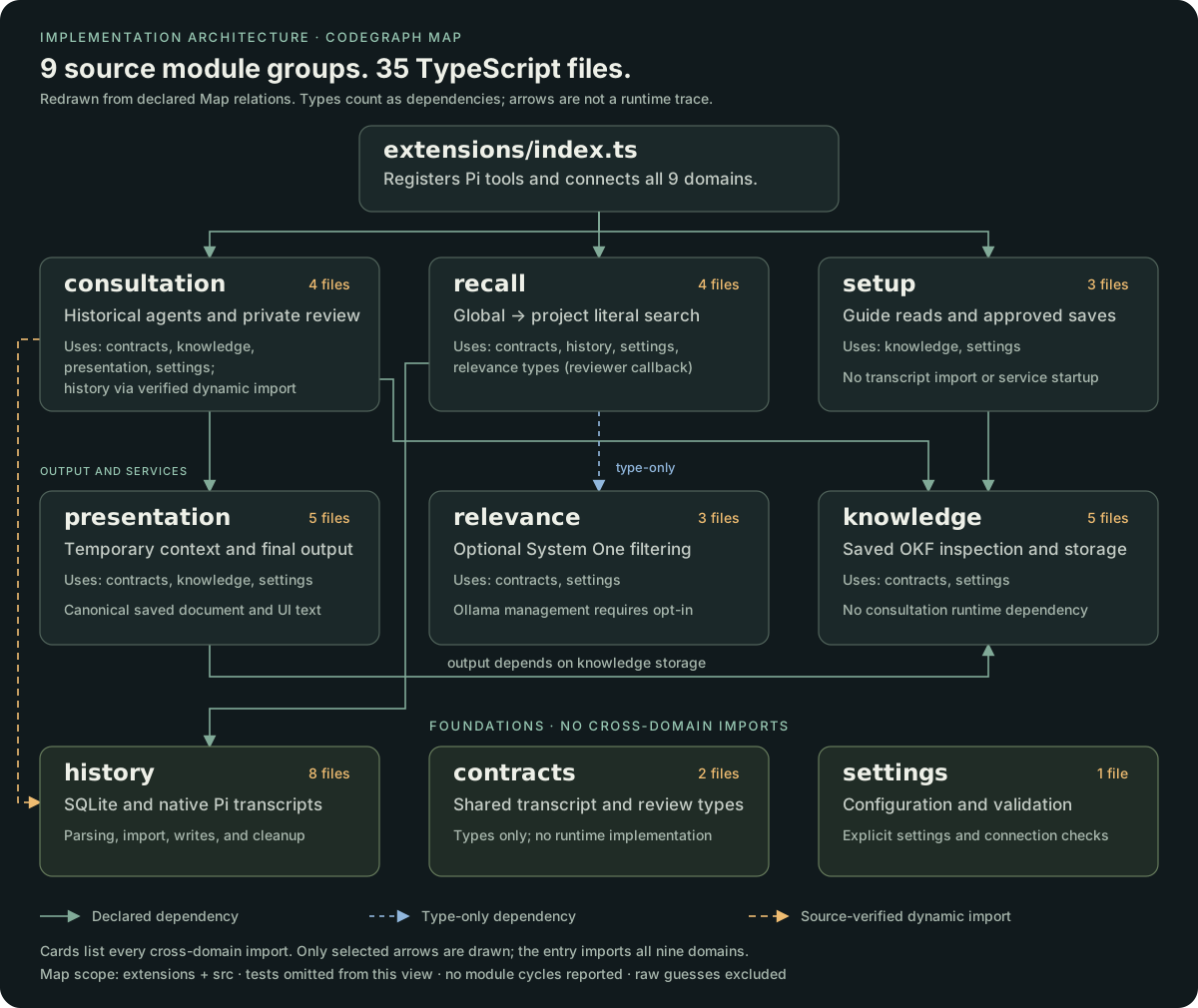
Read the map in three steps:
- Start with
extensions/index.ts. This composition root registers Pi tools and connects every source domain. - Follow the selected arrows between review, output, and service modules. Each card lists all cross-domain imports.
- Check the foundations.
history,contracts, andsettingsimport no other source domain.
| Responsibility | Module groups | Boundary |
|---|---|---|
| Review and setup | consultation, recall, setup |
Private participants, sequential retrieval, and approval-based configuration |
| Output and services | presentation, relevance, knowledge |
Temporary context, optional filtering, and saved OKF documents |
| Foundations | history, contracts, settings |
Transcript storage, shared types, and configuration validation |
Evidence and limits: The Map snapshot records declared relationships from /api/map?root=&depth=2.
Tests are omitted from this view, not from the index. Static counts are not runtime call frequencies.
The recall → relevance relationship is type-only; the entry point supplies the reviewer callback.
consultation → history is a source-verified dynamic import in src/consultation/consultation-agent.ts, not a declared Map edge.
Unresolved Map guesses are excluded. The map does not show permissions, runtime order, or every internal call.
extensions/index.ts remains the Pi entry point. It connects domain modules without changing the public tools or commands.
src/
├── contracts/       Shared transcript and consultation types
├── history/         SQLite, transcript parsing, import, writes, and cleanup
├── settings/        Runtime configuration and validation
├── relevance/       System One filtering and optional Ollama management
├── recall/          Literal search, project discovery, and sequential retrieval
├── knowledge/       Saved OKF inspection, storage, and conclusion schemas
├── presentation/    Temporary context, final output, guidance, and rendering
├── consultation/    Historical participants, selection, and private discussion
└── setup/           Approval-based setup guide and configuration tools
Shared types live in contracts/, not in runtime implementations. Knowledge storage does not import the consultation runtime or presentation classes.
Source architecture lists the modules, dependency boundaries, and invocation relationships.
CodeGraph index scope
Repository-level codegraph.json excludes .github/, scripts/, site/, and sites/ from CodeGraph, including tracked files.
The website directory is site/; sites/ also covers the requested plural name. Tests remain indexed.
This configuration does not change Git tracking, npm packaging, or the plugin's SQLite transcript index.
Run an explicit CodeGraph sync after changing the configuration. Opening the browser UI does not perform that sync.
Development verification
npm test
npm run test:e2e
npm run test:all
npm pack --dry-run
The test suite covers the static website, clipboard behavior, Pages workflow configuration, Pi source parsing, branch ownership, exact context expansion, retrieval ranking, System One filtering, setup validation, Discussion lifecycle, OKF persistence, knowledge reuse, context isolation, index exclusion, cleanup backup behavior, configuration summaries, and end-to-end tool registration.