pi-sessions
Pi session search, ask, handoff, messaging, auto-titling, and indexing tools
Package details
Install pi-sessions from npm and Pi will load the resources declared by the package manifest.
$ pi install npm:pi-sessions- Package
pi-sessions- Version
0.11.1- Published
- Jul 28, 2026
- Downloads
- 1,807/mo · 281/wk
- Author
- thurstonsand
- License
- MIT
- Types
- extension
- Size
- 1.2 MB
- Dependencies
- 0 dependencies · 4 peers
Pi manifest JSON
{
  "extensions": [
    "./extensions/pi-sessions.ts"
  ]
}
Security note
Pi packages can execute code and influence agent behavior. Review the source before installing third-party packages.
README
pi-sessions
pi-sessions turns your old Pi sessions into something you can actually reuse. It gives you search, follow-up Q&A, deliberate handoffs into new child sessions, automatic session titles, and a local index that keeps future sessions searchable.
Screenshots
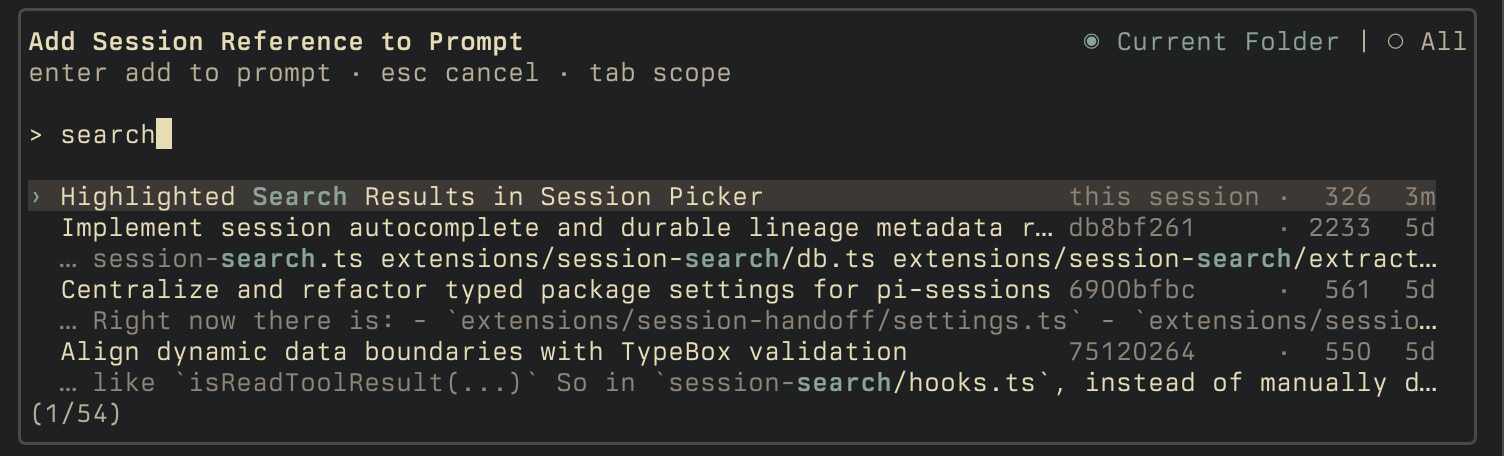
Session lookup
Handoff board


Subagent report

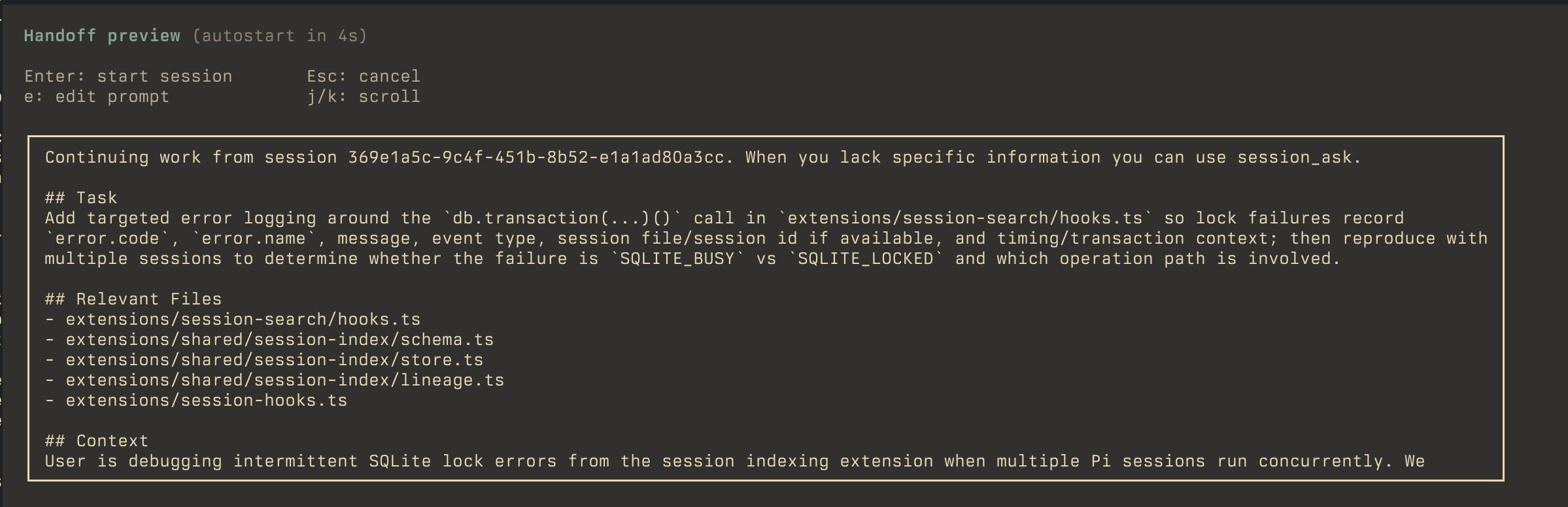
Session handoff

Handoff prompt review
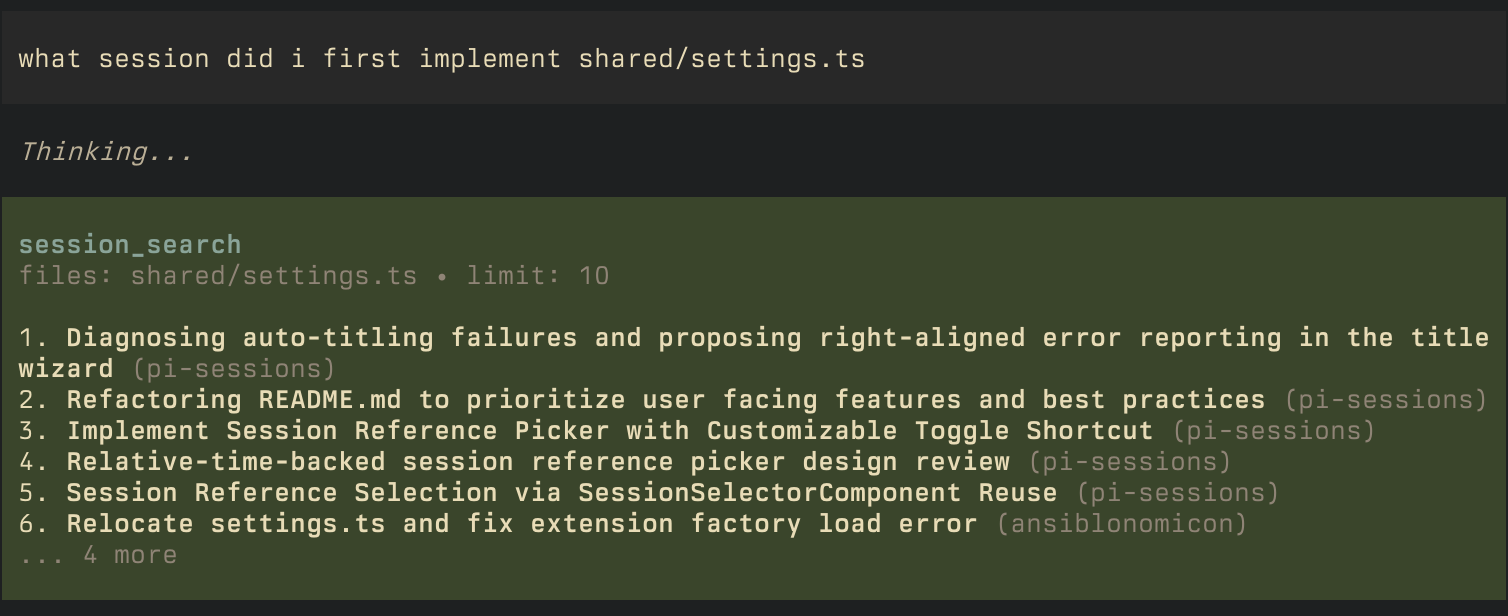
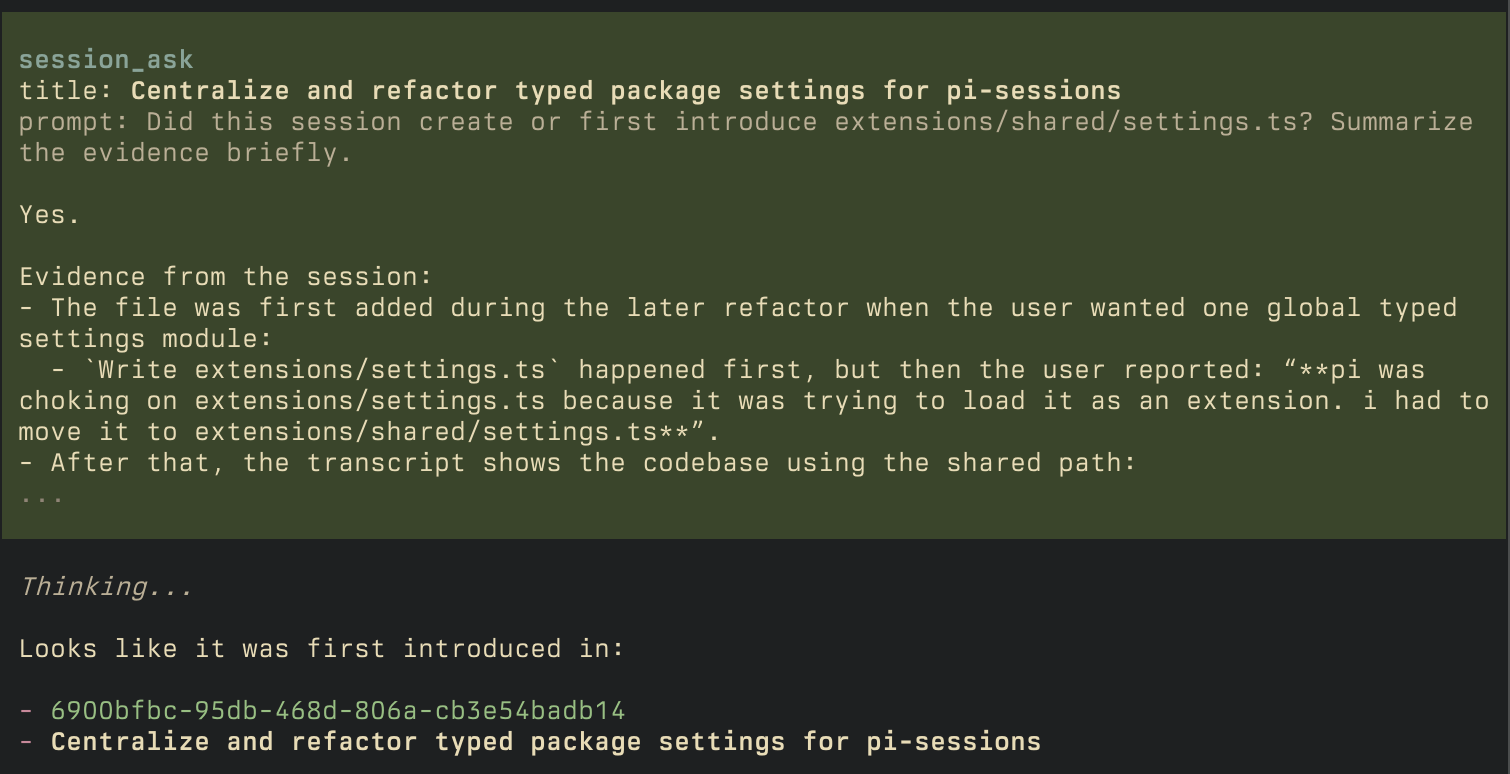
Ask about old sessions
Install
Requires Pi 0.82.1 or newer and Node >=24 <26.
From npm (recommended):
pi install npm:pi-sessions
If you want to run directly from a local clone while developing:
pi -e /absolute/path/to/pi-sessions
Quick start
- Install the package.
- Open Pi and run
/session-index. - Press
rto build the index for all your prior sessions. - Try the main flows:
What session did I implement the db layer?
Open the frontend implementation task in a session to the right.
Features
| Extension | Surface | What it does |
|---|---|---|
| Session Search | session_search pi tool |
Search through old sessions |
| Session Ask | session_ask pi tool |
Ask questions about old sessions |
| Session Handoff | session_handoff pi tool, /handoff board |
Start and manage focused child sessions |
| Session Messaging | session_reachable, session_send_message, session_cancel pi tools |
Coordinate between live Pi sessions and own subagents |
| Session Picker | Alt+O |
Reference old sessions in your prompt |
| Session Index | /session-index slash command |
Shows index status and rebuilds the local session index |
| Session Auto Title | in background, /title slash command |
Give sessions titles |
Every feature is on by default. Turn one off with enable: false under its own settings namespace, which unregisters its tools and hooks.
{
  "sessions": {
    "messaging": { "enable": true },
    "subagents": { "enable": true },
    "handoff": { "enable": true },
    "search": { "enable": true },
    "ask": { "enable": true },
    "autoTitle": { "enable": true },
    "hooks": { "enable": true }
  }
}
Session Search
session_search searches the local session index by text, repo, cwd, time range, and file evidence.
Queries support regular text for normal usage, quoted phrases, AND / OR / NOT, parentheses, and -term negation when matching needs to be stricter. Unquoted terms use prefix matching, quoted terms are exact. A search with no query returns matching sessions chronologically, newest first.
File filters distinguish read-or-write evidence from write-only evidence:
files.touched: sessions that read or changed a pathfiles.changed: sessions that changed a path
Use kind: "user" or kind: "subagent" to filter by session type across the whole index. Searching for sessions that can be addressed right now is a different question, answered by session_reachable.
Session Handoff
The session_handoff tool lets the agent create a child session with a self-contained task. Ask for a direction when you want a visible split, ask for a deferred handoff when you only want the prepared session, or let the agent delegate suitable independent work to a background subagent.
Directional launches use tmux when the current terminal is inside tmux, or Ghostty on macOS. Deferred launches create the child without starting it and copy its resume command to the clipboard. A background subagent runs in a detached tmux window and reports back when finished.
Run /handoff to open the Handoffs board. The Subagents and User sessions tabs show status, age, launch details, and the actions currently available: stop, copy an observation command, or copy a resume command.
Session Messaging
Agents can coordinate with live Pi sessions and their own subagents:
session_reachablelists the sessions this session can send messages tosession_send_messagesends a message to a live session or own subagentsession_cancelaborts another live session's current turn
Incoming messages start the recipient agent when idle and steer it when already running. Messaging a dormant owned subagent resumes it automatically; other inactive sessions cannot receive messages, but you can still use session_search and session_ask with them.
Session picker
Directly reference prior sessions by looking them up by contents.
- shortcut:
Alt+O - press
Tabto switch between current folder and all sessions - type to filter results
- press
Enterto insert a session id into your prompt
Handoff setting
If you want to override the shortcut, put this in your ~/.pi/agent/settings.json:
{
  "sessions": {
    "handoff": {
      "pickerShortcut": "alt+p",
      "model": "openai-codex/gpt-5.6-terra",
      "thinkingLevel": "low",
      "deferred": {
        "copyToClipboard": true
      }
    }
  }
}
model and thinkingLevel configure the agent that builds handoff prompts. They default to the new session's values when absent.
deferred.copyToClipboard (default true) controls whether deferred handoffs copy the resume command to the clipboard. When off, the resume command is only shown in the tool call.
Subagents require the handoff and messaging features. Limit recursive delegation depth with sessions.subagents.maxDepth (default 2):
{
  "sessions": {
    "subagents": {
      "maxDepth": 2
    }
  }
}
Session Index
By default, pi-sessions will start indexing all conversations moving forward. If you want to backfill all prior conversations:
- run
/session-index - hit
rto (re)index everything
this is idempotent, so if you run into any issues, or disable pi-sessions for a while, feel free to re-index to see if that resolves anything.
By default the index lives at:
~/.pi/agent/pi-sessions/index.sqlite
but you can change the location in ~/.pi/agent/settings.json:
{
  "sessions": {
    "index": {
      "dir": "~/.pi/agent/pi-sessions"
    }
  }
}
Session Auto Title
The auto-title extension keeps your session list readable by:
- Setting a title based on initial prompt
- Reevaluating the title every 4 turns to see if it should be updated
To manage existing titles, run /title, where you can:
- Regenerate a title for the current session
- Generate titles for all sessions in the folder
- Generate titles for all sessions across pi
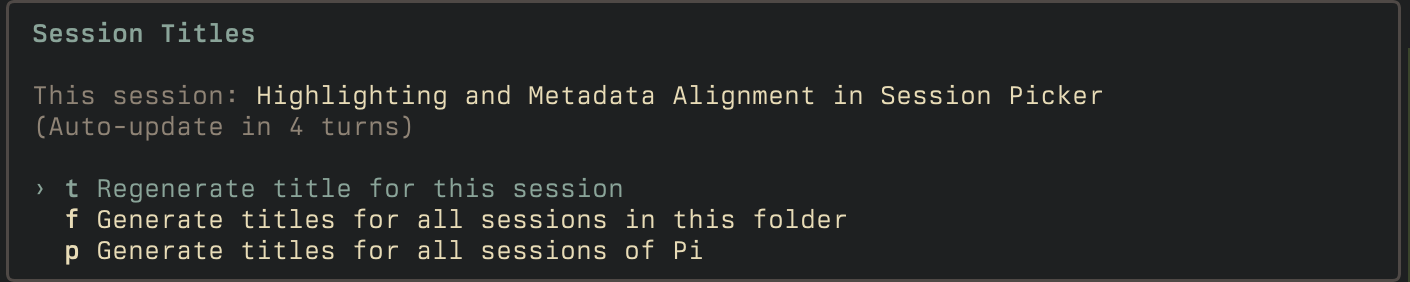
Note that generating titles for all sessions can take some time, and will hit your configured model with the full contents of all sessions.
- automatic retitles run every few turns
- if you manually rename a session with
/name, automatic retitling pauses for that session - Regenerate the title for the current session to resume automatic retitling
- if unconfigured, it will attempt to use these models in order, first one that is available:
openai-codex/gpt-5.6-lunaopenai/gpt-5.6-lunaanthropic/claude-haiku-4-5google/gemini-flash-lite-latest- your currently configured model
To change auto-titling settings, edit ~/.pi/agent/settings.json:
{
  "sessions": {
    "autoTitle": {
      "refreshTurns": 4,
      "timeoutSecs": 15,
      "tokenBudget": 64,
      "model": "anthropic/claude-haiku-4-5",
      "thinkingLevel": "off",
      "prompt": "Custom prompt that overrides the default.",
      "persistRuns": false
    }
  }
}
persistRuns records each title request as its own session file under ~/.pi/agent/pi-sessions/session-auto-title/, holding the exact prompt and response. Open one with pi --session <file> to see what the titling model was sent.
Development
mise trust && mise bootstrap
mise run check
mise run test
For an end-to-end manual flow, see SMOKE.md.