pi-spark
Pi package that polishes your daily experience and keeps you at the frontier of agentic workflows.
Package details
Install pi-spark from npm and Pi will load the resources declared by the package manifest.
$ pi install npm:pi-spark- Package
pi-spark- Version
0.14.4- Published
- Jun 14, 2026
- Downloads
- 4,403/mo · 4,014/wk
- Author
- zlliang
- License
- MIT
- Types
- extension
- Size
- 2.6 MB
- Dependencies
- 6 dependencies · 5 peers
Pi manifest JSON
{
  "extensions": [
    "./index.ts"
  ],
  "image": "https://raw.githubusercontent.com/zlliang/pi-spark/main/assets/cover.png"
}
Security note
Pi packages can execute code and influence agent behavior. Review the source before installing third-party packages.
README

pi-spark
Pi package that polishes your daily experience and keeps you at the frontier of agentic workflows.

Features
Compact TUI: editor, footer, and fullscreen
pi-spark ships with custom editor, footer, and fullscreen rendering, replacing the default ones. The compact TUI gives you a calm, immersive experience without distraction.
- The editor shows a working indicator inspired by Amp and the current model on the top border. If you use presets, the active preset appears there too.
- The footer shows session information, extension statuses, cost, and context usage on one line.
- The fullscreen rendering clears the terminal screen and scrollback on session start and exit, and pins the editor and footer to the bottom.

Credits
pi-spark shows the active provider's credit balance or rate-limit usage in the status line, so you can keep an eye on what's left without leaving the terminal.
- Supported providers: DeepSeek, Fireworks, Moonshot, OpenAI Codex, OpenRouter, and Vercel AI Gateway.
- Most provider fetching follows CodexBar. Fireworks is the exception: its balance sits behind an internal gRPC API, reverse-engineered from the
firectlbinary (see docs/fireworks.md).

Presets
pi-spark lets you define named model presets in spark.json (see Configuration), so you can switch between models and thinking levels without retyping provider details. The active preset is shown on the editor's top border.
- Switch interactively with
/preset, or jump straight to one with/preset <name>. - Start pi on a given preset with
pi --preset <name>. - Cycle presets with
ctrl+super+p(forward) andctrl+shift+super+p(backward);superiscommandon macOS and needs a terminal that forwards it.

Recap
pi-spark generates a short recap of the current session after it goes idle, or on demand, inspired by Claude Code's session recap.
- A recap is generated automatically once the session stays idle past
recap.idleinspark.json. - Run
/recapto generate one manually at any time. - The recap can use its own model, configured separately from your working model.

Agent tools: pi and web
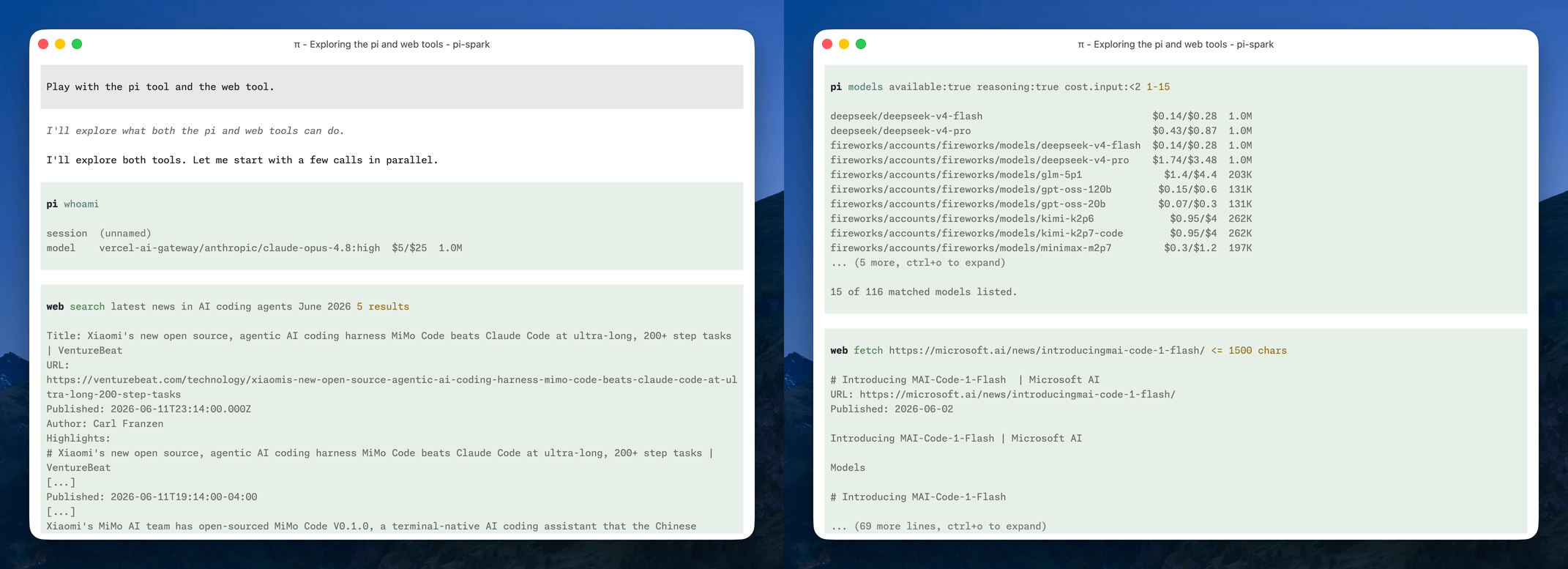
pi-spark adds two agent tools:
The pi tool lets the pi coding agent inspect and manipulate itself (~740 tokens).
modelslists and searches the model catalog.namesets or updates the current session's name.whoamishows the current pi state, including session name, active model, and thinking level.
The web tool gives the agent live web access, backed by the free Exa MCP (~350 tokens). No separate MCP setup or API key is needed.
searchfinds current information across the web and returns ready-to-use content.fetchreads the full content of known URLs as clean markdown, and can batch several URLs in one call.
Configuration
pi-spark reads config from ~/.pi/agent/spark.json and from the current project's .pi/spark.json. Project config overrides matching global fields.
For example:
{
  "editor": {
    "spinner": "dots"
  },
  "footer": false,
  "presets": {
    "claude-opus": {
      "provider": "anthropic",
      "model": "claude-opus-4-8",
      "thinkingLevel": "high"
    },
    "gpt": {
      "provider": "openai-codex",
      "model": "gpt-5.5",
      "thinkingLevel": "medium"
    }
  },
  "recap": {
    "idle": "5m",
    "provider": "openai-codex",
    "model": "gpt-5.4-mini",
    "thinkingLevel": "off"
  }
}
References
All fields are optional. Each top-level feature runs with the defaults below unless you turn it off.
| Field | Value (or false) |
Description |
|---|---|---|
credits |
{} |
Shows the active provider's credit balance or rate-limit usage in the status line. |
editor |
EditorConfig |
Shows a working indicator and the current model on the editor's top border. |
footer |
{} |
Shows session info, extension statuses, cost, and context usage on one line. |
fullscreen |
{} |
Clears the screen and scrollback on start and exit, and pins the editor and footer to the bottom. |
pi |
{} |
Exposes the pi agent tool (models, name, whoami actions). |
presets |
{ [name]: Preset } |
Defines named model presets, keyed by name. |
recap |
RecapConfig |
Generates a session recap when idle or on demand. |
web |
{} |
Exposes the web agent tool (search, fetch actions) via Exa's hosted MCP server. |
EditorConfig
The spinner field is optional and defaults to tildes.
| Field | Value | Description |
|---|---|---|
spinner |
dots |
⠋, ⠙, ⠹, ⠸, ⠼, ⠴, ⠦, ⠧, ⠇, ⠏ |
lights |
○, ● |
|
tildes (default) |
∼, ≈, ≋, ≈, ∼ |
|
pulse |
·, •, ●, •, · |
Preset
Each preset must set all three fields.
| Field | Value | Description |
|---|---|---|
provider |
string | Provider ID, e.g., anthropic. |
model |
string | Model ID, e.g., claude-opus-4-8. |
thinkingLevel |
off, minimal, low, medium, high, xhigh |
Thinking level for the preset. |
RecapConfig
All fields are optional, including thinkingLevel.
| Field | Value | Description |
|---|---|---|
idle |
number (ms) or duration string | How long the session must stay idle before a recap is generated. Accepts a millisecond number or a vercel/ms string (e.g., "3m"); minimum 5000 ms, defaults to 3 minutes. |
provider |
string | Provider ID for the recap model. |
model |
string | Model ID for the recap model. |
thinkingLevel |
off, minimal, low, medium, high, xhigh |
Thinking level for the recap model. |
Turn off the features you don't like
All features are enabled by default. Set a specific feature to false in spark.json to disable it.
For example, to disable the customized footer:
{
  "footer": false
}