pi-sych
General project and artifact development workbench for Pi
Package details
Install pi-sych from npm and Pi will load the resources declared by the package manifest.
$ pi install npm:pi-sych- Package
pi-sych- Version
3.0.2- Published
- Jul 31, 2026
- Downloads
- 1,279/mo · 1,279/wk
- Author
- joao-o-santos
- License
- MIT
- Types
- extension, skill
- Size
- 418.3 KB
- Dependencies
- 3 dependencies · 5 peers
Pi manifest JSON
{
  "extensions": [
    "./extensions/workbench/index.ts"
  ],
  "skills": [
    "./skills"
  ],
  "image": "https://unpkg.com/pi-sych@3.0.2/docs/img/architecture.png"
}Security note
Pi packages can execute code and influence agent behavior. Review the source before installing third-party packages.
README
Pi Sych
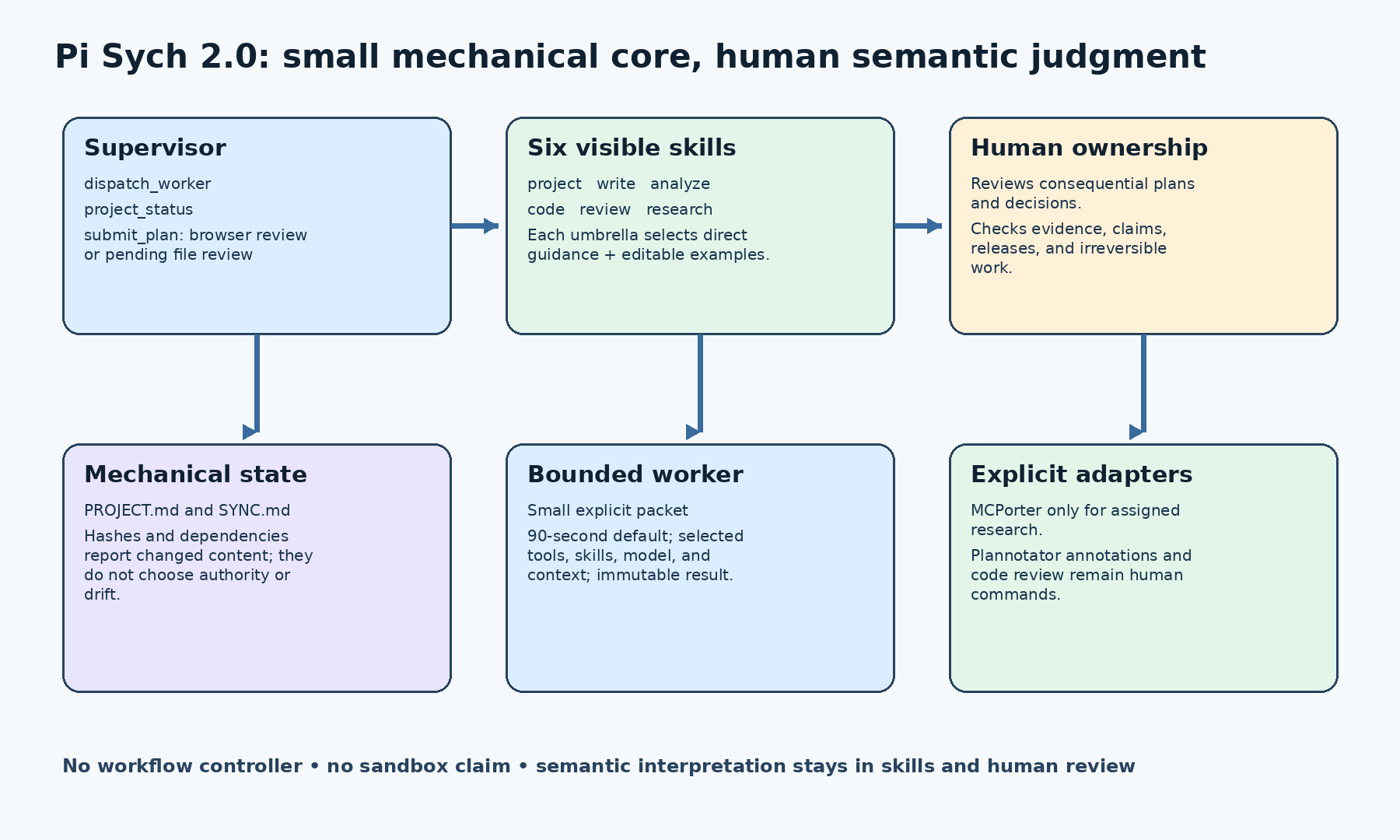
Pi Sych is a Pi package for visible project state, bounded delegation, and human-owned judgment in writing, research, analysis, and software work. It keeps mechanical facts mechanical: a changed hash is not a verdict about meaning, quality, or authority.
Install
pi install npm:pi-sych
Configure private worker model profiles as described in configuration. Pi Sych does not contain your credentials or provider choices.
Six skills, selected detail
Pi initially exposes six distinct skills:
project--- state, artifacts, dependencies, decisions, and plans;write--- scholarly, professional, instructional, slide, and web content;analyze--- quantitative, qualitative, R/Quarto, and reporting work;code--- architecture, testing, Git, npm, and web implementation;review--- independent structure, evidence, detail, copyedit, code, analysis, response, and verification review; andresearch--- search, source assessment, synthesis, and citations.
Each umbrella skill contains its always-applicable guidance and points
directly to one-level modules/*/guidance.md and editable examples.md
files. Copy an umbrella skill to ~/.pi/agent/skills/, .pi/skills/,
or .agents/skills/, then edit only its relevant examples. Named worker
selection checks .pi/skills/, then .agents/skills/, then user
skills, then the packaged skill; the first matching copy wins.
Project state and review
Keep PROJECT.md and SYNC.json close to work that benefits from
visible state. PROJECT.md records purpose, direction, completion
criteria, previous action, and immediate next step. SYNC.json records
acknowledged fingerprints and declared dependencies. Optional
AGENTS.md, STYLE.md, EVIDENCE.md, DECISIONS.md, TODO.md, and
INBOX.md serve distinct purposes; TODO.md is task state, while
INBOX.md holds unreviewed promotion proposals and is never canonical
state.
Use project_status or /pi-sych-status to inspect mechanical state
and pending INBOX.md proposals. /compact and automatic compaction
preserve a task-centred working-memory summary plus Pi's recent context;
review proposals with /plannotator-annotate INBOX.md before promoting
them into canonical files. Acknowledge only files you actually reviewed.
For substantive work made in the current session, prefer an independent
read-only reviewer with an unprimed verdict. For substantive
behavior-changing code, prefer independently authored failing tests
before implementation.
Workers are short-lived Pi sessions for one bounded task. They receive only selected context, never the supervisor transcript. Tool modes limit visible Pi tools, not host permissions.
Plans and Plannotator
Put consequential or long plans in project-local Markdown and call
submit_plan. Browser review is used when Plannotator is available. If
it cannot start, Pi returns a pending file-review result:
Plan ready at PLAN.md. Review or edit it, then reply with your comments and @PLAN.md.
Submission or approval never starts implementation automatically.
/plannotator-annotate <file>, /plannotator-last, and
/plannotator-review remain human commands. Pi Sych does not register
Plannotator plan mode or /plannotator.
For maintainers
Read architecture, development, configuration, and contributing. Pi Sych is alpha software: inspect code, dependencies, and outputs before using it for consequential work.