pi-sych
General project and artifact development workbench for Pi
Package details
Install pi-sych from npm and Pi will load the resources declared by the package manifest.
$ pi install npm:pi-sych- Package
pi-sych- Version
4.0.4- Published
- Aug 3, 2026
- Downloads
- 2,403/mo · 2,403/wk
- Author
- joao-o-santos
- License
- MIT
- Types
- extension, skill
- Size
- 11.3 MB
- Dependencies
- 3 dependencies · 5 peers
Pi manifest JSON
{
  "extensions": [
    "./extensions/workbench/index.ts"
  ],
  "skills": [
    "./skills"
  ],
  "image": "https://unpkg.com/pi-sych@4.0.4/docs/img/architecture.png"
}Security note
Pi packages can execute code and influence agent behavior. Review the source before installing third-party packages.
README
Pi Sych
Pi Sych is a small Pi package for research, writing, analysis, and code projects that need to remain understandable beyond a single LLM conversation.
Long conversations accumulate abandoned ideas, reviewer arguments, stale assumptions, and decisions that may never leave the chat. Memory systems can help, but they can also become large, opaque, or another source of irrelevant context. Pi Sych explores a file-first alternative: keep durable project knowledge in ordinary documents, give short-lived workers only the context needed for one task, and leave consequential decisions with the user.
It is not an autonomous project manager or a hierarchy of persistent agents. It provides a small set of mechanisms for keeping project state visible, separating tasks when fresh context helps, reviewing changes independently, and handing work between people or models without relying on hidden conversational memory.
Pi Sych is installed as a package for Pi. In this
README, the supervisor is the model in your main Pi session. A
worker is a separate, short-lived model process created for one
bounded task. A skill is reusable model guidance, not a persistent
agent. project_status is the mechanical tool that checks or
acknowledges project state.
A typical research workflow
Pi Sych does not impose a fixed workflow. One useful pattern is to separate independent review, revision, and verification into fresh contexts.
- You write or update a manuscript.
- The supervisor checks project state and launches an independent reviewer with the manuscript, relevant evidence, and a focused brief.
- You read the findings and decide which to accept, reject, prioritize, or clarify.
- The supervisor launches a fresh edit worker with the accepted corrections and only the source context needed to implement them.
- Another fresh worker verifies the revised manuscript against the original evidence and requirements.
- After you approve the result, Pi Sych can acknowledge the reviewed files and identify any dependent files that now require attention.
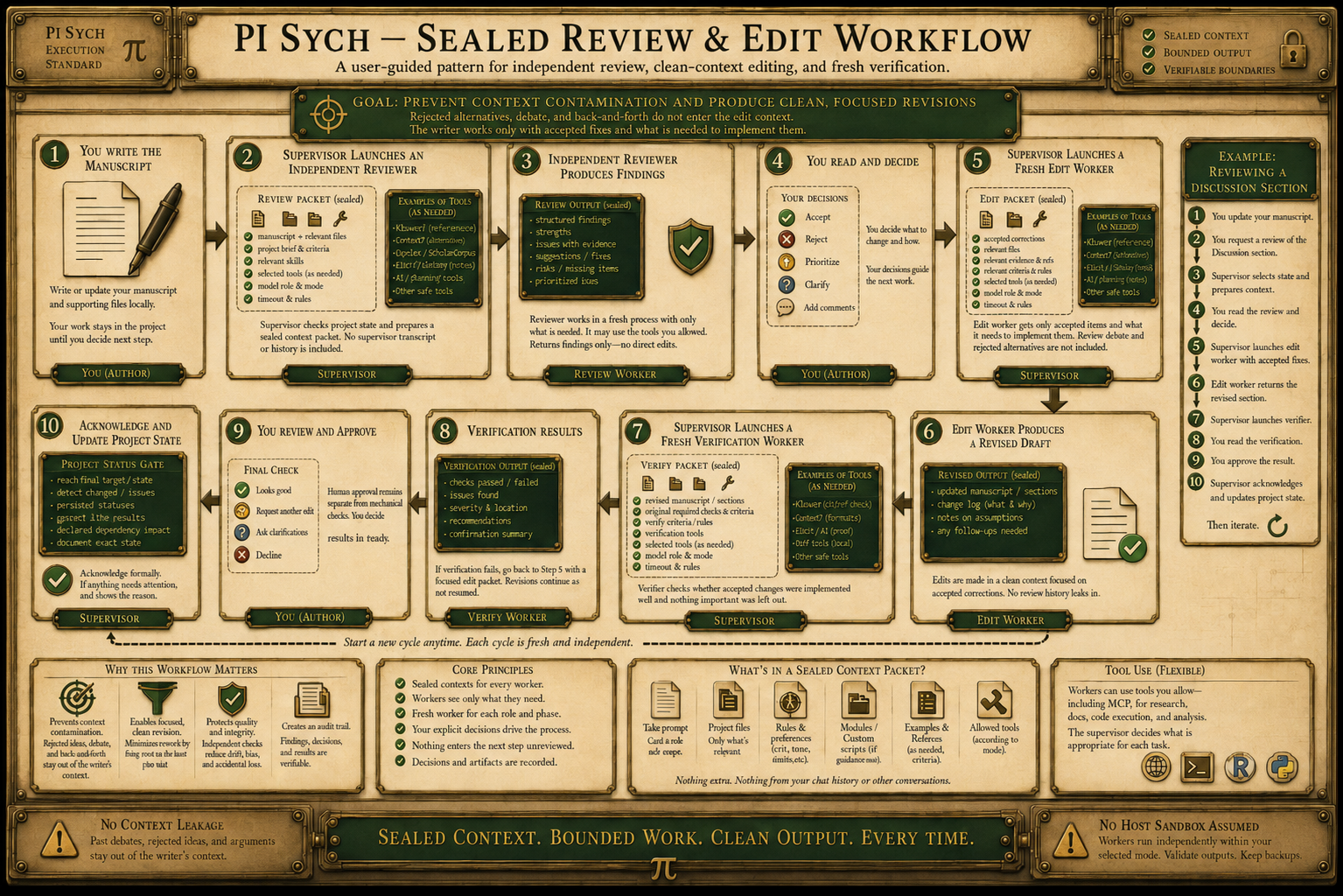
The separation between review and editing is deliberate. Rejected alternatives and the arguments used to evaluate them do not normally belong in the writer's context.
Suppose an earlier draft said X. A reviewer recommends Y, and you agree. A writer exposed to the entire debate may produce "Not X, but Y."
A fresh edit worker given the accepted correction can instead produce the clean statement "Y."
See the review and revision workflow for the complete example and its limits.
Quick start
Install Pi Sych:
pi install npm:pi-sych
Open a project in Pi and inspect its state:
/pi-sych-status
The status command reports tracked files, missing files, declared dependency impact, project-file problems, and pending review proposals. It does not decide whether a change is scientifically, conceptually, or editorially correct.
You can use Pi Sych's project files and skills directly. Separate worker configuration is required only when you want the supervisor to launch fresh model processes for bounded tasks.
Project files as shared memory
Pi Sych does not treat the conversation transcript as the authoritative record of a project. Durable information belongs in ordinary files that a collaborator, another model, or a future session can inspect.
A project can begin with PROJECT.md and add other files only when they
become useful.
| File | Typical purpose |
|---|---|
PROJECT.md |
The objective, accepted direction, definition of done, previous action, and immediate next step. |
EVIDENCE.md |
Important claims, sources, quotations, outputs, caveats, and material that may support the artifact. |
DECISIONS.md |
Accepted methodological, conceptual, editorial, or architectural decisions and their reasons. |
TODO.md |
Open work that has not yet been completed. |
STYLE.md |
Stable terminology, spelling, venue conventions, and writing preferences. |
SYNC.json |
Mechanical fingerprints, statuses, and declared relationships between files. |
INBOX.md |
Unreviewed proposals that have not become authoritative project state. |
These files are not an invitation to document everything. They preserve the information that another person or model would need to continue the work without reconstructing it from chat history.
For example, a small manuscript project might contain:
my-paper/
├── PROJECT.md
├── manuscript.qmd
├── EVIDENCE.md
├── DECISIONS.md
├── TODO.md
├── STYLE.md
└── SYNC.json
Why separate contexts?
A model can be influenced by everything in its current context window, including ideas that were considered and rejected. That can be useful during discussion, but it is not always useful during implementation.
Reviewing and revising a manuscript in one long conversation can cause the final prose to retain traces of the debate. Rejected alternatives may reappear as unnecessary qualifications, contrasts, defensive language, or explanations that the reader never needed.
Pi Sych can instead launch a fresh worker with a deliberately selected packet:
- the task;
- the expected result;
- the files required for that task;
- the relevant skills and guidance;
- the selected model and tool mode;
- optional integrations; and
- a bounded timeout.
The worker does not receive the supervisor transcript. Its result returns to the supervisor, where the user decides what should happen next.
This is context isolation, not an operating-system sandbox. The supervisor still chooses what the worker receives. Depending on the task, that may include editing tools, Bash, or remote-research tools.
What Pi Sych can help with
Skills are reusable guidance for a model, not persistent agents. Pi Sych initially exposes six broad skills and loads more specific guidance only when it is relevant.
project--- project state, artifacts, dependencies, decisions, and plans;write--- scholarly, professional, instructional, slide, and web content;analyze--- quantitative, qualitative, R/Quarto, and reporting work;code--- architecture, testing, Git, npm, and web implementation;review--- structure, evidence, detail, copyediting, code, analysis, response, and verification; andresearch--- search, source assessment, synthesis, and citations.
Each skill has one level of focused modules containing guidance and editable examples. Project, user, and packaged versions can override one another without enlarging the initial public skill catalogue. See skill customization for the lookup order and customization paths.
Commands you can use
Human-facing commands:
/pi-sych-status--- show mechanical project state;/pi-sych-mcp--- inspect optional MCPorter configuration without printing credentials;/plannotator-annotate <project-local-file>--- annotate a file and save feedback beside it;/plannotator-last--- annotate the last assistant response and return the feedback to the conversation; and/plannotator-review--- open Plannotator code review for current changes or a pull request.
Plannotator is a human review adapter. It does not add a plan controller, automatically accept feedback, or promote generated output into project state.
Tools available to the supervising model
Pi Sych gives the supervisor two mechanical tools:
project_statuschecks or acknowledges project state; anddispatch_workerstarts one bounded, short-lived worker.
These tools support a workflow; they do not decide what the workflow must be.
Optional: enable workers
Direct work does not require a worker model catalogue. To let the supervisor launch separate workers, create a private catalogue and initialize the worker runtime once:
mkdir -p ~/.config/pi/pi-sych
$EDITOR ~/.config/pi/pi-sych/models.json
node /path/to/pi-sych/scripts/bootstrap-worker-agent-dir.mjs
Replace /path/to/pi-sych with the package location used by your Pi
installation.
The catalogue contains provider model identifiers and remains outside the package. Pi Sych does not ship credentials, rank providers, or choose models for you. The bootstrap operation is explicit and does not silently modify your home directory during ordinary use.
See configuration for model roles, worker directories, canonical paths, skill overrides, and optional remote research.
How it works
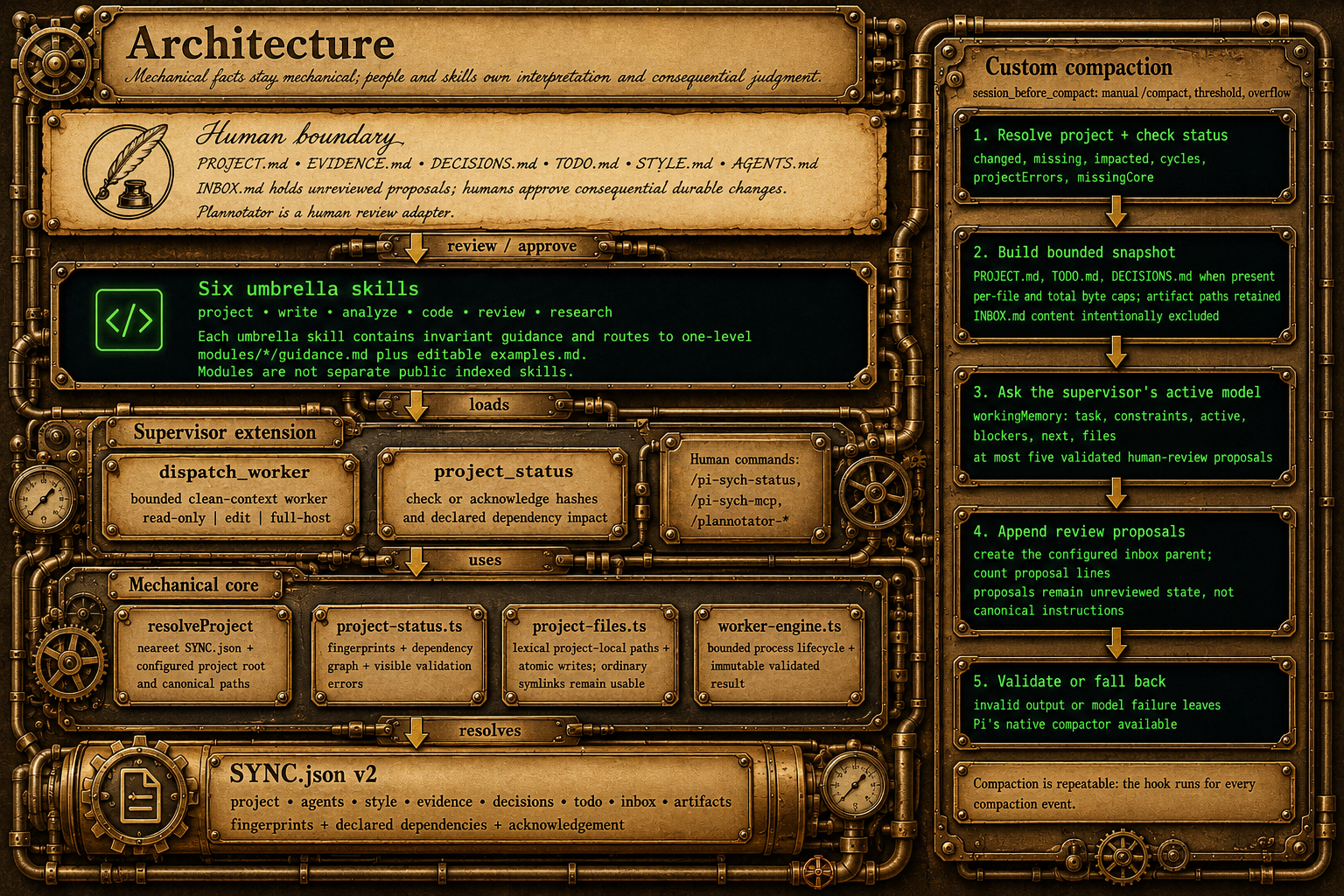
Pi Sych supplies a few mechanical pieces rather than a general orchestration system:
- Explicit project state:
PROJECT.mdrecords the accepted direction andSYNC.jsonrecords fingerprints and declared dependencies. - Mechanical status:
project_statusreports changed or missing files and affected dependants. Human review supplies the meaning. - Bounded delegation:
dispatch_workerstarts one fresh worker with an explicit task, context packet, skills, model role, mode, and timeout. - Small working memory: compaction retains a bounded summary and may
place plainly marked proposals in
INBOX.md. - Human review: Plannotator provides annotation and code-review interfaces without becoming a workflow controller.
This is intentionally not an autonomous project manager. It does not silently turn model output into evidence, citations, release state, approval, or project truth.
Limits and responsibilities
Pi Sych provides context and process boundaries, not proof that an artifact is correct.
- A changed hash establishes that content changed; it does not establish conceptual drift, improvement, or error.
- A successful test establishes only what that test examined.
- A worker result is model-generated output and still requires appropriate review.
- Worker modes control which Pi tools are visible. They do not remove the worker process's underlying host permissions.
- Remote research and external tools may return incomplete, outdated, or incorrect information.
- Human users remain responsible for consequential decisions, publication, release, and final approval.
Inspect sources, generated outputs, external results, and package behaviour before relying on them for consequential work.
Why I built this
Pi Sych grew out of my move from OpenCode to Pi. I was attracted to Pi because its core is small and its extension model leaves room for users to build the workflow they need.
I did not want to reproduce a large orchestration framework or maintain a roster of persistent specialist agents. Other extensions already explore those approaches, and they may be a better fit for people who want them. I wanted to see how far a smaller set of mechanisms could go: explicit project files, normal Pi skills, short-lived workers, and human review.
The project was also shaped by experience with memory systems. Many of those tools are useful, and Pi Sych is not an argument that they should not exist. My difficulty was that memories could become large, opaque, or closely tied to one model and one conversation. Important findings were not always easy for another researcher, collaborator, or model to inspect.
Pi Sych therefore treats ordinary files as the durable record. The conversation remains useful working space, but accepted evidence, decisions, and project direction should be written somewhere that can be reviewed and handed over.
This is an experiment in keeping that approach useful without adding more machinery than the problem appears to require.
For supervising models
When working in a Pi Sych project:
- inspect project state before substantial work;
- read
PROJECT.mdand only the additional files needed for the task; - treat accepted project files, rather than conversational recollection, as the durable project record;
- work directly unless an independent context would materially improve the result;
- give workers the smallest complete packet and no supervisor transcript;
- treat changed hashes as evidence of changed content, not semantic drift;
- do not treat proposals, generated text, successful checks, or reviewer output as human approval; and
- report only retrieval, execution, review, and verification that actually occurred.
See architecture for the complete runtime contract.
Status and contributions
Pi Sych is alpha software. Its current design reflects one approach to organizing long-running LLM-assisted work, and it will not suit every project.
Issues and contributions are welcome, especially from researchers, writers, analysts, and maintainers using it outside conventional software-development workflows.
Useful contributions include:
- clearer documentation and examples;
- improvements to the public skills;
- small reproducible bug reports;
- project templates;
- accessibility improvements; and
- reports of where the file-first approach does or does not work well.
See contributing before proposing code or release changes.
Detailed documentation
- Review and revision workflow --- a user-guided pattern for independent review, clean-context editing, and fresh verification;
- Configuration --- private models, worker setup, project roots, canonical paths, skill customization, and optional integrations;
- Architecture --- supervisor-facing runtime boundaries and mechanical invariants;
- Development --- checks, tests, style, and design constraints for contributors; and
- Contributing --- issues, pull requests, and release ownership.