pi-tidy
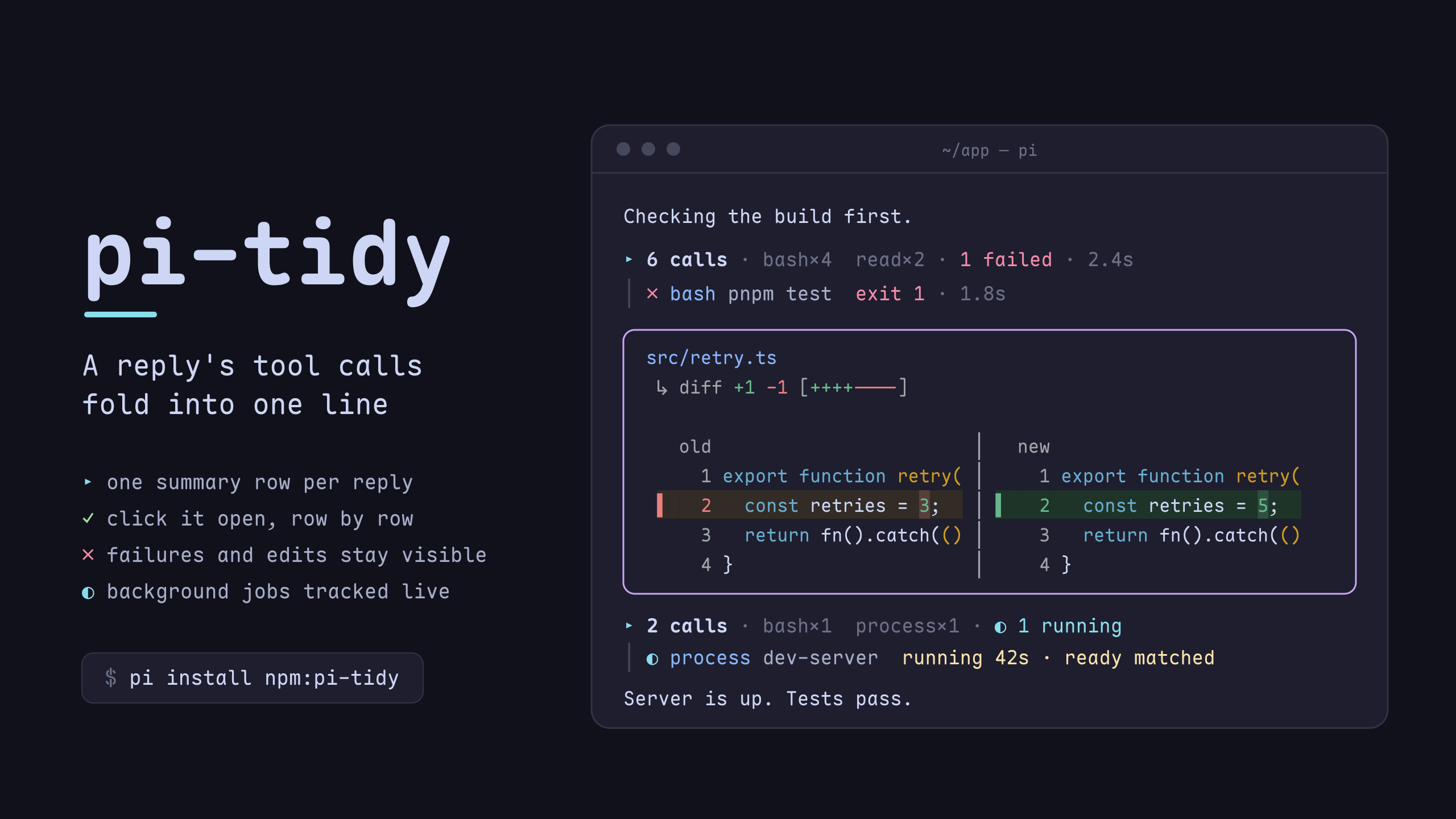
Tool folding for the pi agent — a reply's tool calls collapse to one clickable line; failures, edit diffs and running jobs stay visible
Package details
Install pi-tidy from npm and Pi will load the resources declared by the package manifest.
$ pi install npm:pi-tidy- Package
pi-tidy- Version
0.9.2- Published
- Nov 7, 2026
- Downloads
- 4,868/mo · 3,240/wk
- Author
- andy8647
- License
- MIT
- Types
- extension
- Size
- 587.5 KB
- Dependencies
- 0 dependencies · 2 peers
Pi manifest JSON
{
  "image": "https://raw.githubusercontent.com/Andy8647/pi-tidy/main/assets/cover.png",
  "video": "https://cdn.jsdelivr.net/gh/Andy8647/pi-tidy@v0.4.3/assets/demo.mp4",
  "extensions": [
    "./src/index.ts"
  ]
}
Security note
Pi packages can execute code and influence agent behavior. Review the source before installing third-party packages.
README
pi-tidy
Tool folding for the pi coding agent: a reply's tool calls fold into one line you can click open, while edits, failures and background jobs stay in view — and every box gets a rounded transparent frame.
Features
- Rounded borders — ╭╮╰╯ box drawing instead of pi's ┌┐└┘, on a transparent background: no fill, so terminal transparency works
- Every tool box — built-in tools, MCP calls (pi-mcp-adapter), subagents and any other extension's tools get the same frame, a kind icon, and the tool's own border color on success (pending stays grey, errors red)
- Turn folding — a whole run folds to
▸ took 1m20s · LLM 58s · tools 20s · 12 calls · read×6 · bash×4, and opens to the process it replaced. Steering, retries and continuations stay in the run - Grouped tool calls — the calls between two pieces of assistant text fold to
▸ 5 calls · bash×3 · 1 failed · 1.2s: click for a row per call under a│gutter, click a row for its output underneath, and each row says what the call produced (12 lines,3 matches,exit 1). A failure is counted once in the summary; only a running call keeps a row. Edits and writes never fold — their diff is the point - Every message box — compaction, branch, skill and extension custom messages get the same frame, each kind its own border color, its
[kind]label set into the top border - One row per failure — pi prints its own errors (a failed request, an extension that threw) once per retry attempt, provider body and all; tidy keeps the first row, frames it, and counts the rest as
×N. Warnings and notes are left alone - User messages that fit — tidy's rounded frame, as wide as the text, with the user icon and time in its top border; a one-word prompt gets a small box. Or the rail (a rule above and below, an accent
│in front, the same icon and time in the top rule), or pi's own look - Your own
!commands — framed in the user color with the!you typed, so a!run never passes for the agent's bash box - Thinking, folded in — a step that only thinks leaves a
thinkingrow inside its group (a brain, the word, one line of what the model thought, sliding over the newest words while it streams); the summary counts the runs (🧠 5 thoughts), and a click opens that step's thinking full length, in a framed box with thinkingin its border. pi'shideThinkingBlockis ignored on purpose: the row is the same either way, and the click is the one way to read it - Background jobs — a call that starts a pi-processes job shows the job's live state on its row (
◐ process ticker running 12s · READY matched, then✓ … exited 0 · 20s); its[process]notifications are folded into that row, and a click opens the command, working directory and last 20 output lines without expanding the call - codemode reads as a call list — opened, the calls a script ran are tidy rows with a name and a duration column; the script and the output each fold to one row
- Side-by-side edit diffs —
old │ newwith line numbers on both sides, a bar and a tint per changed row, the changed word emphasised; belowsplitDiffMinWidthit falls back to pi's unified diff - One-line boxes — a collapsed box keeps
bashResultLinesrows of output under a(+N more lines, ctrl+o to expand)footer, so a long call no longer owns the screen - Nerd Font icons — a kind icon per box, and the target file's nvim-web-devicons glyph in front of its path (
write /tmp/x.tsrenderswrite /tmp/x.ts) - Bash syntax highlighting — token-level colors for commands, flags, strings, variables and operators
- Copies without the chrome — text you select in pi's fullscreen mode goes to the clipboard without frames, corners or the rail around a box. A tool box's border is the exception: the path it names is what you dragged for, so it copies on its own
- One-click paths — a
writeoreditbox puts a copy chip next to the path in its border (╭─ src/app.ts ────╮): click it for the path, no drag, and the chip reads a tick for a moment - Click to fold — clicks land on pi's own expand toggle, for every tool including
renderShell: "self"ones; only left clicks are taken, so selecting text still works - Scroll-safe caching — an unchanged box costs one string comparison per frame
Turn folding
On by default since 0.8.0. To go back, merge these keys into the tidy object in
~/.pi/agent/settings.json and run /reload:
{ "tidy": { "collapseTurns": "off", "finalReplyStyle": "off" } }The keys are independent: collapseTurns: "live" folds while the run is still arriving, and
finalReplyStyle works without turn folding.
A run folds to one line, where it started:
▸ took 1m20s · LLM 58s · tools 20s · 12 calls · read×6 · bash×4 · codemode×2Click it to open the process, click again to fold. The fold hides thinking and alwaysShowTools
boxes, never your own inputs, and reopens with manual expansion, groupOpen and output budgets
intact. /tidy turn toggles the latest run, /tidy turn N the one at that position on the branch;
ctrl+o still expands tool outputs and their turns. User inputs, background-job notifications and
pi's error rows stay visible, because the rows that would own them may be hidden. A reply with no
hidden process gets no summary.
took is wall time. LLM is the main agent's model requests, including response wait. tools is
the union of top-level tool intervals (codemode and MCP waits included, parallel and nested calls
not counted twice). Retries and overlap mean the parts need not sum to the total; missing historical
timings show —.
Opened, the process hangs on a rail under the summary's marker, and the rail runs into the final
reply's border. A box from alwaysShowTools joins the rail of a group that is open right above or
below it. A run that fails with no text keeps the failure in view when it folds.
finalReplyStyle draws only a settled final text reply, keeping pi's Markdown and mouse targets —
an intermediate tool-calling message is never promoted. The border names the model that answered
(from the message, not the current selection) with its provider glyph, clipped to … when it does
not fit, and icons: false drops the glyph.
What it looks like
A reply's tool calls, folded:
A background process (pi-processes), tracked on the row that started it:
Click ▸ 5 calls and it becomes a ▾ header with one row per call, each step's thinking above it:
 ▾ 5 calls ·  bash×3  read×2 · 4 thoughts · 1 failed · 2.4s
 │ 🧠 thinking  测试挂了,先确认是哪一个断言炸的,再看是不是我们这边的问题
 │ ✓  bash git status --short  4 lines · 0.1s
 │ 🧠 thinking  看一眼改了什么
 │ ✓  read src/app.ts  120 lines · 0.0s
 │ ✗  bash pnpm test  exit 1 · 1.8s
 │ 🧠 thinking  …
Installation
pi install npm:pi-tidyRequires pi ≥ 1.1.0 (component mouse events, tool durations); on an older pi it
says so at session start. Bash highlighting, the bash output budget and the custom
write preview also need pi.registerToolRenderer() (pi 1.3.0). Without that API they are skipped and Tidy
says so once, rather than falling back to a tool override that would stop another
extension from loading.
Or straight from the repo:
pi install git:github.com/Andy8647/pi-tidyRestart pi to activate.
Coming from pi-toolbox
pi-tidy is @andy8647/pi-toolbox renamed (from 0.4.2). Swap the package, and
remove the old one first so the two aren't loaded side by side:
pi remove npm:@andy8647/pi-toolbox
pi install npm:pi-tidy
Your "toolbox" settings keep working; rename the key to "tidy" when convenient.
The old package re-registered bash and write as its own tools so it could draw
the highlighted command row and the write preview. pi treats a second registration
under a built-in name as a hard failure, so Tidy could not be loaded alongside an
extension that sandboxes or gates those tools, in either load order. Since 0.4.5
both previews travel as pi.registerToolRenderer() resolvers instead, which is why
there is nothing left to conflict with (see How it works).
Releasing
.github/workflows/publish.yml publishes to npm on a published GitHub Release,
using npm's Trusted Publisher (OIDC) — no NPM_TOKEN secret. Bump version in
package.json, tag vX.Y.Z, and publish the release; the workflow fails fast
if the tag and the manifest version disagree.
Configuration
Add keys to the tidy object in ~/.pi/agent/settings.json, then run /reload. A key you leave
out keeps its default:
{ "tidy": { "collapseTurns": "off", "userMessageStyle": "rail", "bashResultLines": 3 } }Colors are theme color names, so they follow the active theme. thinkingColor, userMessageColors
and messageBorderColors.assistant also take #rrggbb.
General
| Key | Default | What it does | When it applies |
|---|---|---|---|
enabled |
true |
Turns the whole extension on or off | Always |
icons |
true |
Nerd Font icons on boxes, rows and message labels, and the copy chips (a glyph instead of the word copy) |
Always. Off, a user message loses its label, so its time goes too |
User messages
| Key | Default | What it does | When it applies |
|---|---|---|---|
userMessageStyle |
"frame" |
frame: a rounded frame as wide as the text, with the user icon and time in its top border. rail: a full-width rule above and below, an accent │ in front of every row, and the icon and time in the top rule. rules: the same without the │, so a terminal's own selection copies the text without any verticals. off: pi's own look |
frame needs frameMessages; without it you get pi's own look. rail and rules do not need it |
userMessageAlign |
"left" |
"left" or "right". Long messages still use the available width |
frame moves the message and its label. rail and rules move only the label, so they need icons. off ignores it |
userMessageTime |
true |
Shows when you sent a message (14:06, with the date when it is not from today). The final reply's border keeps its own time |
Needs icons, and any userMessageStyle but off |
userMessagePaddingY |
1 |
Rows between each rule and the text, 0 to 3 |
userMessageStyle rail or rules |
userMessageColors |
{ "rail": "accent", "rule": "borderMuted" } |
Colors of the │ and the icon (rail), and the rules (rule) |
userMessageStyle rail or rules. Under rail, rail also colors your ! commands' frames |
Final reply and turn folding
| Key | Default | What it does | When it applies |
|---|---|---|---|
collapseTurns |
"afterRun" |
Folds a whole run's process to one line. afterRun waits until the run settles, live folds while it runs and keeps the latest assistant text visible, off never folds |
Always, with grouping on or off |
finalReplyStyle |
"frame" |
The final assistant reply, with the provider glyph, model name and time in its top edge. frame: a full-width rounded frame. rail: a full-width rule above and below and a │ in front of every row. rules: only the rules, so a terminal's own selection copies the text without any verticals. off: pi's own look. frameFinalReply from before 0.9 still works: true is frame, false is off |
Once the run settles, and only on a final text reply. Independent of collapseTurns and frameMessages |
messageTimeFormat |
"auto" |
The time in a message's top edge. auto is the clock, with the date when the message is not from today. Anything else is a pattern of YYYY, M, MM, D, DD, H, HH, mm, ss and literal text, such as "M月D日 HH:mm:ss". Those letters are always read as tokens, so a word like Mon will not survive |
Wherever a time is shown: a final reply drawn by finalReplyStyle, and a user message under userMessageTime |
messageHeaderStyle |
"inline" |
How a message's top edge sets out who and when. inline: ╭─ model 13:09 ───╮. split: ╭── model ── 13:09 ───╮ |
Where a label is drawn: a final reply drawn by finalReplyStyle, and a user message with icons. With no time to separate, or on an edge too narrow for it, split looks like inline |
See Turn folding for what a fold keeps and how to open it.
Other message boxes
| Key | Default | What it does | When it applies |
|---|---|---|---|
frameMessages |
true |
Frames compaction, branch, skill and custom messages, and your own ! / !! commands. Also allows userMessageStyle: "frame" |
A custom message drawn by an extension's own renderer keeps its look. Does not affect the rail, the final reply or tool boxes |
messageBorderColors |
{ "assistant": "accent", "user": "toolTitle", "compaction": "customMessageLabel", "branch": "mdCode", "skill": "accent", "custom": "warning" } |
Border color per message kind, merged over the defaults | assistant colors the final reply's frame and an opened run's rail and ▾ marker, and needs finalReplyStyle or collapseTurns. The rest need frameMessages. user colors a frame message and your ! commands; under rail, those commands use userMessageColors.rail |
Tool folding
| Key | Default | What it does | When it applies |
|---|---|---|---|
groupTools |
true |
Folds the tool calls between two assistant text blocks (or a user message) into one summary line. Click it for one row per call, click a row for its output, click the ▾ header to fold. false gives every call its own box (a codemode box still reads as its call list) |
Always |
groupOpen |
false |
Starts each new group open (▾ header, one row per call). Only the level a group is born with: clicking the header or ctrl+o's collapse-all stays folded, and nothing is saved |
Needs groupTools |
toolRowLines |
1 |
Rows a call in an open group may take. With 2, a call that does not fit goes on to a second row. Calls that fit keep one |
Needs groupTools |
alwaysShowTools |
["edit", "write"] |
Tools that never fold: they keep their own box and end the group before them. [] folds edits and writes like everything else |
Needs groupTools; with it off every tool has its own box anyway. A folded turn still hides these boxes |
Tool output
| Key | Default | What it does | When it applies |
|---|---|---|---|
highlightBash |
true |
Syntax-highlights bash commands | Needs pi 1.3 |
bashResultLines |
1 |
Visual lines of output in a collapsed bash box. pi's own number is 5, with no setting. 0 hides the output until you expand |
Needs pi 1.3. A failed command keeps pi's preview. ctrl+o shows everything |
writeLines |
10 |
Visual lines of a written file in a collapsed box. 0 keeps just the header |
Needs pi 1.3. ctrl+o shows everything |
splitDiff |
true |
Draws an edit's diff as two panes (old │ new) with line numbers, a bar and a tinted row per changed line. Also decides whether a reply's diff code block gets panes. false keeps pi's unified diff |
edit boxes at least splitDiffMinWidth wide, and diff code blocks on a row that wide; narrower ones get the unified form |
splitDiffMinWidth |
72 |
Box width below which the panes give way to pi's unified diff | Needs splitDiff |
diffLines |
20 |
Diff rows in a collapsed edit box, starting a third of the budget above the first change, with … (N more lines, M total, ctrl+o to expand) under them. 0 keeps just the summary row |
Only when the panes are drawn. pi's unified diff has no limit, so with splitDiff: false or in a narrower box a long diff is shown whole |
codeBlocks |
true |
Draws a reply's fenced blocks as a section: the two fence rows become rules, the opening one labelled with its language and a copy chip (├─ fish ────┤), and they join the reply's frame or rail at the edges. The code rows are pi's own, apart from the chip: it lights up and the pointer turns into a hand while it is under it (needs a terminal without tmux, where pi tracks the pointer), and shows a tick for a moment after a click puts the block's text on the clipboard. A diff block goes side by side instead, under the same switch and width as an edit's diff, and languages highlight.js has no grammar for (fish, .env, TOML) get the closest one it does. false leaves pi's own fences |
Assistant replies that tidy draws (needs collapseTurns or finalReplyStyle). A pi whose Markdown has no renderToken keeps its own code blocks, and tidy says so once at session start. With icons: false the chip is the word copy instead |
Colors
| Key | Default | What it does | When it applies |
|---|---|---|---|
toolColors |
{ "bash": "bashMode", "read": "toolTitle", "edit": "syntaxVariable", "write": "syntaxVariable", "grep": "syntaxOperator", "find": "syntaxOperator", "ls": "syntaxOperator", "mcp": "customMessageLabel" } |
Border color per tool, on success. Pending stays grey, errors red, unlisted tools take accent. The map replaces the defaults, so {} turns per-tool colors off |
Tool boxes only, not the rows in a group |
thinkingColor |
"warning" |
Color of the brain, the N thoughts count and an expanded thinking box |
Always, with grouping on or off |
Tool boxes keep green, red and grey for a call's state, so the default message colors avoid them: mauve for compactions, peach for branch summaries, sky for skills and yellow for extension notices.
Background jobs
| Key | Default | What it does | When it applies |
|---|---|---|---|
backgroundJobs |
true |
A call that started a job shows the job's live state on its row and in the summary. A running job keeps its row while folded; a finished one folds away. The spinner turns once a second for a job's first 5 minutes, then stands still | Needs pi-processes and groupTools: the state lives on a group's row, so a tool in alwaysShowTools has none to show it on |
hideJobNotifications |
true |
Stops drawing a job's notifications ([process] "ticker" matched stdout: READY) once its row shows them. The model still receives them |
Needs backgroundJobs, groupTools and collapseTurns: "off". With turn folding on, the default, notifications stay visible, because the row that would own them may be hidden |
Other
| Key | Default | What it does | When it applies |
|---|---|---|---|
dedupeErrors |
true |
pi prints its own error rows (a failed request, an extension that threw) once per retry attempt. Folds the repeats into the first as ×N and frames that row (╭─ error ×3 ─╮). pi's "Retry failed after N attempts" replaces it when pi gives up |
Error rows only. Warnings, notes and an abort stay as pi drew them |
cleanCopy |
true |
Takes tidy's frames, corners, rail glyphs and rules out of what you copy, on select or with the copy key. A top border's label stays when it names a file — a write or edit box's path is what the drag was for |
pi's fullscreen selection only. A terminal's own selection (shift or option and drag) never reaches tidy. A rules user message with icons: false has no label to tell its rules from a model's, so they stay |
How it works
pi builds one ToolExecutionComponent per tool call, no matter which extension
registered the tool. pi-tidy patches that component's render to frame the whole
box — which is why MCP and subagent boxes are framed too. Message boxes (compaction, branch
summary, skill invocation, extension custom message) never go through that
component; their own prototypes get the same treatment, with one exception
that keeps its native styling: custom messages rendered by an
extension-provided renderer. Their [compaction] / [branch] / [skill] /
[type] row is a title, so it sits in the top border next to the kind icon and
the spacer under it is gone; a collapsed skill box keeps its label inline, where
it shares the row with the skill's name. ! bash-mode runs are framed as the user's
rather than as a tool's: the agent's bash box changes color with its state,
while the user's keeps the user messages' color (messageBorderColors.user, or
userMessageColors.rail under the rail) and lets pi's own rows (Running...,
(exit 1)) say how it went. Both user message styles render pi's own Markdown
child narrower and swap only its chrome, so markdown
transformers registered by other extensions (pi-ide-context's selection
references, for one) keep working. With pi-starline 0.9 and later, tidy is the
only extension that styles user messages; earlier pi-starline versions draw
their own over it.
Tidy registers no tools at all. Everything it changes about bash and write
(the highlighted command row, the collapsed output budgets, the write preview)
travels as a pi.registerToolRenderer() resolver, so the tool that is actually
installed keeps its execution, schema, shell and result renderer, and next()
hands Tidy whatever is downstream — pi's built-in renderers when an extension
defines none. Registering a tool under a built-in name is a hard failure in pi
(Tool "write" conflicts with …), which is why an extension that sandboxes
bash/write used to be mutually exclusive with Tidy no matter which loaded
first. It no longer is (issue #7, PR #8 and the bash follow-up).
An unchanged box returns its cached line array outright: pi re-renders the whole transcript on every frame, including every mouse packet while scrolling. Measured against unpatched pi at 300 boxes / 2400 lines: +0.03 ms per full render.
pi's own error rows — Error: 429: …, an extension that threw — have no
patchable prototype: they are ThemedText, which pi does not export. That seam
is the chat container instead. After InteractiveMode.init, its addChild is
wrapped: a row painted in the error colour that repeats the previous one folds
into it as ×N, and the survivor gets the frame. If a future pi renames init,
the hook stays uninstalled and those rows render exactly as pi draws them — the
behaviour before 0.7.2, not a crash.
Grouping
Groups are derived at render time from transcript order — nothing is
persisted, so a reloaded session folds the same way. A boundary is a user
message or an assistant message with visible text; pi gives every model step its
own assistant message, and steps that only call a tool don't split a group.
ctrl+o and pi's own box clicks both arrive through setExpanded, which is how
the group levels stay in step with pi's per-box expand flag.
Background jobs
pi has no notion of a job that outlives its tool call, so src/tools/background-jobs.ts
has a small provider interface. pi-processes is the one provider: its
processes:* events on pi's shared extension bus keep a row live, its persisted
ad-process:notification messages rebuild a reloaded session, and a process it
no longer knows reads not running. If that protocol changes, rows fall back to
plain tool rows.
Mouse
Clicks come from pi's own fullscreen mode (tuiMode: "fullscreen", pi ≥ 0.86
component mouse events); pi-tidy never turns on mouse reporting itself. Only left
clicks on its own rows are taken — presses and drags pass through, so text
selection works as usual. Without fullscreen there are no clicks: ctrl+o still
toggles every box.
A selection in the transcript copies without tidy's chrome (cleanCopy). A frame is
recognised by its shape: rounded corners of equal width in one column, with a vertical
on both sides of every row. A table's square corners and a blockquote's │ stay. So
does the rail beside an open run's rows, which a selection cannot tell from a quote,
and a rounded box a model drew in an unframed message is taken for a frame. A top
border's label survives when it names a file: dragging the path out of a tool box's
border copies the path, and ctrl+x on that selection has something to hand over.
A write or edit box's path also has a chip in the border, one click away from the
clipboard, and the same on a reply's code block (see codeBlocks).
A row you can click lights up under the pointer, and the pointer turns into a hand while it is on one (OSC 22: Ghostty, kitty, foot and WezTerm draw it; other terminals ignore it). Under tmux, zellij or screen pi only reports motion with a button held, so there is no hover there.
The transcript's scrollbar is pi's, and with fullscreenScrollbar: "auto" (the
default) pi paints it over the rightmost column — the one these frames put their
border in, so it covers the border while it is on screen. Set "always" and pi
reserves that column instead, drawing the frames one cell narrower; "hidden"
works too if you never want it. Nothing to configure on this side either way.
Render benchmark
PRs include a Render benchmark check. Its Job Summary compares the PR's base and head commits on the same runner using the same fixture and installed dependencies. It reports median and P95 milliseconds per frame at 100, 500 and 1,500 components: folded, runs folded, and with all tool outputs expanded. At 500 and 1,500 it also measures opened runs on the rail, with two-row calls and with large groups. Raw samples are attached as an artifact. Timing changes do not fail CI.
The fixture uses real pi components with synthetic user messages, thinking, tool groups,
failures, edit diffs and codemode calls. It never executes tools or contacts a model.
Measurements cover warm transcript rendering, not terminal drawing or end-to-end scroll latency.
Identical code can differ a lot between processes, so each revision runs in four workers and the
table shows their range: a change whose ranges overlap is not evidence of anything. For a local
comparison, run pnpm bench /path/to/base-checkout
from the PR checkout. Both checkouts must resolve the PR checkout's installed dependencies.
Compatible themes
For the best transparent experience, set tool background colors to "" in your theme:
{
  "toolPendingBg": "",
  "toolSuccessBg": "",
  "toolErrorBg": ""
}
License
MIT