pi-tmux-orchestrator
Pi extension, skill, and dependency-free Python CLI for coordinating coding agents in tmux
Package details
Install pi-tmux-orchestrator from npm and Pi will load the resources declared by the package manifest.
$ pi install npm:pi-tmux-orchestrator- Package
pi-tmux-orchestrator- Version
0.9.5- Published
- Sep 2, 2026
- Downloads
- 2,230/mo · 930/wk
- Author
- revazi
- License
- MIT
- Types
- extension, skill
- Size
- 783 KB
- Dependencies
- 0 dependencies · 0 peers
Pi manifest JSON
{
  "extensions": [
    "./extensions/tmux-orchestrator.js"
  ],
  "skills": [
    "./SKILL.md"
  ]
}
Security note
Pi packages can execute code and influence agent behavior. Review the source before installing third-party packages.
README
Pi Tmux Orchestrator




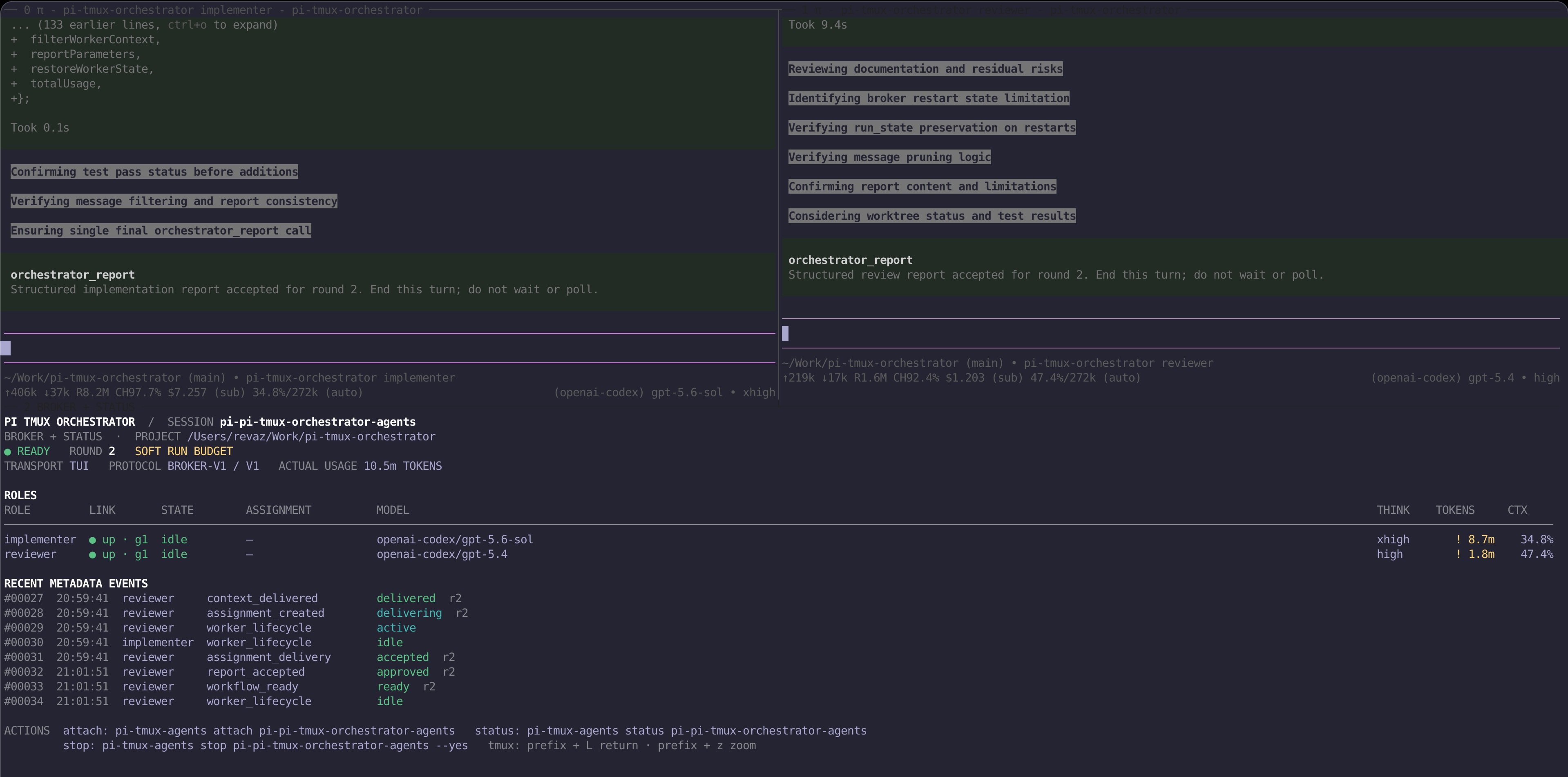
A Pi package for coordinating coding agents in a monitorable tmux grid.
- One implementer writes and one independent reviewer is always required.
- Configure each orchestration's models, thinking profile, flow, budgets, skills, workspace hints, and optional built-in specialists.
- Native Pi workers remain visible and directly steerable in a grid that adapts to the roles enabled for that run.
- An event-driven broker handles structured coordination and recovery.
- Durable orchestration state is bounded and metadata-only.
Install
Requirements: Pi, Python 3.11+, tmux 3.2+, and macOS or Linux.
pi install npm:pi-tmux-orchestrator
Run once without installing:
pi -e npm:pi-tmux-orchestrator
Pi packages execute with your user permissions. Inspect packages before installing them.
Quick start
Start Pi inside tmux from the project you want to change:
tmux new -s coding
cd /absolute/path/to/project
pi
Then use either:
/or-start Describe the change you want
or natural language:
Describe the change you want. Use the orchestrator.
Review the preview and confirm. The default run starts one implementer and the mandatory reviewer. No configuration file is required.
Open /or-dashboard to inspect or attach to runs. When attached to the worker
grid, press the tmux prefix followed by L to return to the same Pi session.
Pi commands
The extension intentionally exposes only five commands:
| Command | Purpose |
|---|---|
/or-dashboard |
List, inspect, attach/watch, run doctor, or confirm stop |
/or-models [query] |
Find exact provider/model IDs |
/or-start [task] |
Preview, confirm, and start work |
/or-send [session] |
Send private guidance; attention targets the waiting assignment, and post-ready implementer guidance opens a reviewed repair round |
/or-stop [session] |
Select and confirm stopping a run |
The dashboard is keyboard-driven:
| Key | Action |
|---|---|
arrows or j/k |
Select a run |
| Enter | Watch future transitions and attach |
d |
Run current-project doctor explicitly |
r |
Refresh the session list |
x |
Request confirmed stop |
? |
Show help |
q or Escape |
Close |
Opening or refreshing the dashboard never runs doctor and never starts background polling. Attaching does not replay an already-completed outcome into the invoking Pi; use explicit watch behavior when that Pi should assess an existing outcome.
How it works
Tmux hosts the worker panes but does not transport workflow messages. Each run has an owner-only Unix-socket broker that authenticates role bridges, accepts bounded typed reports, and schedules the mandatory review.
The invoking Pi remains the parent supervisor. It receives event-driven
completion or attention updates while each worker keeps its normal durable Pi
session. The broker dashboard refreshes assignment-bound thinking, streaming,
tool, reporting, and finalized-usage metadata directly from worker events; it
does not wait for handoff. Crashes and ambiguous delivery fail to uncertain
rather than blindly replaying work.
The package supports interactive native Pi panes and explicit headless RPC
workers through the same broker protocol. New runs use manifest v5 and
broker-v1; retained older runs remain readable.
Configure orchestrations
Every start can choose exact role models and thinking levels, a single or
phased implementation flow, optional probe/Playwright/Django specialists,
observational budgets, explicitly reviewed worker skills, and the experimental
workspace capsule. Use /or-start, natural language, the model tool, or the
terminal CLI; explicit run options take precedence.
Reusable defaults are user-global, never project-local:
~/.pi/agent/tmux-orchestrator.json
Packaged profiles change only Pi thinking levels:
economybalancedthorough— compatibility default
Profiles do not change models, tools, role authority, mandatory review, routing, or budget behavior.
Version-3 configuration can apply exact defaults to canonical project paths:
{
  "version": 3,
  "defaultProfile": "balanced",
  "projects": [
    {
      "directory": "/absolute/canonical/path/from/pwd-P",
      "profile": "thorough",
      "implementationFlow": "phased",
      "specialists": ["probe"],
      "workspaceCapsule": false
    }
  ]
}
Project directories must already exist and exactly match pwd -P; there are no
globs, prefix matches, repository-name matches, or symlink components. Explicit
run options override an exact project mapping.
Pi remains authoritative for provider authentication. The orchestrator does not read or copy provider credentials. Model policy, custom profiles, specialist activation, observational budgets, worker skills, and workspace capsules are documented in the complete usage reference.
Upgrading to 0.9
Version 0.9 removed duplicate long-form commands and separate helper commands:
| Before | Now |
|---|---|
/orchestrator-dashboard |
/or-dashboard |
/orchestrator-models |
/or-models |
/orchestrator-start |
/or-start |
/orchestrator-send |
/or-send |
/orchestrator-stop |
/or-stop |
| list/status/help/about/doctor/watch/attach helpers | /or-dashboard |
| supervisor/restart helpers | pi-tmux-agents or the model tool |
Finish or stop active runs, update, and restart Pi:
pi update npm:pi-tmux-orchestrator
Existing manifest v1-v4 runs remain readable. The mandatory reviewer,
one-writer policy, and thorough compatibility profile are unchanged.
See the v0.9.0 release notes and migration discussion archive. If migration is blocked, stop active 0.9 runs and roll back:
pi remove npm:pi-tmux-orchestrator
pi install npm:pi-tmux-orchestrator@0.8.1
Terminal CLI
The Python CLI provides the complete operational surface:
pi-tmux-agents list
pi-tmux-agents status SESSION
pi-tmux-agents attach SESSION
pi-tmux-agents send SESSION --role implementer --message-file /tmp/message.txt
pi-tmux-agents restart SESSION --role implementer --yes
pi-tmux-agents stop SESSION --yes
Run pi-tmux-agents --help for all commands, JSON output, Supervisor API,
controller, profile, model, specialist, and headless-worker options.
Safety
- The implementer is the only writer; reviewer and specialist roles are read-only but are not OS sandboxes.
- Project trust, start, restart, and stop retain explicit confirmation boundaries.
- Existing tmux sessions are never replaced and operations use exact targets.
- Workflow, prompt, report, message, diff, log, provider, and credential bodies stay out of durable/public orchestration metadata.
- Provider usage and cost are shown only when Pi/provider metadata supplies them; synthetic benchmarks are not billing or quality claims.
See SECURITY.md for the complete security model.
Documentation
- Complete operator and CLI usage
- Coordination protocol and state boundaries
- Dashboard design
- Pre-release artifact testing
- Changelog
Development
python -m pip install ruff==0.11.11
scripts/test.sh
The default test suite is model-free and isolates package, Pi, and npm state from real authentication.
Created and maintained by Revaz Zakalashvili. Licensed under the MIT License.