pi-until-done
Pi extension that brings Hermes Agent's /goal (Ralph loop with judge) to Pi as /until-done. Pi self-judges every turn, runs verifyCommand to confirm done, and routes all CI/CD through mise across 18 language profiles.
Package details
Install pi-until-done from npm and Pi will load the resources declared by the package manifest.
$ pi install npm:pi-until-done- Package
pi-until-done- Version
0.2.2- Published
- May 5, 2026
- Downloads
- not available
- Author
- kirensrinivasan
- License
- MIT
- Types
- extension, skill, prompt
- Size
- 1.8 MB
- Dependencies
- 1 dependency · 4 peers
Pi manifest JSON
{
  "extensions": [
    "./extensions/until-done.ts"
  ],
  "skills": [
    "./skills"
  ],
  "prompts": [
    "./prompts"
  ],
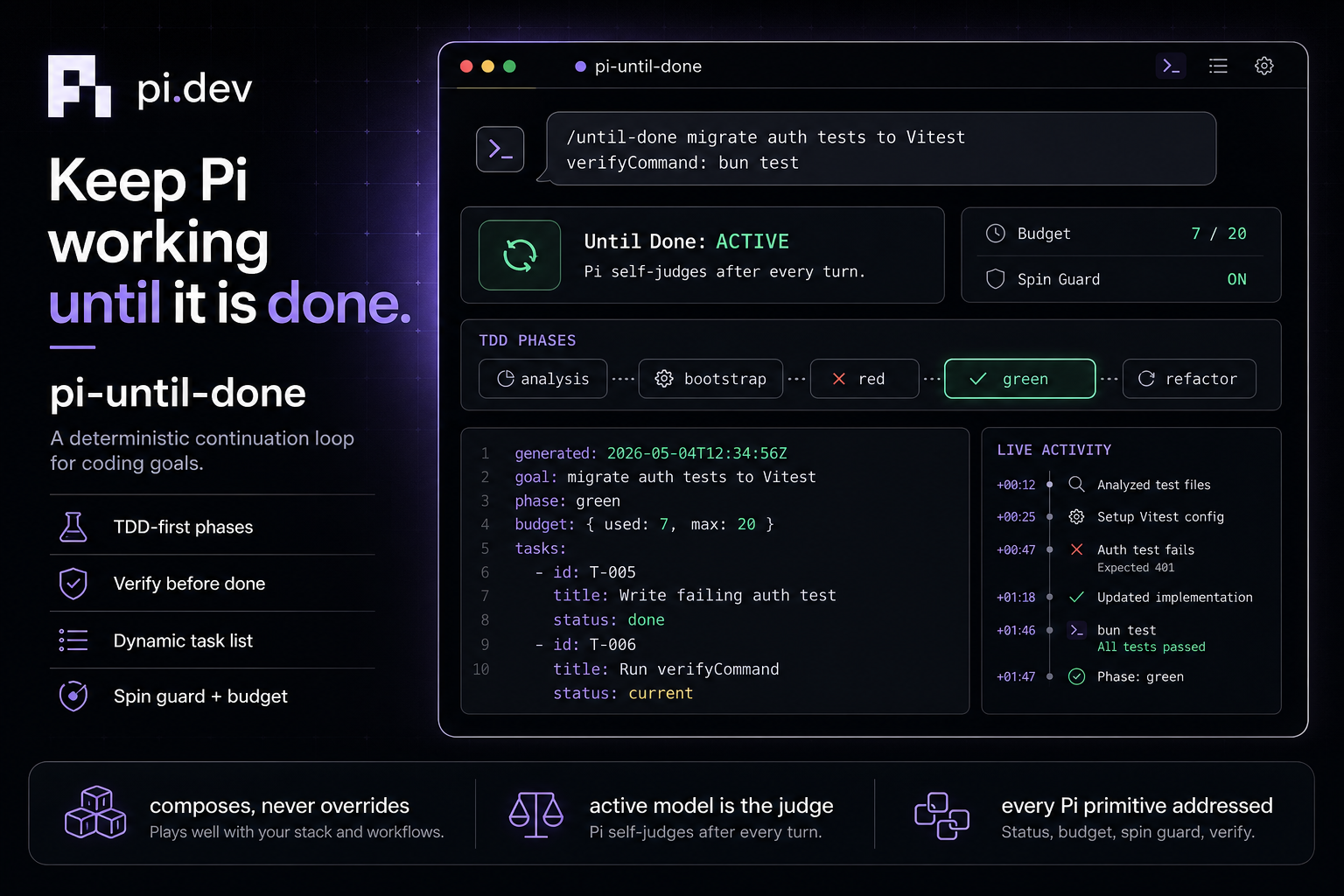
  "image": "https://raw.githubusercontent.com/srinitude/pi-until-done/main/assets/preview.png"
}
Security note
Pi packages can execute code and influence agent behavior. Review the source before installing third-party packages.
README
pi-until-done
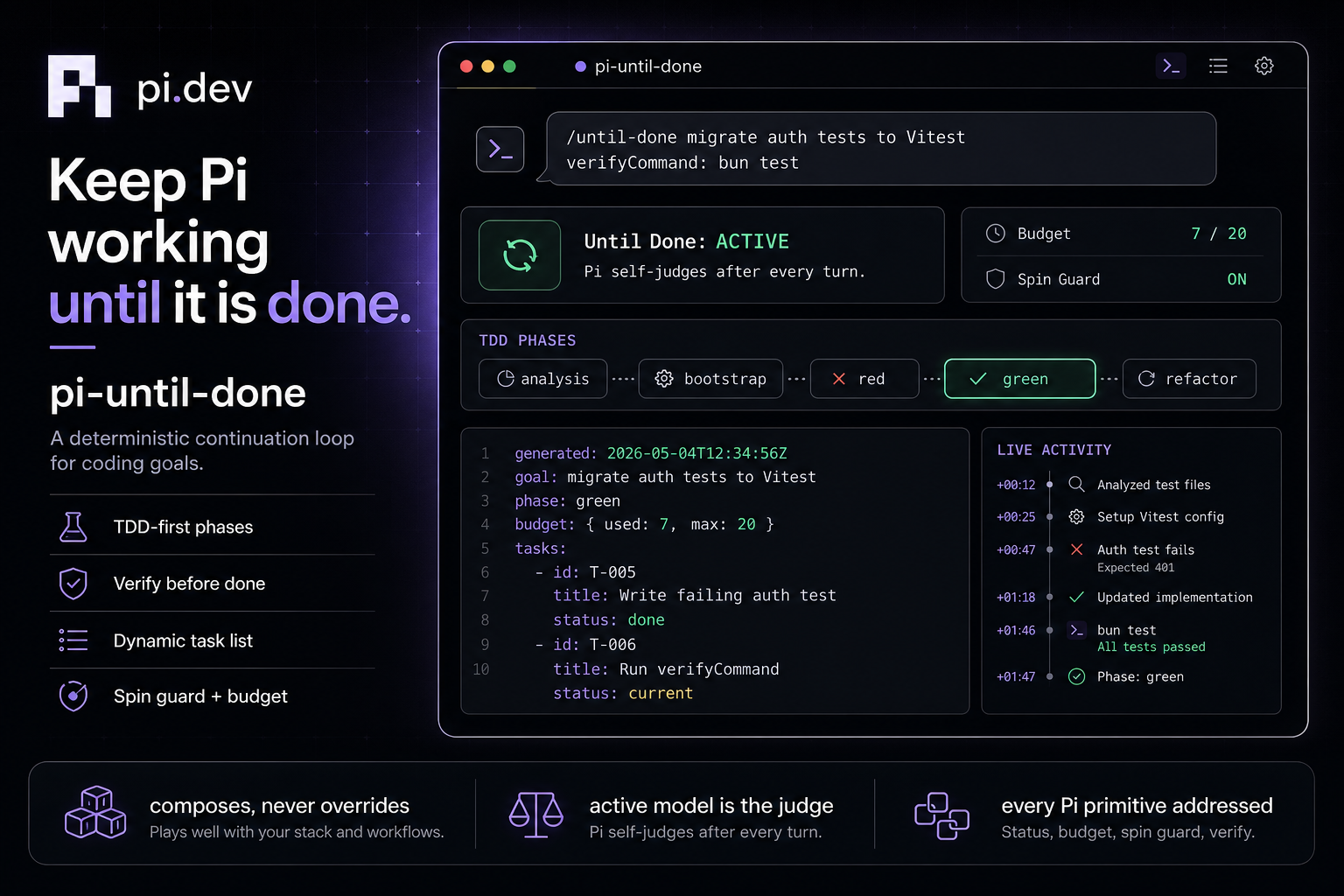
A Pi extension that brings Hermes Agent's /goal
("the Ralph loop with a judge") to Pi as /until-done. Every
until_done_complete is gated by a cross-model LLM judge by default —
the standard fix for Ralph-loop oscillation, where the executor talks
itself into a premature "done." Pick a different model than the
executor at setup time (judgeModel: { provider, modelId }) and the
judge LLM has to agree before the goal transitions to done. If you
genuinely have no second model available, opt back into same-model
self-judge with sameModelJudge: true — until_done_set refuses
without one of those two. Uses every Pi extension primitive that the
goal-pursuit loop needs, and coexists cleanly with every other
extension.






Pi's own philosophy (from srinitude/pi-config): minimal core, extensible edges, deterministic, inspectable, preserve developer agency. This extension hews to that line. It composes; it does not override. State lives in session entries. Every completion is judged by default — cross-model (different model than the executor) is required unless the contract explicitly opts into same-model self-judge. No system-prompt replacement, no side-database, no hidden state, no silent path past the judge.
Install
The package is on npm: https://www.npmjs.com/package/pi-until-done.
Through Pi (recommended)
pi install npm:pi-until-done                              # from npm (recommended)
pi install github:srinitude/pi-until-done                 # from git
pi install /path/to/pi-until-done                         # local install
pi -e /path/to/pi-until-done/extensions/until-done.ts     # try without installing
The package manifest declares all four pi.dev resource types
(pi.extensions, pi.skills, pi.prompts, pi.image), so a single
pi install wires up everything.
Directly via your package manager
bun add pi-until-done           # bun
npm install pi-until-done       # npm
pnpm add pi-until-done          # pnpm
yarn add pi-until-done          # yarn
deno add npm:pi-until-done      # deno
The runtime entrypoint is extensions/until-done.ts. No tools to
install separately — every CI command routes through
mise, which the extension assumes is already
on your PATH.
Requirements
- Pi >= 0.x (
pi --version) - Bun >= 1.2 (the runtime extensions load through)
- mise on PATH (used for every CI/CD invocation)
Use
/until-done finish migrating auth tests to Vitest
- Pi runs a PHASE 0 brainstorm — refines the goal type
(
ticketvs.exploratory), inventories accessible surfaces (logs, metrics, staging URLs, flame graphs, sandboxes), and nails down the verifyCommand. Sharp goals terminate cleanly; vague goals burn turns. - Pi drafts a contract — outcome, done-criteria,
verifyCommand(auto-wrapped withmise exec --if not already mise-routed), ask-before list, decision style, goalType, surfaces, startPhase — and shows it to you. - You approve via the dialog (or
/until-done autopilotto skip). - Pi calls
until_done_set+until_done_planand starts working in TDD-first mode: ANALYSIS → BOOTSTRAP → RED → GREEN → REFACTOR → CLEANUP (per pi-config). - After every turn, Pi self-judges. If done, it calls
until_done_completewith quoted output of the verifyCommand as evidence. If blocked,until_done_block. Phase transitions go throughuntil_done_progress({phase}). After complete, Pi callsuntil_done_distillto compile the journey into a PRD at.until-done/distilled.md. - When the budget (default 20 turns) is exhausted, the loop pauses and tells you exactly how to resume.
- Anything you type at any point preempts the loop. For non-preempting
side-questions, use
/until-done ask <question>.
The status line shows the live phase glyph:
◷ analysis— reading code⚙ bootstrap— validating infra✗ red— failing test exists✓ green— test passes↺ refactor— cleanup of structure⌫ cleanup— strip debug prints / scratch files before complete· none— research/doc goal
Subcommands
| Command | Purpose |
|---|---|
/until-done <intent> |
Start setup for a new goal |
/until-done status |
One-line current state |
/until-done detail |
Full contract overlay |
/until-done tasks |
Print the live YAML task list |
/until-done plan |
Show .until-done/tasks.yaml location |
/until-done northstar |
Print the locked goal contract |
/until-done replan-log |
Show every replan and its reason |
/until-done pause |
Halt continuation, keep state |
/until-done resume |
Resume + reset budget |
/until-done cancel |
Clear the goal |
/until-done budget <n> |
Change turn budget (1..20000; >500 prompts a confirm) |
/until-done ask <question> |
Side question — does not preempt the loop |
/until-done autopilot |
Toggle skipping the contract dialog for future setups |
/until-done judge |
Show the session-default judge mode |
/until-done judge <provider>/<modelId> |
Set a cross-model judge default (recommended; e.g. anthropic/claude-opus-4-7) |
/until-done judge same |
Set same-model self-judge as the default |
/until-done judge clear |
Unset the judge default; future setups must specify judgeModel or sameModelJudge: true per goal |
/until-done help |
Show this list |
Plus: --until-done "<intent>" CLI flag and Ctrl+Shift+G shortcut
to redraw the status widget.
Tools (8)
| Tool | Purpose |
|---|---|
until_done_set |
Lock the North Star contract after user approval |
until_done_plan |
Provide the TDD-first task list (called once after set) |
until_done_replan |
Mid-execution restructuring — insert/remove/replace/split/merge/reorder |
until_done_task_update |
Patch a single task — status, learnings, gotchas, context |
until_done_progress |
Record a one-line progress note + optional phase transition |
until_done_complete |
Declare done — requires quoted verifyCommand output. If the contract opted into a judgeModel, the executor's claim is verified by that model before the goal transitions to done. |
until_done_block |
Pause with a question for the user |
until_done_distill |
After complete: compile the journey into a PRD at .until-done/distilled.md |
Cross-model judge (default-on, required)
Every until_done_complete is gated by a strict-JSON judge LLM call.
until_done_set requires you to pick a judge mode up front:
- Cross-model (default, recommended): set
judgeModel: { provider, modelId }to a model different from the executor. The judge sees only the goal, done-criteria, verifyCommand, and the executor's cited evidence — no executor history to bias it. Cross-vendor pairs (Anthropic + OpenAI), or same-family different-size pairs (Sonnet executor / Opus judge, GPT-5 executor / GPT-5-mini judge), both work. - Same-model self-judge: set
sameModelJudge: trueto use the active executor model with a fresh, completion-focused context. Use only when no second model is available — it's strictly weaker than cross-model for Ralph-loop convergence. - Neither set:
until_done_setrefuses withjudge_unspecified. There is no silent path past the judge.
The /until-done judge slash command lets the user pre-configure
a session-level default so the LLM doesn't have to specify on every
goal. /until-done judge anthropic/claude-opus-4-7 configures
cross-model; /until-done judge same configures same-model;
/until-done judge clear unsets. Per-goal until_done_set arguments
always win over the user default.
Verdict semantics:
- Verdict
done→ executor's claim approved; status →done; judge's reason appended as evidence. - Verdict
continue→ completion refused; judge's reason appended as evidence; loop staysactiveand the executor must address the gap with stronger evidence. - Judge unavailable / unparseable → fail-open with a warning evidence line so judge-infra glitches don't block legitimate completion.
This closes the only convergence gap in the Ralph loop: a single model evaluating its own work has a documented tendency to talk itself into premature "done." Cross-model judge breaks that loop because the judge has no commitment to the executor's previous turns.
Pi primitive coverage matrix
The brief was: use every Pi primitive that the goal-pursuit loop
needs, and have Pi call the shots wherever the active LLM can decide
better than the extension. Each row below maps a primitive to how
/until-done uses it. Lines marked no-op are intentionally inert
— exercising a hook for its own sake would violate Pi philosophy.
Primitives that don't serve the loop (e.g. provider registration,
editor-text mutation) are explicitly listed as "not used" below.
Hook events (28/29 subscribed; one declarative)
| Event | Mode | Why |
|---|---|---|
resources_discover |
declarative | Companion skills/ and prompts/ paths are declared via package.json#pi.skills and package.json#pi.prompts so Pi's package manager handles discovery (relative paths in a runtime hook resolve against cwd, not the extension dir, so the declarative form is the only correct path) |
session_start |
active | Reconstruct goal state from custom entries; honor --until-done flag; warn if @qhn/pi-goal is also installed |
session_before_switch |
active | Confirm before leaving an active goal |
session_before_fork |
active | Three-way choice: carry/leave/cancel the fork |
session_before_compact |
not subscribed | SessionBeforeCompactResult has no customInstructions slot — Pi reads compaction's customInstructions from outside the hook, so mutation is a no-op. Goal context is preserved via session_compact (re-anchor as a CustomMessageEntry in LLM context) and the per-turn system-prompt reminder via before_agent_start |
session_compact |
active | Re-anchor by emitting a verdict state event AND a custom_message containing recent evidence, learnings, and the current task — so the next turn's LLM context retains them past the compaction summary |
session_before_tree |
observed | Pi handles snapshotting; nothing to gate |
session_tree |
active | Full state reconstruction from new branch (todo.ts pattern) |
session_shutdown |
active | Clear status + widget keys cleanly |
context |
no-op | Pi philosophy: don't mutate LLM messages |
before_provider_request |
observed | Telemetry counter |
after_provider_response |
observed | Telemetry counter |
before_agent_start |
active | Append (never replace) a goal reminder block to the system prompt |
agent_start |
active | Reset per-iteration counters; set working-message to "pursuing: …" |
agent_end |
active | THE HEURISTIC JUDGE STEP: budget check, spin-guard, user-driven-turn detection, CI on stop, clean-end nudge, queue continuation. (LLM-based cross-model judge fires inside until_done_complete, not here.) |
turn_start |
active | Refresh status line |
turn_end |
active | Capture last assistant text snapshot |
message_start |
observed | Reserved hook |
message_update |
observed | Live status (rate-limited 500ms) |
message_end |
active | Capture finalized assistant text |
tool_execution_start |
observed | Tool-start counter |
tool_execution_update |
observed | Pi handles streaming UI |
tool_execution_end |
observed | Tool-end counter |
model_select |
observed | Telemetry only — judge model is whichever is active |
thinking_level_select |
observed | Telemetry counter |
tool_call |
active | POLICY GATE: enforce ask-before list against bash; tally progress signals per built-in tool |
tool_result |
observed | Reserved for future progress detection |
user_bash |
observed | Counter only — user-driven activity is allowed but doesn't count toward goal progress |
input |
active | Mark userMessagedThisTurn = true for interactive-source input only (extension-source pi.sendUserMessage calls don't flag it), so agent_end skips auto-continuation only when the human has actually spoken |
Built-in tool coverage (7/7 enumerated)
| Tool | How /until-done reasons about it |
|---|---|
read |
weak progress signal (+1) — investigation |
bash |
progress signal (+2) AND policy gate against ask-before |
edit |
strong progress signal (+3) — real change |
write |
strong progress signal (+3) — real change |
grep |
weak progress signal (+1) — search |
find |
weak progress signal (+1) — search |
ls |
weak progress signal (+1) — search |
If progressSignalsThisTurn === 0 at agent_end, /until-done enters
blocked with reason "spin guard" — the model literally did
nothing useful that turn.
Other Pi primitives addressed
| Primitive | Where |
|---|---|
pi.registerCommand |
/until-done with subcommand autocomplete |
pi.registerTool |
All 8 tools: until_done_set, until_done_plan, until_done_replan, until_done_task_update, until_done_progress, until_done_complete, until_done_block, until_done_distill |
pi.registerFlag |
--until-done <text> |
pi.registerShortcut |
Ctrl+Shift+G toggles the contract widget |
pi.appendEntry |
Persists until-done.state events (load/save) |
pi.sendUserMessage |
Continuation prompts + setup interview |
pi.sendMessage |
Re-anchors goal context as a CustomMessageEntry after compaction (with display:false) |
pi.getCommands |
Detects @qhn/pi-goal collisions |
pi.getFlag |
Reads --until-done value |
ctx.ui.confirm/select/input/editor |
Setup confirmation, fork choice, ask-before, cancel |
ctx.ui.notify |
Status messages |
ctx.ui.setStatus |
Footer status line |
ctx.ui.setWidget |
Above-editor widget with full contract |
ctx.ui.setTitle |
Terminal title during pursuit |
ctx.ui.setWorkingMessage |
"pursuing: …" during streaming |
ctx.ui.custom |
Full contract overlay (/until-done detail) |
ctx.ui.theme.fg |
All UI color uses theme tokens |
ctx.sessionManager.getBranch |
State reconstruction from JSONL entries |
ctx.waitForIdle |
Setup flow waits for the assistant before opening confirm |
ctx.signal |
Threaded into CI subprocesses so user Esc aborts in-flight checks. Also threaded into the cross-model judge LLM call so Esc cancels in-flight verdict requests. |
ctx.modelRegistry |
Used by the cross-model judge to resolve the configured judge model and its auth (api key + headers). |
pi-ai's complete() |
Used by the cross-model judge for a one-shot LLM call against the judge model — kept out of Pi's session so it doesn't pollute the executor's context. |
Skills (skills/until-done/SKILL.md) |
Loaded on demand to teach Pi the contract & tool protocol |
Prompts (prompts/) |
Reserved for future prompt templates; /until-done itself is an extension command (which takes precedence over template names anyway) |
Not used (intentional):
pi.registerProvider/unregisterProvider(extension does not register providers in production — judges resolve through the user's existing model registry; the test harness usespi.registerProviderto wire in a faux judge for deterministic tests),pi.setActiveTools(would silently disable user tools — a Pi-philosophy violation),ctx.compact/fork/navigateTree/switchSession/newSession(those replace user state and must stay user-initiated),pi.exec(CI runs through its ownBun.spawnto threadctx.signal),pi.eventsandpi.setSessionName/setLabel/setModel/setThinkingLevel(no value when Pi already drives those decisions), and most of the editor-mutatingctx.ui.*surface (editor,setEditorText,pasteToEditor,setHeader/setFooter, etc. — would fight the user for the input box). The extension intentionally leaves these on the table.
North Star + dynamic task list
The brief was: a fixed criterion to guide the entire process to a
clean end, but a task list that can be edited mid-flight when reality
diverges. /until-done separates the two:
Locked at until_done_set |
Mutable mid-execution | |
|---|---|---|
goal |
✓ | ✗ |
doneCriteria |
✓ | ✗ |
verifyCommand |
✓ | ✗ |
askBefore boundaries |
✓ | ✗ |
decisionStyle |
✓ | ✗ |
| Task list (insert/remove/split/merge/reorder/replace) | ✗ | via until_done_replan |
| Per-task: validationSteps, ciCommands, styleguideRules, guardrails | ✗ | via until_done_task_update |
| Per-task: status, learnings, gotchas, context refs | ✗ | via until_done_task_update |
phase |
✗ | via until_done_progress |
maxTurns |
✗ | via /until-done budget <n> |
The North Star (top block) is the fixed reference point. Pi can change
how it gets there but never where it's going. The only way to
change the North Star is /until-done cancel followed by a new
setup — by design, this requires fresh user approval.
Replan operations (until_done_replan)
| Op | Use when |
|---|---|
insert |
A new sub-task surfaced (insertAfter optional) |
remove |
A planned task is moot (must be pending/blocked; done is immutable) |
replace |
A pending task was specced wrong |
split |
One task is actually 2+ tasks |
merge |
Two+ tasks collapse into one |
reorder |
Dependencies need adjusting |
Every replan requires a non-empty reason which is appended to
affected tasks' learnings and to /until-done replan-log. Cycles are
rejected. The whole batch validates atomically — if one op is illegal,
none apply.
Live YAML on disk
After until_done_plan and every until_done_task_update /
until_done_replan, the extension rewrites .until-done/tasks.yaml
in the project root so humans can read the current state without
opening the TUI:
generated: 2026-05-04T12:34:56.000Z
goalId: ud-abc123
goal: finish migrating auth tests to Vitest
doneCriteria: bun test exits 0 with all auth specs green
verifyCommand: bun test
phase: green
askBefore: [git push]
budget: { used: 7, max: 20 }
currentTaskId: T-005
tasks:
  - id: T-001
    title: Bootstrap Vitest config
    phase: bootstrap
    status: done
    dependencies: []
    blocks: [T-002]
    prerequisites: []
    validationSteps:
      - cat vitest.config.ts
      - bun test --version
    ciCommands: [bun test]
    styleguideRules: []
    guardrails: ["no new top-level deps without confirmation"]
    learnings: ["replan: discovered tsconfig conflict"]
    gotchas: ["forgot to update tsconfig include"]
    context:
      - path: package.json
        why: read existing test script
  - ...
Clean-end guarantee
When every planned task is done (or skipped) but Pi hasn't called
until_done_complete, the extension sends Pi exactly one structured
reminder per cycle:
All planned tasks are marked done. Two paths from here, pick one:
- Run
<verifyCommand>. If it passes, calluntil_done_complete.- If residual work surfaced, call
until_done_replanwith reasonresidual_work_discovered. Do not invent new work outside the plan.
After two such reminders, the loop pauses and yields to the user. The turn budget remains the absolute backstop.
Per-turn principle injection
Every turn, before_agent_start appends (never replaces) a composite
reminder block to the system prompt. Setup and the loop continuation
tick include the same blocks. Sources, in injection order:
- TDD discipline — RED → GREEN → REFACTOR → CLEANUP.
- Verifiability discipline — do not accept proxy signals; treat uncertainty as not achieved; quote command output as evidence.
- pi-config principles (extensions/lib/strings/principles/):
- Bootstrap mandate (the 8 automation-foundation items)
- Performance mandate (any unnecessary slowdown is a defect)
- Capability injection + test model (no internals, no shared state)
- Definition of done (stricter — both validation suites + parity)
- Working style (declare phase, never claim unverified)
- Mise-first CLI policy — every shell command via
mise runormise exec --.verifyCommandauto-wrapped onuntil_done_set. - Structural constraints — applies to every language Pi generates in: ≤3 nesting depth, ≤30 LOC per construct, ≤200 LOC per file.
- Plan management + tool flow — when to call
until_done_replan,until_done_task_update,until_done_complete,until_done_block.
TDD-first discipline (from pi-config)
/until-done enforces the
pi-config operating contract
end-to-end:
- Phases are explicit and tracked. Pi declares
phase: "analysis"|"bootstrap"|"red"|"green"|"refactor"|"none"viauntil_done_progressand the extension renders it live in the status line. - No GREEN without RED. The contract requires a failing test
before any production change for code-shipping goals. The
SKILL.mdloaded in-session enforces this; the system-prompt reminder repeats it every turn. - Done = verifyCommand passes.
until_done_completerequiresevidencethat quotes the command output. Speculative completion is refused. - Performance is a defect when there's a safe gain. REFACTOR encourages it.
- No claims about unverified state. The skill bans pretending tests, guarantees, or context exist when they have not been verified.
- Structural constraints. Nesting ≤ 3, construct ≤ 30 LOC, file ≤ 200 LOC, single responsibility per construct.
How /until-done differs from @qhn/pi-goal and Hermes /goal
@qhn/pi-goal |
Hermes /goal |
/until-done |
|
|---|---|---|---|
| Setup flow | User-led interview | None — judge asks each turn | Pi-led interview |
| Judge | None — model self-decides | Auxiliary model judge call | Self-judge via tools by default; opt-in cross-model judge gates until_done_complete |
| State storage | Pi session entries | SessionDB.state_meta | Pi session entries |
| Hook coverage | 1–2 events | n/a (Hermes-internal) | 28/29 events subscribed (one declarative) |
| Conflict-safe | yes | n/a | yes (auto-detects qhn/pi-goal) |
| System-prompt mutation | none | none | append-only |
If both @qhn/pi-goal and pi-until-done are installed, the user
sees a one-time notice at session_start and can pick whichever they
prefer per session. Tool/command/event keys are namespaced
until-done.* and until_done_* to avoid collisions with anything
else in the package ecosystem.
Edge cases the implementation handles
- Extension loaded mid-session → state reconstructs from existing custom entries; if none, no-op.
- Compaction during a goal → on
session_compact, the extension emits aCustomMessageEntry(LLM-bound,display:false) containing the goal headline, verifyCommand, current task, recent evidence and recent learnings — so the next turn's LLM context retains them past the compaction summary. The per-turn system-prompt reminder viabefore_agent_startkeeps the locked North Star in front of the model on every subsequent call. - Fork during a goal → user picks via
selectdialog. - Switch session during a goal → confirm dialog protects against accidental loss.
- Branch via
/tree→ state fully rebuilt from new branch (matches the todo.ts reference pattern). - User interjects mid-loop →
inputhook flagsuserMessagedThisTurn(interactive-source only — extension-drivenpi.sendUserMessagecalls don't trigger it);agent_endconsults the flag, persists averdict: continuestate event with reason"user-driven turn", and skips auto-continuation. Flag resets inagent_endafter consumption (not inagent_start, which would race with the input hook). - Model produces no tools/text →
progressSignalsThisTurn === 0triggersblockedwith spin-guard reason, prevents tight loop. - Turn budget exhausted → auto-pause with explicit
/until-done resumeinstructions (Hermes parity). - Pi calls
until_done_completefalsely → user can/until-done resumeto challenge it; new evidence required. - Goal already exists during setup →
selectdialog: replace / keep / cancel. - RPC / print mode (no UI) →
ctx.hasUIchecks degrade gracefully;setWidgetskipped,notifystill fires, custom overlay falls back to JSON dump. - Provider/model switch mid-goal → no judge re-binding required because the active model itself is the judge.
- Thinking level change mid-goal → tracked but doesn't affect state.
- Compaction over contract → contract is one of the first entries on the branch; reconstruction walks from root.
- Goal text with special chars → rendered through theme tokens, no shell expansion.
--until-doneflag at startup → triggers/until-done <text>viasendUserMessageexactly once at startup.@qhn/pi-goalalso installed → coexistence notice; commands do not collide because/goaland/until-doneare different names.- Ask-before timeout (no human at terminal) → 30s timeout on
confirm; on dismiss, the tool call is blocked withuser denied. - Hard ceiling 20000 turns →
cmdBudgetrejects values >20000; values >500 prompt a confirm dialog (the "go to lunch" threshold) so users opt into the spend / wall-clock cost explicitly. - Goal cancelled mid-streaming → state transitions to
cleared; nextagent_endshort-circuits viastate.status !== "active"guard. - Approval dialog times out →
confirmresolves to false; goal is cleared. - Multiple goals attempted →
until_done_setrejects withgoal_exists. - Tool called before approval →
until_done_setrejects withnot_confirmed. - Skill discovery → declared via
package.json#pi.skillsandpi.promptsso Pi's package manager resolves paths against the extension root, not the user's cwd. - Session shutdown → status + widget keys cleared; entries
persist on disk for the next
pi -c.
Verifying
Every CI/CD operation runs through mise. Once you've installed deps:
cd pi-until-done
mise install              # installs bun + node per mise.toml
mise run install-deps     # installs bun deps (idempotent)
mise run check            # fast: typecheck + lint + format (parallel)
mise run ci               # full: typecheck + lint + format + compile + test + build
mise run release-ready    # release-readiness suite (parity check + surface presence)
Then in a Pi project:
pi -e ./extensions/until-done.ts
/until-done finish migrating auth tests to Vitest
Security
/until-done is an autonomous-loop extension. By default it runs Pi's
built-in tools (read, bash, edit, write, grep, find, ls)
on the active model's behalf each turn. You should know:
- Filesystem writes are unrestricted unless you list specific commands
in the contract's
askBefore[]. Ask-before triggers a confirm dialog for any matchingbashinvocation. Examples:git push,destructive sql,rm,terraform apply. - Network calls are whatever the model decides to make via
bash. The extension itself makes no network calls. - Credentials are never read or stored by the extension. Pi's session state is the only thing it persists, and it lives in your local Pi session entries (JSONL).
- CI commands run through
mise exec --against your project's mise config.mise tasks ls --jsonis the only direct invocation the extension makes for discovery; nothing else. - No system-prompt replacement — the extension only appends to the
system prompt via
before_agent_start, so other extensions' rules still apply. - No background side effects — no daemons, no hidden state, no uploads, no telemetry. State is auditable in the JSONL session log.
- Hard turn budget ceiling of 20000 with a confirm dialog above 500;
default is 20. Spin guard, clean-end nudge, CI failure, user input,
and
/until-done pauseall preempt regardless of budget.
For vulnerability disclosure see SECURITY.md.
Cross-platform CI
The GitHub workflow runs the full suite on macos-latest,
ubuntu-latest, and windows-latest in parallel via a matrix
strategy. The release-readiness job runs the same matrix on main and
on dispatch.
Upstream Pi watcher (auto-merge gated on CI + CodeRabbit)
Two workflows cooperate to keep this extension current with upstream pi-mono with no manual ceremony when the upgrade is clean — and zero auto-merges when it's not:
.github/workflows/upstream-watch.yml(daily 06:13 UTC + manual dispatch) — checks npm for new releases of@mariozechner/pi-coding-agentand@mariozechner/pi-ai, refreshesbun.lockif a bump is available, runsmise run ciagainst the bumped versions in-workflow, and opens / updates a PR (upstream/pi-bump) withcoderabbitairequested as reviewer and theauto-mergelabel..github/workflows/upstream-pi-merge-gate.yml— fires on every PR review submission and every CI workflow completion. It evaluates the PR's latest head SHA against two explicit gates:- CI is green — every required check run on the head SHA
reports
success(orskipped), and at least three checks have completed (the OS matrix). This excludes the gate's own runs to avoid deadlocking on itself. - CodeRabbit approved — the most recent review from
coderabbitai[bot]isAPPROVED.
Only when both gates are green on the same SHA does the workflow call
gh pr merge --squash --delete-branch. Either gate failing keeps the PR open. The gate re-evaluates on every push, every CI completion, and every review submission, so push-fixes converge automatically.- CI is green — every required check run on the head SHA
reports
This is an explicit gate in workflow source, not GitHub's native auto-merge. Branch protection settings are unnecessary for the gate to work, though they remain a useful defense-in-depth.
Repo prerequisites:
UPSTREAM_PATrepo secret — a personal access token withrepo+workflowscope. Without it, PRs created byupstream-watch.ymluseGITHUB_TOKENand no downstream workflows fire on the PR (GitHub's recursive-workflow safeguard). The merge gate would then never see CI results and would never merge. The workflows fall back toGITHUB_TOKENwhen the secret is absent, so the PR opens but holds indefinitely until CI is re-triggered manually.- CodeRabbit installed on the repo (https://app.coderabbit.ai).
The workflow's
reviewers: coderabbitairequest invites it explicitly; CodeRabbit posts an approving review when its analysis is clean.
When upstream introduces a real API break, the in-workflow CI fails, the PR-triggered CI matrix fails, the merge gate refuses to merge — fix the extension code drift before merging rather than pinning back.
Tests live in tests/ and run against a real Pi runtime
(via createAgentSessionRuntime from @mariozechner/pi-coding-agent)
with deterministic LLM responses supplied by registerFauxProvider
from @mariozechner/pi-ai. No hand-rolled ExtensionAPI mocks. Real
fs (temp dirs), real subprocesses (Bun.spawn), real AbortSignal
abort propagation. The harness lives in
tests/helpers/.
| Path | Covers |
|---|---|
tests/integration/harness-smoke.test.ts |
Runtime boots; extension binds; tools and command register |
tests/integration/goal-flow.test.ts |
Full happy-path E2E: setup → set → plan → progress → task_update → complete → distill, with real tasks.yaml + distilled.md on disk |
tests/tools/lifecycle.test.ts |
until_done_set/complete/block/progress status guards + state transitions |
tests/tools/judge.test.ts |
Cross-model judge: schema round-trip, judge-approves, judge-rejects, malformed JSON fail-open |
tests/tools/plan.test.ts |
until_done_plan dependency validation, tasks.yaml write |
tests/tools/replan.test.ts |
until_done_replan cycle detection, done-immutability, replanLog growth |
tests/tools/task-update-distill.test.ts |
Task patches, cursor advancement, distilled.md write |
tests/commands/router.test.ts |
Subcommand dispatch — autopilot toggle, "status report on the migration" → setup, budget numeric vs. text disambiguation |
tests/commands/setup.test.ts |
Contract dialog approve/reject, autopilot skips dialog, replace-vs-keep selector |
tests/commands/control.test.ts |
Pause/resume/cancel/budget — including resume-from-done with confirm and cleanEndPrompts reset |
tests/commands/info-ask.test.ts |
Status / detail / tasks / northstar / replan-log / ask side-question |
tests/hooks/agent-hooks.test.ts |
agent_start/agent_end — userMessagedThisTurn race fix (#1), budget exhaustion path |
tests/hooks/before-agent-start.test.ts |
System-prompt reminder block — augments only when active, includes verifyCommand line |
tests/hooks/session-hooks.test.ts |
session_start reconstruction, session_compact re-anchor (CustomMessageEntry), session_shutdown cleanup |
tests/hooks/tools-hook.test.ts |
Ask-before — UI-on confirm, no-UI block, scoring, until_done_* exclusion (#20) |
tests/ci/discovery.test.ts |
discoverChecks with real fs scenarios — Java vs Kotlin Gradle, PYTHON vs PYTHON_UV, ROBLOX vs LUAU, content-sniff disambiguation |
tests/ci/runner.test.ts |
runOne against real subprocesses — true/false/timeout/AbortSignal abort/output truncation marker |
tests/mise.test.ts |
routeThroughMise / isMiseCommand semantics |
tests/profiles/{bun,pnpm,npm,yarn,deno}.test.ts |
Each TypeScript runtime profile shape |
tests/platform/os.test.ts |
macOS/Linux/Windows path + line-ending neutrality |
tests/platform/discovery.test.ts |
All profiles use POSIX-style markers; mise as sole entry point |
tests/build-smoke.ts |
The runtime entrypoint resolves on every supported OS |
Run them with mise run test. The full suite (mise run ci) covers
typecheck + lint + format + compile + test + build and finishes in
under 5 seconds locally.
Contributing
This project is open source under MIT. Contributions welcome.
- Read AGENTS.md — the project's pi-config-derived contract
- Read CONTRIBUTING.md — dev setup, TDD flow, PR rules
- No AI co-authorship trailers in commits or PRs (project policy enshrined in CONTRIBUTING.md)
- See CODE_OF_CONDUCT.md for community standards
- For security issues: SECURITY.md (do not file public issues)
- Changelog: CHANGELOG.md
PR template at .github/PULL_REQUEST_TEMPLATE.md. Issue templates under .github/ISSUE_TEMPLATE/.
Sources
- Hermes Agent goals doc: https://hermes-agent.nousresearch.com/docs/user-guide/features/goals
- Hermes Agent goals source:
hermes_cli/goals.pyin https://github.com/nousresearch/hermes-agent - Pi extension API:
packages/coding-agent/src/core/extensions/types.tsin https://github.com/badlogic/pi-mono - Pi philosophy: https://github.com/srinitude/pi-config
- Pi extensions doc: https://pi.dev/docs/latest/extensions
License: MIT.