pi-zentui
A Starship-inspired statusline and Opencode-style TUI for Pi.
Package details
Install pi-zentui from npm and Pi will load the resources declared by the package manifest.
$ pi install npm:pi-zentui- Package
pi-zentui- Version
0.7.0- Published
- Jul 13, 2026
- Downloads
- 3,362/mo · 1,541/wk
- Author
- lmilojevic
- License
- MIT
- Types
- extension
- Size
- 231.6 KB
- Dependencies
- 0 dependencies · 3 peers
Pi manifest JSON
{
  "extensions": [
    "./extensions"
  ],
  "image": "https://raw.githubusercontent.com/lmilojevicc/pi-zentui/main/assets/zentui.png"
}Security note
Pi packages can execute code and influence agent behavior. Review the source before installing third-party packages.
README
Zentui
A Starship-inspired statusline and Opencode-style TUI for Pi.
Screenshots
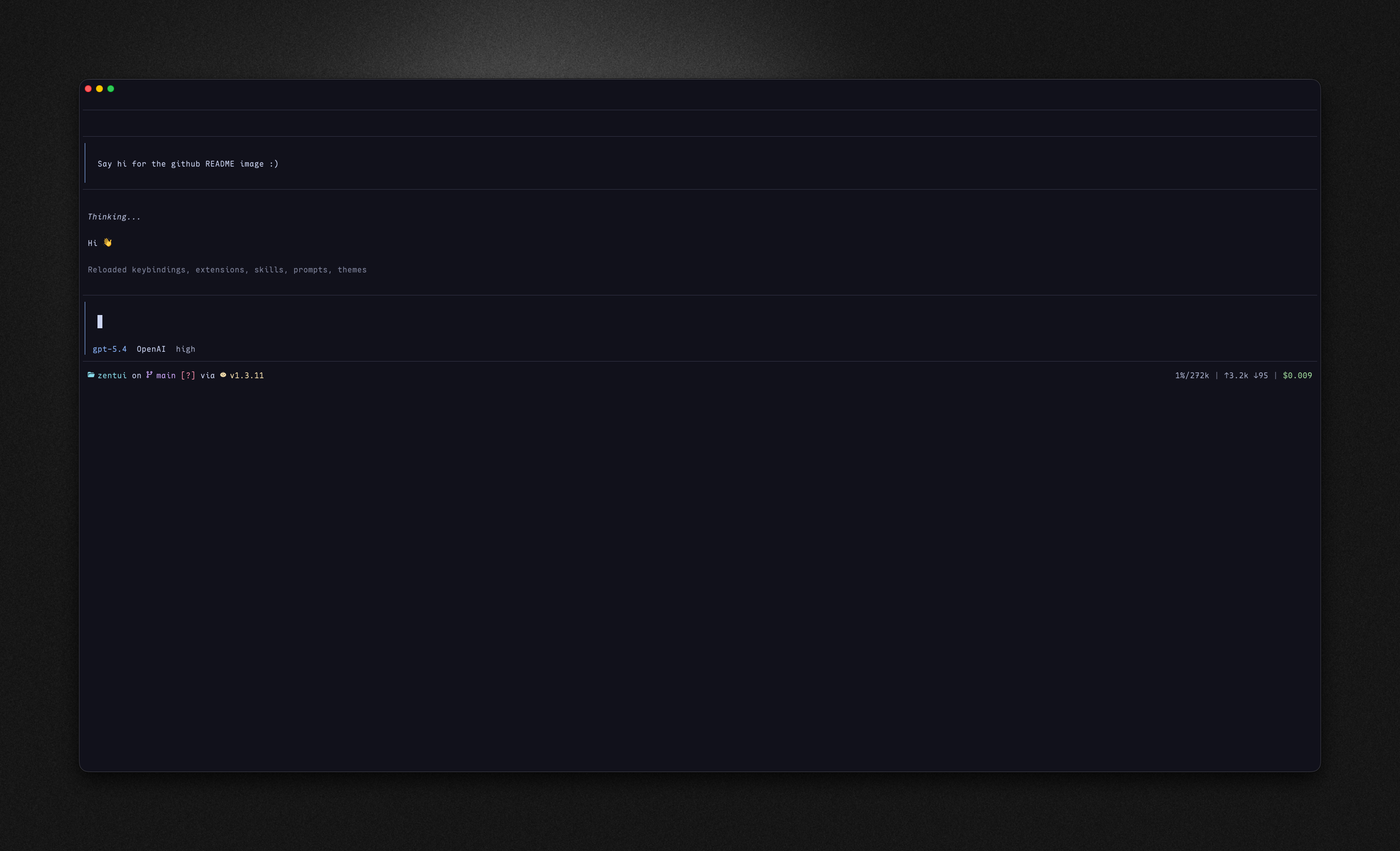
What is this?
Zentui brings two popular aesthetics to Pi:
- Starship footer — shows your current directory, git branch, git status indicators, and runtime/version detection in a compact, icon-rich format
- Opencode editor — clean bordered input box with accent rail, copy-friendly mode, and model/provider display inside the editor frame
Features
Footer (Starship-inspired)
dirname— current directory (basenameby default; optionalfullpath with directory depth viapathDisplay)on branch— git branch with icon[!?↑]— git status indicators (modified, untracked, ahead/behind, stashed, etc.)via v5.5.0— runtime detection with version and Starship-style Nerd Font runtime/language modules- Optional segments (off by default):
user@host, current time, OS icon, session duration, and the project package version (e.g.package.json→0.6.0) — distinct from the runtime segment, which shows the installed toolchain - Right side shows context usage, token counts, and cost
- Built-in footer segments can be shown or hidden individually from
/zentui - Fully custom Starship-style layout via a
footerFormattemplate string — see Footer Format Template - Third-party Pi extension statuses from
ctx.ui.setStatus()can be shown on the left, middle, or right side, or hidden per status key from/zentui
Editor (Opencode-inspired)
- Bordered input box with configurable accent rail and border colors
- Model name and provider displayed inside the editor frame
- Configurable model, provider, and thinking-level indicator colors
- Prompt-box-style user messages matching the ZentUI input chrome
- Copy-friendly mode hides editor and previous-message rail glyphs so terminal selection copies less chrome
Git Status Icons
| Icon | Meaning |
|---|---|
! |
Modified |
? |
Untracked |
+ |
Staged |
✘ |
Deleted |
» |
Renamed |
= |
Conflicted |
$ |
Stashed |
↑ |
Ahead |
↓ |
Behind |
⇕ |
Diverged |
Runtime Detection
Detects Starship Nerd Font runtime/language modules, uses the Starship Nerd Font symbols, and keeps Starship-style defaults such as bold green for Node.js. By default Zentui maps those styles through your active Pi theme; switch the Starship/footer color source to terminal in /zentui if you want your terminal colorscheme to supply the exact ANSI colors.
| Runtime/language | Detection examples |
|---|---|
| Buf | buf.yaml, buf.gen.yaml, buf.work.yaml |
| Bun | bun.lock, bun.lockb |
| C | .c, .h files |
| C++ | .cpp, .cc, .cxx, .hpp files |
| CMake | CMakeLists.txt, CMakeCache.txt |
| COBOL | .cbl, .cob files |
| Conda | CONDA_DEFAULT_ENV environment |
| Crystal | .cr files, shard.yml |
| Dart | .dart files, pubspec.yaml, .dart_tool/ |
| Deno | deno.json, deno.jsonc, deno.lock |
| .NET | .csproj, .fsproj, global.json, Directory.Build.* |
| Elixir | mix.exs |
| Elm | .elm files, elm.json, elm-stuff/ |
| Erlang | rebar.config, erlang.mk |
| Fennel | .fnl files |
| Fortran | .f, .f90, .f95, .f03, .f08, .f18, fpm.toml |
| Gleam | .gleam files, gleam.toml |
| Go | go.mod |
| Gradle | build.gradle, build.gradle.kts, gradle/ |
| Guix shell | GUIX_ENVIRONMENT environment |
| Haskell | .hs, .cabal, stack.yaml, cabal.project |
| Haxe | .hx, .hxml, haxelib.json, .haxerc |
| Helm | helmfile.yaml, Chart.yaml |
| Java | .java-version |
| Julia | .jl files, Project.toml, Manifest.toml |
| Kotlin | .kt, .kts files |
| Lua | .lua files, stylua.toml, .luarc.json, lua/ dir |
| Maven | pom.xml |
| Meson | MESON_DEVENV=1 and MESON_PROJECT_NAME environment |
| Mojo | .mojo files |
| Nim | .nim, .nims, .nimble, nim.cfg |
| Nix shell | IN_NIX_SHELL=pure or IN_NIX_SHELL=impure environment |
| Node.js | package.json, .nvmrc, .node-version |
| OCaml | .opam, .ml, .mli, dune, _opam/, esy.lock/ |
| Odin | .odin files |
| OPA/Rego | .rego files |
| Perl | .pl, .pm, Makefile.PL, cpanfile, META.* |
| PHP | composer.json |
| Pixi | pixi.toml, pixi.lock, PIXI_ENVIRONMENT_NAME environment |
| Pulumi | Pulumi.yaml, Pulumi.yml |
| PureScript | .purs files, spago.dhall, spago.yaml, spago.lock |
| Python | pyproject.toml, requirements.txt, setup.py, Pipfile |
| R | .R, .Rmd, .Rproj, DESCRIPTION, .Rproj.user/ |
| Raku | .raku, .rakumod, .p6, .pm6, META6.json |
| Red | .red, .reds files |
| Ruby | Gemfile, .ruby-version |
| Rust | Cargo.toml |
| Scala | .scala, .sbt, build.sbt, .metals/ |
| Solidity | .sol files |
| Spack | SPACK_ENV environment |
| Swift | .swift files, Package.swift |
| Terraform | .tf, .tfplan, .tfstate, .terraform/ |
| Typst | .typ files, template.typ |
| Vagrant | Vagrantfile |
| V | .v files, v.mod, vpkg.json |
| Xmake | xmake.lua |
| Zig | .zig files, build.zig |
Install
# From npm
pi install npm:pi-zentui

# From git
pi install git:github.com/lmilojevicc/pi-zentui
Config
User config lives at ~/.pi/agent/zentui.json. The file is optional: missing or invalid known values fall back to Zentui defaults, unknown keys are ignored at runtime, and /zentui can patch color-source settings, UI feature toggles, built-in footer segment visibility, and active third-party status placements.
The interactive /zentui menu is split into five sections. Use Tab and Shift+Tab to switch between Coloring, Features, Layout, Built-in segments, and Extension segments.
Useful slash-command shortcuts:
/zentui editor enable
/zentui editor disable
/zentui statusline enable
/zentui statusline disable
/zentui editor toggle
/zentui statusline toggle
/zentui copy-friendly enable
/zentui copy-friendly disable
/zentui copy-friendly toggle
/zentui format "$cwd on branch $git_branch$git_status using $runtime $fill $context"
/zentui format clear
Default config values — copy this and change any value you want:
{
"projectRefreshIntervalMs": 30000,
"footerFormat": "",
"contextStyle": "text",
"contextThresholds": {
"warning": 70,
"error": 90
},
"pathDisplay": {
"mode": "basename",
"depth": 0
},
"icons": {
"mode": "auto",
"cwd": "",
"git": "",
"ahead": "↑",
"behind": "↓",
"diverged": "⇕",
"conflicted": "=",
"untracked": "?",
"stashed": "$",
"modified": "!",
"staged": "+",
"renamed": "»",
"deleted": "✘",
"typechanged": "T",
"cacheHit": "",
"editorPrompt": "",
"rail": "│",
"username": "",
"time": "",
"os": ""
},
"colors": {
"cwd": "bold cyan",
"gitBranch": "bold purple",
"gitStatus": "bold red",
"contextNormal": "bright-black",
"contextWarning": "bold yellow",
"contextError": "bold red",
"tokens": "bright-black",
"cost": "bold green",
"extensionStatus": "bright-black",
"separator": "bright-black",
"runtimePrefix": "",
"sessionDuration": "yellow",
"packageVersion": "208",
"gitCommit": "bold green",
"gitMetricsAdded": "bold green",
"gitMetricsDeleted": "bold red",
"username": "bold yellow",
"time": "bold yellow",
"os": "bold white",
"editorAccent": "accent",
"editorPrompt": "accent",
"editorBorder": "borderMuted",
"editorModel": "accent",
"editorProvider": "text",
"editorThinking": "muted",
"editorThinkingMinimal": "thinkingMinimal",
"editorThinkingLow": "thinkingLow",
"editorThinkingMedium": "thinkingMedium",
"editorThinkingHigh": "thinkingHigh",
"editorThinkingXhigh": "thinkingXhigh"
},
"colorSources": {
"starship": "theme",
"editor": "theme",
"userMessages": "theme"
},
"features": {
"editor": true,
"statusLine": true,
"copyFriendly": false
},
"footerSegments": {
"cwd": true,
"gitBranch": true,
"gitStatus": true,
"gitCounts": false,
"runtime": true,
"context": true,
"tokens": true,
"cost": true,
"sessionDuration": false,
"username": false,
"time": false,
"os": false,
"packageVersion": false,
"gitCommit": false,
"gitMetrics": false
},
"gitCommit": {
"hashLength": 7,
"onlyDetached": true,
"showTag": true
},
"gitMetrics": {
"onlyNonzero": true,
"ignoreSubmodules": false
},
"extensionStatuses": {
"defaultPlacement": "right",
"placements": {},
"colorModes": {}
}
}
- Style values can be Starship/terminal strings (
bold purple,fg:202,#89b/#89b4fa,bg:blue fg:bright-green) or Pi theme tokens (accent,borderMuted,thinkingHigh). Short#rgbhex values expand to#rrggbb. projectRefreshIntervalMs: project status polling interval;0disables polling. Values1..4999clamp up to5000(minimum 5s); invalid/non-finite values fall back to30000.contextStyle:text(default),gauge, ortext+gaugefor the context segment.contextThresholds:{ warning, error }percentages (default70/90) that select contextNormal / contextWarning / contextError colors.pathDisplay: controls how the cwd/$cwdpath is shown.modeisbasename(default, last segment only) orfull(path with home contracted to~). Infullmode,depthkeeps only the last N trailing directories (0= entire path after~, max5); when parents are dropped the path is prefixed with…/(Starship-style). The/zentuiLayout tab cycles path mode and path depth (0–5; depth is ignored for basename). Example:~/Projects/foo/barwithdepth: 2→…/foo/bar.icons: every shown icon key is configurable; omit any key to use the Zentui default.icons.modeisauto|nerd|ascii(defaultauto, same glyphs as nerd). ASCII mode swaps in plain fallbacks for statusline icons and runtime symbols — useful without a Nerd Font. Custom per-icon strings always win over mode defaults. Customicons.osalways wins; when left at the mode default, Zentui maps the OS icon by platform.railsets the vertical glyph drawn as the left rail of the active editor frame and previous user messages whencopyFriendlyis disabled (default│; any single Unicode vertical or block glyph).editorPromptcontrols an optional copy-friendly editor prompt glyph; the default is""so copy-friendly mode stays rail-free.colorSources:thememaps styles through Pi theme tokens;terminalemits terminal colors./zentuiswitches these sources; manual JSON controls specific style values.features:editorenables Zentui's custom editor, selector borders, and previous-message chrome.statusLineenables Zentui's custom footer/status line.copyFriendlyhides editor and previous-message rail glyphs so native terminal selection copies less chrome. All three can be changed from/zentuior direct slash-command arguments.footerSegments: show or hide individual built-in footer segments (cwd,gitBranch,gitStatus,gitCounts,gitCommit,gitMetrics,runtime,packageVersion,sessionDuration,username,time,os,context,tokens,cost). Toggle them from theBuilt-in segmentstab in/zentui.footerFormat: optional Starship-style template string that fully controls the footer layout. When set, it overridesfooterSegments. See Footer Format Template below. The/zentuiLayout tab configures context style, path display mode/depth, and icon mode; set or clear custom formats with/zentui format.gitCommit: Starshipgit_commit-style options for thegitCommitfooter segment.hashLength(default7, clamped to4–40) controls the short-hash display length.onlyDetached(defaulttrue) shows the hash mainly on detached HEAD.showTag(defaulttrue) appends an exact-match tag (git describe --tags --exact-match HEAD). The tag probe piggybacks on the existing git refresh — it only runs when both the segment andshowTagare on, and misses/failures degrade silently.gitMetrics: Starshipgit_metrics-style options for thegitMetricsfooter segment. Usesgit diff HEAD --numstat(staged + unstaged combined — the Starship “total dirty” view) to show aggregate+added −deletedline counts.onlyNonzero(defaulttrue) omits each zero component independently and hides the segment entirely at0/0.ignoreSubmodules(defaultfalse) adds--ignore-submodules=all. The numstat diff piggybacks on the existing git refresh and uses a hard 2s timeout; a metrics-only failure degrades silently without discarding fresh branch/status data. On very large monorepos the diff may lag or be omitted on timeout.extensionStatuses: controls third-party statuses published by other Pi extensions throughctx.ui.setStatus().defaultPlacementand eachplacementsvalue can beoff,left,middle, orright. TheExtension segmentstab in/zentuilists only statuses that are currently active.- The shown
editor*values match the defaultthemesource. Omit those keys to keep Zentui's source-aware defaults when switching betweenthemeandterminal. editorAccentstyles the active editor rail and previous user-message rail whenfeatures.copyFriendlyis disabled.editorPromptstyles the copy-friendly editor prompt glyph. Omit it to useeditorAccent, then the default accent fallback.editorBorderstyles the active editor and previous user-message top/bottom border color only; the border glyph stays─.editorModel,editorProvider, andeditorThinking*style the editor metadata.editorThinkingapplies to every non-offthinking level unless a level-specific key is set.
Tip: when using copy-friendly mode, setting Pi's editorPaddingX to 1 in ~/.pi/agent/settings.json keeps a small left gutter without copying a rail glyph.
Footer Format Template
For full control, set a Starship-style footerFormat template string. It supports $variable and ${variable} tokens, a special $fill token that splits the line into left and right zones, and conditional groups ( ... ) that drop entirely when every nested variable is empty. When set, it overrides the built-in footerSegments layout; when empty or omitted, the segment layout above is used.
A second $fill creates a centered middle zone — content between the two fills is true-centered (floor((gap - middle) / 2)), just like third-party statuses placed middle.
{
	"footerFormat": "$os $username $cwd( on $git_branch)( $git_status)( via $runtime)$fill($context)($sep$tokens)($sep$cost)($sep$time)"
}
Center the branch between directory and cost:
{
	"footerFormat": "$cwd $fill $git_branch $fill $cost"
}
Variables
| Token | Aliases | Renders |
|---|---|---|
$cwd |
$directory |
current directory |
$git_branch |
$branch |
git branch with icon |
$git_status |
$status |
[!?↑] status block |
$git_state |
$state |
REBASING / MERGING / … (optional n/m) |
$git_commit |
$commit |
short commit hash (+ exact-match tag when present) |
$git_tag |
$tag |
exact-match tag at HEAD |
$git_metrics |
aggregate line changes +added −deleted |
|
$git_added |
added line count (+N) |
|
$git_deleted |
deleted line count (−N) |
|
$runtime |
runtime icon + version | |
$package |
project package version, is <glyph> <version> (manifest-derived) |
|
$package_version |
raw project package version (no icon) | |
$session_duration |
$duration |
session running time |
$username |
user@host |
|
$os |
operating-system icon | |
$time |
current time HH:MM |
|
$context |
context usage (text and/or gauge via config) | |
$tokens |
input/output token counts | |
$cost |
session cost | |
$sep |
$separator |
themed | using colors.separator |
$fill |
— | special: splits zones |
$fill behavior
$fill count |
Layout |
|---|---|
| 0 | everything left-aligned |
| 1 | tokens before → left, tokens after → right |
| 2 | before first → left, between → centered middle, after second → right |
| 3+ | first two count; extras ignored |
- Literal text (
on branch,using,\|, spaces) is rendered verbatim — you control all spacing. - Each variable renders its core value only (no
on/viaprefixes); add those words as literal text. - Conditional groups: wrap optional pieces in parentheses, e.g.
$cwd( on $git_branch)($git_status)$fill($context). If every$varinside a group is empty, the whole group (including its literals) is dropped. - Unknown
$variablesrender empty. - Set or clear at runtime:
/zentui format "<template>"and/zentui format clear.
Requirements
Development
npm install
npm run verify
npm run fmt
npm run pack:check
Test in Pi
The project keeps Pi core packages as peer dependencies for runtime and dev dependencies for
typechecking. To avoid accidentally running the local node_modules/.bin/pi shim, the dev scripts use
the globally installed Pi binary by default:
npm run pi:dev
npm run pi:install-local
Override the binary if your Pi install is somewhere else:
PI_BIN=/path/to/pi npm run pi:dev
Credits
Inspired by:
- Starship — the minimal, blazing-fast, and infinitely customizable prompt
- Opencode — terminal-based AI coding assistant
License
MIT