pi-zentui
A Starship-inspired statusline and Opencode-style TUI for Pi.
Package details
Install pi-zentui from npm and Pi will load the resources declared by the package manifest.
$ pi install npm:pi-zentui- Package
pi-zentui- Version
0.17.0- Published
- Aug 4, 2026
- Downloads
- 8,398/mo · 2,529/wk
- Author
- lmilojevic
- License
- MIT
- Types
- extension
- Size
- 484.5 KB
- Dependencies
- 0 dependencies · 3 peers
Pi manifest JSON
{
  "extensions": [
    "./extensions"
  ],
  "image": "https://raw.githubusercontent.com/lmilojevicc/pi-zentui/main/assets/zentui.png"
}Security note
Pi packages can execute code and influence agent behavior. Review the source before installing third-party packages.
README
Zentui
A Starship-inspired statusline and Opencode-style TUI for Pi.
Screenshots
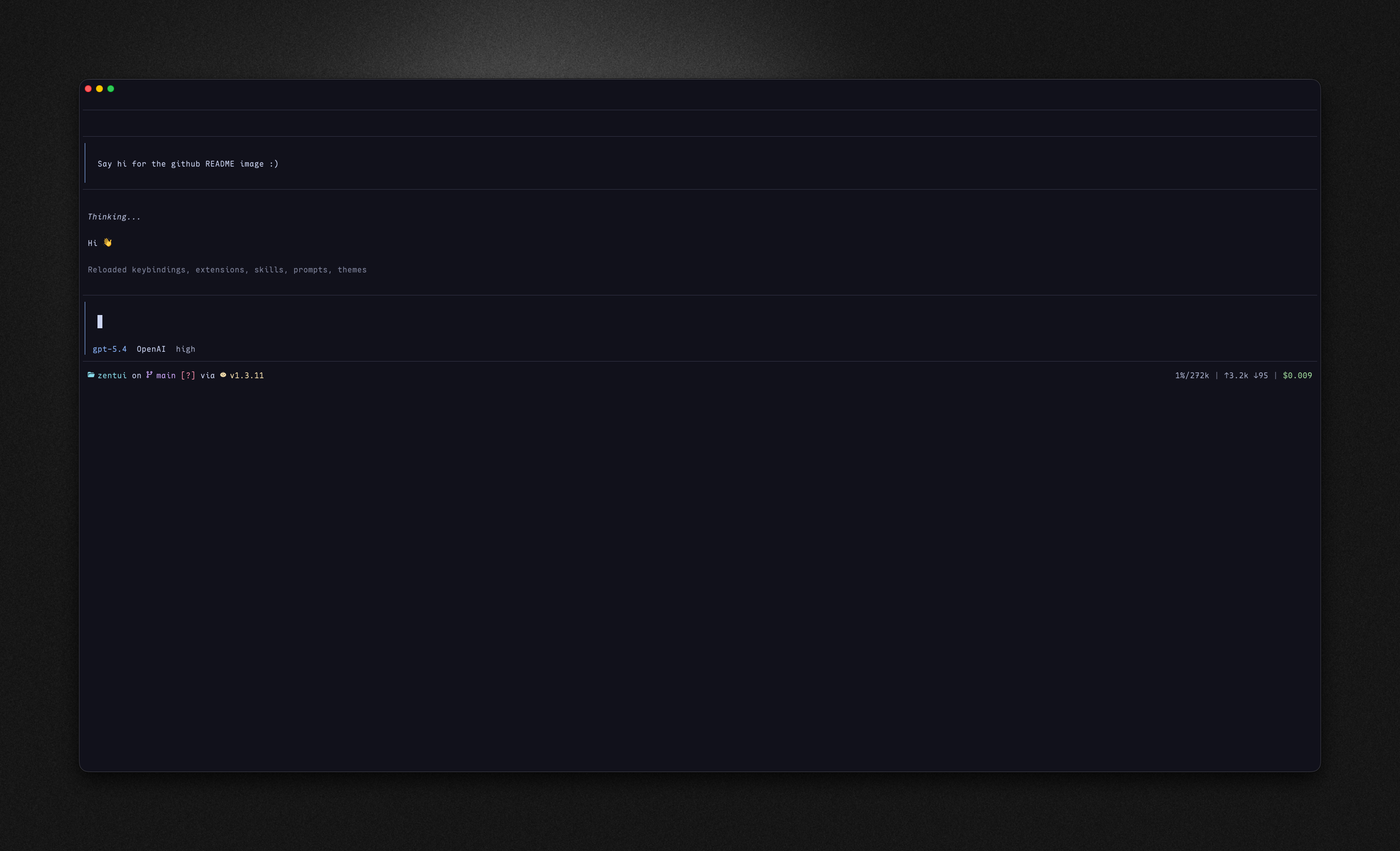
What is this?
Zentui styles three major Pi surfaces independently:
- Editor — selectable opencode, low-rail opencode, and minimalist input frames inspired by Opencode
- User messages — selectable framed, framed copy-friendly, compact, and labeled transcript messages
- Starship footer — current directory, Git, runtime, context, tokens, cost, and other configurable segments
Editor, User messages, and selector borders use an enabled field. Footer uses one style: native, starship, or hidden. Appearance (selector borders and icons) and Layout (the fixed-editor experiment) remain supporting configuration domains.
Features
Footer (Starship-inspired)
dirname— current directory (basenameby default; optionalfullpath with directory depth viapathDisplay)on branch— git branch with icon[!?↑]— git status indicators (modified, untracked, ahead/behind, stashed, etc.)via v5.5.0— runtime detection with version and Starship-style Nerd Font runtime/language modules- Optional segments (off by default): selected model/provider,
user@host, current time, OS icon, session duration, and the project package version (e.g.package.json→0.6.0) — distinct from the runtime segment, which shows the installed toolchain - Right side shows context usage, token counts, and cost
- Built-in footer segments can be shown or hidden individually from
/zentui - Fully custom Starship-style layout via the
components.footer.styles.starship.formattemplate string — see Footer Format Template - Third-party Pi extension statuses from
ctx.ui.setStatus()can be shown on the left, middle, or right side, or hidden per status key from/zentui
Editor (Opencode-inspired)
opencode(default) keeps an accent rail on every interior rowopencode-copy-friendly(Opencode (copy-friendly) in/zentui) preserves the low-rail rendering for clean terminal selectionminimalistmoves session name, cost, model, thinking, context, Git, configurable path, Bash state, and turn duration into a rounded frame- The selected model label and provider appear inside both Opencode editor variants; the model ID is used by default, while
components.editor.modelLabel: "name"uses the display name with ID fallback. - Opencode autocomplete rows retain Pi's original unframed trailing layout; Minimalist keeps autocomplete inside its rounded frame
- Configurable model, provider, thinking-level, accent, and border colors
- Fixed editor (experimental, opt-in): pin the editor cluster at the bottom of the terminal while the transcript scrolls above, independently of selected editor and Footer modes
Editor previews:
opencode                 opencode-copy-friendly     minimalist
────────────────────     ────────────────────       ╭─ session ── model ╮
│
│ prompt                 › prompt                  │ prompt             │
│
│ metadata                metadata                 ╰─ git ───── path ──╯
────────────────────     ────────────────────
User messages
framed(default) preserves the full-width bordered prompt box with an accent railframed-copy-friendly(Framed (copy-friendly) in/zentui) keeps the full-width horizontal borders and blank spacer rows, removes the copied accent rail, and retains a one-cell leading gutter before body text.compactuses only an accent rail, with no border or padding rowslabeleduses a rounded box with the fixed labelUser- Disabling User-message styling delegates byte-for-byte to Pi's native renderer; native is not a style ID
- No custom
plainmessage style is provided
framed                    framed-copy-friendly
────────────────────      ────────────────────
│
│ Message                  Message
│
────────────────────      ────────────────────

compact                    labeled
│ Message                 ╭─ User ───────────╮
│ Continued               │ Message          │
                          │ Continued        │
                          ╰──────────────────╯
Git Status Icons
| Icon | Meaning |
|---|---|
! |
Modified |
? |
Untracked |
+ |
Staged |
✘ |
Deleted |
» |
Renamed |
= |
Conflicted |
$ |
Stashed |
↑ |
Ahead |
↓ |
Behind |
⇕ |
Diverged |
Runtime Detection
Detects Starship Nerd Font runtime/language modules, uses the Starship Nerd Font symbols, and keeps Starship-style defaults such as bold green for Node.js. By default Zentui maps those styles through your active Pi theme; switch the Starship/footer color source to terminal in /zentui if you want your terminal colorscheme to supply the exact ANSI colors.
| Runtime/language | Detection examples |
|---|---|
| Buf | buf.yaml, buf.gen.yaml, buf.work.yaml |
| Bun | bun.lock, bun.lockb |
| C | .c, .h files |
| C++ | .cpp, .cc, .cxx, .hpp files |
| CMake | CMakeLists.txt, CMakeCache.txt |
| COBOL | .cbl, .cob files |
| Conda | CONDA_DEFAULT_ENV environment |
| Crystal | .cr files, shard.yml |
| Dart | .dart files, pubspec.yaml, .dart_tool/ |
| Deno | deno.json, deno.jsonc, deno.lock |
| .NET | .csproj, .fsproj, global.json, Directory.Build.* |
| Elixir | mix.exs |
| Elm | .elm files, elm.json, elm-stuff/ |
| Erlang | rebar.config, erlang.mk |
| Fennel | .fnl files |
| Fortran | .f, .f90, .f95, .f03, .f08, .f18, fpm.toml |
| Gleam | .gleam files, gleam.toml |
| Go | go.mod |
| Gradle | build.gradle, build.gradle.kts, gradle/ |
| Guix shell | GUIX_ENVIRONMENT environment |
| Haskell | .hs, .cabal, stack.yaml, cabal.project |
| Haxe | .hx, .hxml, haxelib.json, .haxerc |
| Helm | helmfile.yaml, Chart.yaml |
| Java | .java-version |
| Julia | .jl files, Project.toml, Manifest.toml |
| Kotlin | .kt, .kts files |
| Lua | .lua files, stylua.toml, .luarc.json, lua/ dir |
| Maven | pom.xml |
| Meson | MESON_DEVENV=1 and MESON_PROJECT_NAME environment |
| Mojo | .mojo files |
| Nim | .nim, .nims, .nimble, nim.cfg |
| Nix shell | IN_NIX_SHELL=pure or IN_NIX_SHELL=impure environment |
| Node.js | package.json, .nvmrc, .node-version |
| OCaml | .opam, .ml, .mli, dune, _opam/, esy.lock/ |
| Odin | .odin files |
| OPA/Rego | .rego files |
| Perl | .pl, .pm, Makefile.PL, cpanfile, META.* |
| PHP | composer.json |
| Pixi | pixi.toml, pixi.lock, PIXI_ENVIRONMENT_NAME environment |
| Pulumi | Pulumi.yaml, Pulumi.yml |
| PureScript | .purs files, spago.dhall, spago.yaml, spago.lock |
| Python | pyproject.toml, requirements.txt, setup.py, Pipfile |
| R | .R, .Rmd, .Rproj, DESCRIPTION, .Rproj.user/ |
| Raku | .raku, .rakumod, .p6, .pm6, META6.json |
| Red | .red, .reds files |
| Ruby | Gemfile, .ruby-version |
| Rust | Cargo.toml |
| Scala | .scala, .sbt, build.sbt, .metals/ |
| Solidity | .sol files |
| Spack | SPACK_ENV environment |
| Swift | .swift files, Package.swift |
| Terraform | .tf, .tfplan, .tfstate, .terraform/ |
| Typst | .typ files, template.typ |
| Vagrant | Vagrantfile |
| V | .v files, v.mod, vpkg.json |
| Xmake | xmake.lua |
| Zig | .zig files, build.zig |
Install
# From npm
pi install npm:pi-zentui

# From git
pi install git:github.com/lmilojevicc/pi-zentui
Config
User config lives at ~/.pi/agent/zentui.json. The file is optional: missing or invalid known values fall back to Zentui defaults, unknown keys are ignored at runtime, and /zentui can patch color-source settings, UI feature toggles, built-in footer segment visibility, and active third-party status placements.
The interactive /zentui menu is split into exactly eight component-oriented sections, in this order. Use Tab and Shift+Tab to switch sections:
- Appearance — selector-border enablement, style, and colors; icon mode.
- Editor — editor enablement, style, colors, model label, border behavior, viewport indicators, and settings for the selected editor style.
- User messages — message enablement,
framed | framed-copy-friendly | compact | labeledstyle selection (including Framed (copy-friendly)), and colors. - Layout — fixed-editor enablement, mouse scrolling, and copy notices.
- Footer —
Native | Starship | Hiddenstyle selection. Starship additionally shows colors, model label, responsive layout, separator, context style, and path display. - Segments — visibility toggles for non-Git Starship segments.
- Git — Starship Git segment and probe controls.
- Extensions — Starship extension-status placement and color controls for active keys.
Editor and User messages retain independent enablement and style configuration. Footer's single style selects Pi's built-in Footer (Native), Zentui's Starship Footer, or an owned zero-row Footer (Hidden). Color and model-label rows update only their owning component.
Starship-specific Footer rows are shown only while Starship is selected. The Segments, Git, and Extensions sections remain available for preconfiguration under every Footer style. Free-form values such as custom formats, Opencode metadata format, raw colors/styles, numeric values outside the shown presets, and inactive extension keys remain JSON-only.
Useful slash-command shortcuts:
/zentui editor enable
/zentui editor disable
/zentui statusline enable
/zentui statusline disable
/zentui editor toggle
/zentui messages enable
/zentui messages disable
/zentui messages toggle
/zentui statusline toggle
/zentui messages
/zentui user-messages
/zentui layout
/zentui viewport-indicators enable
/zentui viewport-indicators disable
/zentui viewport-indicators toggle
/zentui fixed-editor enable
/zentui fixed-editor disable
/zentui fixed-editor toggle
/zentui format "$cwd on branch $git_branch$git_status using $runtime $fill $context"
/zentui format clear
footer, statusline, status, and status line are aliases: enable selects Starship, disable selects Native, and toggle selects Native only from Starship (Native or Hidden toggle to Starship).
Default config values — copy this and change any value you want:
{
"projectRefreshIntervalMs": 30000,
"components": {
"editor": {
"enabled": true,
"style": "opencode",
"colorSource": "theme",
"borderColorMode": "static",
"modelLabel": "id",
"viewportIndicators": true,
"styles": {
"opencode": {
"metadataFormat": "$model $provider( $thinking)"
},
"opencode-copy-friendly": {
"metadataFormat": "$model $provider( $thinking)"
},
"minimalist": {
"pathDisplay": "compact",
"contextFormat": "percent",
"contextGauge": false,
"showSessionName": true,
"showTimer": true,
"showCost": true,
"showGit": true,
"contextThresholds": {
"warning": 70,
"error": 90
}
}
}
},
"userMessages": {
"enabled": true,
"style": "framed",
"colorSource": "theme",
"styles": {
"framed": {},
"framed-copy-friendly": {},
"compact": {},
"labeled": {}
}
},
"selectorBorders": {
"enabled": true,
"style": "zentui",
"colorSource": "theme"
},
"footer": {
"style": "starship",
"colorSource": "theme",
"modelLabel": "id",
"styles": {
"starship": {
"format": "",
"responsive": true,
"compactFormat": "$cwd$wrap(in $session_name)$wrap(on $git_branch) $git_status$wrap$context$wrap_sep$tokens",
"compactMaxLines": 2,
"separator": "pipe",
"contextStyle": "text",
"contextThresholds": {
"warning": 70,
"error": 90
},
"pathDisplay": {
"mode": "basename",
"depth": 0
},
"segments": {
"cwd": true,
"sessionName": true,
"gitBranch": true,
"gitStatus": true,
"gitCounts": false,
"runtime": true,
"modelInfo": false,
"context": true,
"tokens": true,
"cost": true,
"sessionDuration": false,
"username": false,
"time": false,
"os": false,
"packageVersion": false,
"gitCommit": false,
"gitMetrics": false
},
"gitBranch": {
"maxLength": "full"
},
"gitCommit": {
"hashLength": 7,
"onlyDetached": true,
"showTag": true
},
"gitMetrics": {
"onlyNonzero": true,
"ignoreSubmodules": false
},
"extensionStatuses": {
"defaultPlacement": "right",
"placements": {},
"colorModes": {}
}
}
}
}
},
"layout": {
"fixedEditor": {
"enabled": false,
"mouseScroll": true,
"copyNotice": true
}
},
"icons": {
"mode": "auto",
"cwd": "",
"git": "",
"ahead": "↑",
"behind": "↓",
"diverged": "⇕",
"conflicted": "=",
"untracked": "?",
"stashed": "$",
"modified": "!",
"staged": "+",
"renamed": "»",
"deleted": "✘",
"typechanged": "T",
"cacheHit": "",
"editorPrompt": "",
"rail": "│",
"username": "",
"time": "",
"os": ""
},
"colors": {
"cwd": "bold cyan",
"sessionName": "bold green",
"gitBranch": "bold purple",
"gitStatus": "bold red",
"contextNormal": "bright-black",
"contextWarning": "bold yellow",
"contextError": "bold red",
"tokens": "bright-black",
"cost": "bold green",
"extensionStatus": "bright-black",
"separator": "bright-black",
"runtimePrefix": "",
"sessionDuration": "yellow",
"packageVersion": "208",
"gitCommit": "bold green",
"gitMetricsAdded": "bold green",
"gitMetricsDeleted": "bold red",
"username": "bold yellow",
"time": "bold yellow",
"os": "bold white",
"editorAccent": "accent",
"editorPrompt": "accent",
"editorBorder": "borderMuted",
"editorModel": "accent",
"editorProvider": "text",
"editorThinking": "muted",
"editorThinkingMinimal": "thinkingMinimal",
"editorThinkingLow": "thinkingLow",
"editorThinkingMedium": "thinkingMedium",
"editorThinkingHigh": "thinkingHigh",
"editorThinkingXhigh": "thinkingXhigh"
}
}
- Style values can be Starship/terminal strings (
bold purple,fg:202,#89b/#89b4fa,bg:blue fg:bright-green) or Pi theme tokens (accent,borderMuted,thinkingHigh). Short#rgbhex values expand to#rrggbb. projectRefreshIntervalMs: project status polling interval;0disables polling. Values1..4999clamp up to5000(minimum 5s); invalid/non-finite values fall back to30000.components.editor: owns editor enablement,opencode | opencode-copy-friendly | minimaliststyle selection, color source, border mode, model label, viewport indicators, and all three editor-style configurations.components.userMessages: owns message enablement,framed | framed-copy-friendly | compact | labeledstyle selection, and color source.framed-copy-friendlyremains Zentui-rendered; disabling the component delegates to Pi's native renderer.components.selectorBorders: owns selector-border enablement, the fixedzentuistyle, and its color source.components.footer: ownsnative | starship | hiddenstyle selection, Footer color source, Footer model label, and every Starship option understyles.starship(formats, segments, context thresholds, path, Git, and extension statuses). Native restores Pi's built-in Footer; Hidden installs an empty component with zero rows.layout.fixedEditor: owns fixed-layout enablement, mouse scrolling, and copy notices. Layout activation depends on Pi compatibility inspection, not on Zentui editor/Footer style.- Editor and Footer
modelLabelvalues are independent and have separate controls in the Editor and Footer sections. - Selector borders support only
zentui; set their owningenabledfield tofalsefor native Pi behavior. - Flat released keys such as
editorStyle,features,footerFormat, andfixedEditorremain accepted as migration input.components.footer.enabledandfeatures.statusLinemigrate to Starship or Native when no valid Footer style is present; Hidden projectsfeatures.statusLine: false. Canonicalcomponentsandlayoutpaths are the primary JSON interface, and component saves materialize canonical snapshots. - Explicit unsupported future component style IDs are preserved unchanged on disk but fail open at runtime: Editor, User-message, and selector-border customization stay disabled, while Footer behavior is Native. Missing, empty, or malformed style values continue normal default and legacy migration behavior.
- The flat properties returned by
mergeConfig,loadConfig, and save helpers are deprecated compatibility output and will remain available until at least the next major release. This output deprecation is separate from accepted legacy flat JSON input. polishedandpolished-copy-friendlyremain read-only migration aliases foropencodeandopencode-copy-friendly. Legacyfeatures.copyFriendlyand the old nested Editor/messagecopyFriendlyfields are read-only migration inputs: message copy-friendlytrueselectsframed-copy-friendlyrather than disabling custom rendering. Explicit Editor or User-message style saves remove only the corresponding obsolete nested flag; raw released feature keys, unknown fields, and unknown style data remain preserved as user-owned migration data.- The shown
editor*values match the defaultthemesource. Omit those keys to keep Zentui's source-aware defaults when switching betweenthemeandterminal. editorAccentstyles Editor and User-message accent rails and the labeled message label.editorPromptstyles theopencode-copy-friendlyEditor prompt glyph. Omit it to useeditorAccent, then the default accent fallback.editorBorderstyles theframedandframed-copy-friendlyprevious-message top/bottom borders and the active editor in static border color mode; the border glyph stays─.editorModel,editorProvider, andeditorThinking*style the editor metadata.editorThinkingapplies to every non-offthinking level unless a level-specific key is set.
Tip: with opencode-copy-friendly, setting Pi's editorPaddingX to 1 in ~/.pi/agent/settings.json keeps a small left gutter without copying a rail glyph.
Minimalist editor style
Set components.editor.style to minimalist or select it from the /zentui Editor tab. The rounded frame shows viewport counts, Bash state, the current/completed turn duration, and the explicit Pi session name at top left; cost, model, thinking level, and context usage at top right; viewport count plus Git branch/status at bottom left; and the configured path at bottom right. Unnamed sessions add no placeholder. Autocomplete stays inside the frame when Pi's existing editor output can be split safely. Unknown third-party editor layouts fail open without decoration.
The Minimalist editor is inspired by pi-custom-input, with an independent implementation in Zentui.
While minimalist is selected, the /zentui Editor area shows its focused controls without repeating the style name on every row. Path examples are src (compact), zentui/src (project), and ~/Projects/zentui/src (full). Context can render as 11%, 11%/372k, or—with the gauge enabled and enough room—[█░░░░] 11%/372k. The gauge shortens or disappears before the context text at narrow widths. Session name, timer, cost, and Git can be hidden independently; model, thinking, and context remain structurally stable.
Footer visibility is controlled by components.footer.style: use starship, native, or hidden. Minimalist editor decoration and the Starship Footer may be shown together, including at narrow widths or after decoration fallback. Minimalist style does not remove Pi's header; the experimental fixed-editor layout remains separate.
Editor Metadata Format
Set metadataFormat under either opencode style in ~/.pi/agent/zentui.json to customize that style's metadata row. The two variants retain independent values:
{
	"components": {
		"editor": {
			"styles": {
				"opencode": {
					"metadataFormat": "$model_name ($model_id)( · $provider)( · $thinking)( · $session_name)"
				},
				"opencode-copy-friendly": {
					"metadataFormat": "$model( · $provider)"
				}
			}
		}
	}
}
The syntax follows the Footer Format Template conventions: $variable and ${variable} references, literal text and spaces, and conditional groups ( ... ) that disappear when all variables inside are empty. Unknown variables and $fill render empty; $fill never creates an editor layout zone because the right side remains reserved for structural Vim status.
| Token | Renders |
|---|---|
$model |
label selected by components.editor.modelLabel (id, or name with ID fallback) |
$model_id |
active Pi model ID |
$model_name |
active Pi model display name; empty when no name is set |
$provider |
provider label using Zentui's existing formatting |
$thinking |
current thinking level; empty when thinking is off |
$session_name |
current Pi session name; empty when unnamed |
Model variables use editorModel, provider uses editorProvider, and thinking uses the matching editorThinking* style. Literal text and $session_name use the neutral editor border theme style. The template controls spacing. ANSI/VT sequences, control characters, and line-breaking whitespace are sanitized before rendering without collapsing ordinary spaces.
Missing, non-string, or empty values use the default $model $provider( $thinking). A non-empty format that resolves to no visible metadata keeps the normal blank spacer and metadata rows so the editor frame height remains stable. This option is configured only through JSON in its first version; /zentui format continues to control the footer only.
Footer Format Template
For full control, set components.footer.styles.starship.format to a Starship-style template string. It supports $variable and ${variable} tokens, a special $fill token that splits the line into left and right zones, and conditional groups ( ... ) that drop entirely when every nested variable is empty. When set, it overrides components.footer.styles.starship.segments; when empty or omitted, the segment layout above is used.
A second $fill creates a centered middle zone — content between the two fills is true-centered (floor((gap - middle) / 2)), just like third-party statuses placed middle.
{
	"components": {
		"footer": {
			"styles": {
				"starship": {
					"format": "$os $username $cwd($sep$session_name)( on $git_branch)( $git_status)( via $runtime)$fill($context)($sep$tokens)($sep$cost)($sep$time)"
				}
			}
		}
	}
}
Center the branch between directory and cost:
{
	"components": {
		"footer": {
			"styles": {
				"starship": {
					"format": "$cwd $fill $git_branch $fill $cost"
				}
			}
		}
	}
}
The released flat footerFormat and footerSegments keys remain accepted only as legacy migration inputs.
Variables
| Token | Aliases | Renders |
|---|---|---|
$cwd |
$directory |
current directory |
$session_name |
current Pi session name | |
$git_branch |
$branch |
git branch with icon |
$git_status |
$status |
[!?↑] status block |
$git_state |
$state |
REBASING / MERGING / … (optional n/m) |
$git_commit |
$commit |
short commit hash (+ exact-match tag when present) |
$git_tag |
$tag |
exact-match tag at HEAD |
$git_metrics |
aggregate line changes +added −deleted |
|
$git_added |
added line count (+N) |
|
$git_deleted |
deleted line count (−N) |
|
$runtime |
runtime icon + version | |
$model |
selected model label (components.footer.modelLabel) |
|
$provider |
formatted provider label | |
$package |
project package version, is <glyph> <version> (manifest-derived) |
|
$package_version |
raw project package version (no icon) | |
$session_duration |
$duration |
session running time |
$username |
user@host |
|
$os |
operating-system icon | |
$time |
current time HH:MM |
|
$context |
context usage (text and/or gauge; finite percentages use one decimal) | |
$tokens |
input/output counts and existing cache-hit percentage | |
$cache_read |
cache-read total (R1.2k); empty at zero or when unavailable |
|
$cache_write |
cache-write total (W300); empty at zero or when unavailable |
|
$cost |
session cost | |
$subscription |
(sub) in subscription mode; otherwise empty |
|
$auto_compaction |
(auto) when automatic compaction is enabled; otherwise empty |
|
$sep |
$separator |
themed | using colors.separator |
$fill |
— | special: splits zones |
$fill behavior
$fill count |
Layout |
|---|---|
| 0 | everything left-aligned |
| 1 | tokens before → left, tokens after → right |
| 2 | before first → left, between → centered middle, after second → right |
| 3+ | first two count; extras ignored |
- Literal text (
on branch,using,\|, spaces) is rendered verbatim — you control all spacing. - Each variable renders its core value only (no
on/viaprefixes); add those words as literal text. - Conditional groups: wrap optional pieces in parentheses, e.g.
$cwd( on $git_branch)($git_status)$fill($context). If every$varinside a group is empty, the whole group (including its literals) is dropped. $session_nameis available whenevercomponents.footer.styles.starship.formatis set, independently ofcomponents.footer.styles.starship.segments.sessionName; use a conditional group such as($sep$session_name)so unnamed sessions leave no separator.- The built-in wide footer appends cache totals to the token segment,
(sub)to cost, and(auto)to context when available. Custom formats keep$tokens,$cost, and$contextbackward-compatible and include telemetry only through the atomic variables above. DEFAULT_COMPACT_FOOTER_FORMATomits model/provider and atomic telemetry. Add their variables explicitly tocomponents.footer.styles.starship.compactFormatto opt in at narrow widths. The flatcompactFooterFormatkey is a legacy migration input.- Auto-compaction settings refresh on the next normal footer synchronization event. Unsupported Pi capabilities or settings-read errors safely omit optional markers.
- Unknown
$variablesrender empty. - Set or clear at runtime:
/zentui format "<template>"and/zentui format clear.
Fixed editor (experimental, opt-in)
The fixed layout pins Pi's usable editor cluster at the bottom of the terminal while the transcript scrolls above. It can activate independently of Zentui editor and Footer style; Pi compatibility inspection decides whether it is safe. Hidden contributes zero rows and no spacer. A live Footer style change tears down the compositor, replaces the Footer, and reprobes the new component; reprobe failure leaves ordinary rendering active.
At constrained heights, Zentui reserves one transcript row, keeps a complete Zentui editor frame and cursor, then prioritizes active autocomplete, Footer, below-editor widget, above-editor widget, and status. Editor content crops around the cursor; known autocomplete content crops around its selected item. Native and third-party editors are treated as opaque and are either pinned intact or rendered through Pi's normal layout. If the terminal later grows, fixed layout returns automatically without reinstalling the compositor.
How to enable
/zentui fixed-editor enable
Or in ~/.pi/agent/zentui.json:
{
	"layout": {
		"fixedEditor": {
			"enabled": true
		}
	}
}
Keyboard controls
| Key | Action |
|---|---|
PageUp / PageDown |
Scroll transcript one viewport up/down; consumed at either boundary while transcript scrolling exists |
Ctrl+Shift+↑ / Ctrl+Shift+↓ |
Scroll transcript up/down (Kitty protocol variants supported) |
Enter |
Jump to bottom (and submit message) |
PageUp/PageDown propagate to Pi when there is no transcript scroll range, while normal-flow fallback is active, or while an overlay owns input.
Graceful cleanup
Live disable restores the full scroll region, mouse modes, alternate-scroll behavior, autowrap, cursor visibility, and primary screen before Pi repaints its normal layout. Pi lifecycle shutdown (/quit, Ctrl+C, Ctrl+D, SIGHUP, and SIGTERM) performs the same reset without a late repaint into the caller's shell. Cleanup after SIGKILL, a fatal crash that prevents Pi's shutdown callback, terminal disconnect, or failure of both terminal writers cannot be guaranteed.
Mouse scroll (default on)
Mouse wheel scrolling is enabled by default when the fixed editor is on. Disable it from the /zentui Layout section or:
{
	"layout": {
		"fixedEditor": {
			"enabled": true,
			"mouseScroll": false
		}
	}
}
Warning: Mouse scroll enables SGR mouse reporting, which disables native terminal text selection, URL click-through, and tmux/Herdr scrollback for the Pi session. Toggle off if you need those features.
Conflicts and limitations
- Incompatible with
pi-powerline-footer,@tifan/pi-fixed-editor, andpi-sticky-input. These packages patch the same Pi TUI internals; only one rendering owner can be active at a time. - Alternate screen: Uses the terminal's alternate screen buffer. Native scrollback history is not accessible while the fixed editor is active.
- Pi version fragility: Patches internal TUI methods (
doRender,render,terminal.write,terminal.rows) that may change across Pi versions. If the TUI layout is unsupported, Zentui falls back to normal rendering with a console warning. - Pi has no Footer getter or Footer-change event. Zentui observes normal third-party takeover through Pi's custom-component disposal callback and will not restore Native afterward. Direct internal mutation, a future Pi version that stops disposing replaced components, and automatic fixed-layout reprobe after third-party replacement cannot be detected.
- If your terminal is stuck after a crash, run
resetor restart the terminal.
Acknowledgments
The minimalist frame's information hierarchy was inspired by VinhLe1410/pi-custom-input and is integrated with Zentui's existing editor, state, configuration, and compatibility layers.
Requirements
Development
npm install
npm run verify
npm run fmt
npm run pack:check
Test in Pi
The project keeps Pi core packages as peer dependencies for runtime and dev dependencies for
typechecking. To avoid accidentally running the local node_modules/.bin/pi shim, the dev scripts use
the globally installed Pi binary by default:
npm run pi:dev
npm run pi:install-local
Override the binary if your Pi install is somewhere else:
PI_BIN=/path/to/pi npm run pi:dev
Credits
Inspired by:
- Starship — the minimal, blazing-fast, and infinitely customizable prompt
- Opencode — terminal-based AI coding assistant
License
MIT