pi-zgrep
Semantic, BM25, hybrid, and grep search for the pi coding agent, powered by the zg (zvec-grep) engine. One tool, auto-indexed, local-first. A semantic upgrade over ripgrep for code questions.
Package details
Install pi-zgrep from npm and Pi will load the resources declared by the package manifest.
$ pi install npm:pi-zgrep- Package
pi-zgrep- Version
0.3.0- Published
- Sep 3, 2026
- Downloads
- 125/mo · 125/wk
- Author
- carvalab
- License
- MIT
- Types
- extension
- Size
- 69.3 KB
- Dependencies
- 1 dependency · 2 peers
Pi manifest JSON
{
  "image": "https://raw.githubusercontent.com/zvec-ai/zvec-grep/main/.github/assets/benchmark-overall-retrieval-indexed-v3.png",
  "extensions": [
    "./src/index.ts"
  ]
}
Security note
Pi packages can execute code and influence agent behavior. Review the source before installing third-party packages.
README
pi-zgrep
Semantic code search for the pi coding agent. One tool, four routes (hybrid, BM25, vector, ripgrep), auto-indexed.


What your agent gets
- It finds code by meaning. "Where do we parse the upstream output format?" works before anyone knows the symbol names, which is exactly an agent's situation in an unfamiliar repo.
- No setup and no daemon babysitting. The search engine installs as a dependency, the index builds in the background at session start, and a daemon keeps it fresh.
- Exact matching keeps an escape route:
mode=rgpasses the query to managed ripgrep and skips the index.
This is what that looks like on this repository. The agent makes one tool call:
zg({ query: "where does the extension parse zg output into results", mode: "hybrid" })
and gets ranked file:line hits back (real output):
doc/specs/2026-09-02-pi-zg-extension.md:55-68    heading: Components
doc/specs/2026-09-02-pi-zg-extension.md:69-76    heading: Data flow
doc/plans/2026-09-02-pi-zg-extension.md:353-426  heading: Task 5: Output parser (src/parse.ts)
Nothing in that query is a literal identifier in the codebase. Ripgrep scores zero on questions like this one; see Benchmarks for where the numbers live.
Install
pi install npm:pi-zgrep
Try it without installing first:
pi -e npm:pi-zgrep
The engine, zvec-grep (Apache-2.0, npm @zvec/zvec-grep), ships as a regular npm dependency, so one install brings both. No lifecycle scripts run: npm 12 blocks dependency postinstalls by default, and upstream ships prebuilt native bindings as optional dependencies instead. At runtime the extension resolves the binary in order: PI_ZG_BIN (explicit override), the packaged dependency, zg on PATH, then a global install on first use (npm install -g @zvec/zvec-grep, bun add -g fallback, one --ignore-scripts retry). pi-zgrep itself is an integrator: the search logic lives upstream, and this package translates a pi tool call into zg argv and parses the output.
The zg tool
Local-first semantic + BM25 + hybrid + ripgrep search over the current workspace.
| Parameter | Type | Default | Notes |
|---|---|---|---|
query |
string | (required) | Natural language, symbol, or regex (for mode=rg). |
mode |
hybrid | fts | vector | rg |
hybrid |
Search route. rg skips the index entirely. |
limit |
number (1-50) | 10 |
Max results to return. |
glob |
string | File filter, e.g. *.ts. |
|
type |
string | File-type filter. | |
refresh |
auto | wait |
auto |
wait forces --refresh wait after editing a file in the same session. |
preview |
short | none |
short |
Include a one-line code preview per result. |
Results come back as ranked file:line lines. The tool result details carry the parsed JSON, kept for future TUI rendering.
Commands
/zg-index [args...]passes arguments through tozg index(for example--rebuild). Progress streams in the status line, and the handler notifies you when the build starts and finishes./zg-statusshows the resolved binary and version, index readiness and freshness, and the daemon pointer. Run it when something looks off; the output tells you whether the index is missing, possibly stale, or fresh.
How it behaves
The index is ready before the first question
When a session starts, the extension checks for the binary and, in the background, makes sure the index exists: a missing or stale index builds before you ask anything, with progress on the status line. On a warm repo this costs two cheap spawns (a version probe and a readiness check), and the daemon from your previous session is still running, so nothing new starts. Esc cannot abort a session-start build because it runs in the background; /zg-index is the manual control. On bare dev checkouts (pi -e . without npm install) the binary is not there yet, so startup does nothing and the first tool use installs it.
The first query builds the index if it has to
A zg call that needs the index and does not have one runs zg index for you. Build progress streams in the tool output, and Esc aborts the build (the child receives SIGKILL). Partial builds resume incrementally on the next attempt. A failed build surfaces a memoized error on later calls in the same session; start a new session or run /zg-index, which bypasses the memo. mode=rg queries skip the index entirely.
A daemon keeps the index fresh
After the first successful build, the extension asks zg to start its background daemon (zg server on, loopback-only, detached). The daemon watches the workspace, reconciles the index hourly, and reuses the embedding model across runs. Set PI_ZG_SERVER to any non-empty value to opt out and manage the daemon yourself.
The agent is nudged toward the right route
On every agent turn, the extension appends a short system-prompt note telling the model to prefer zg over grep/find, with mode guidance: hybrid for intent, fts for symbols, vector for paraphrases, rg for exact matches. It also says when to fall back: zero results, a tool error, or a possibly_stale flag on content the agent just edited. Set PI_ZG_GUIDANCE to any non-empty value to disable the nudge.
Configuration
All env vars are read from the pi process environment (set them before launching pi). The "any non-empty value" convention means setting PI_ZG_AUTO_INSTALL=1 is the same as PI_ZG_AUTO_INSTALL=please-stop.
| Variable | Effect when set to any non-empty value |
|---|---|
PI_ZG_BIN |
Path to the zg binary. Skips packaged-dependency and PATH lookup. If set but the binary is not executable there, the extension errors out (no fallback). |
PI_ZG_AUTO_INSTALL |
Never auto-install. Error surfaces the exact manual command. |
PI_ZG_GUIDANCE |
Do not append the system-prompt nudge. |
PI_ZG_SERVER |
Do not start the zg daemon after the first build. |
Troubleshooting
Install fails. Run the manual command the extension surfaces:
npm install -g @zvec/zvec-grep
On hosts without node-gyp the first attempt can fail on sharp's optional postinstall. The extension retries once with --ignore-scripts; sharp ships a prebuilt binary so the retry works. If both attempts fail, the manual command above still works.
Offline first index. The first zg index run downloads a local embedding model. If the download fails, the error surfaces verbatim in the tool output. Reconnect, or pre-stage the model cache, and retry.
mode=rg works without an index. Use it when the index is broken or you want to skip the build step entirely.
Parse miss. If upstream changes its output shape, the tool falls back to raw text passthrough prefixed with a hint to run /zg-status and file an issue at carvalab/pi-zgrep. The fixtures under test/fixtures/ are the compat tripwire for the parser.
Windows: not supported in 0.2.0. The resolver spawns zg directly with shell: false, which cannot launch npm's .cmd shims. macOS and Linux only.
Benchmarks
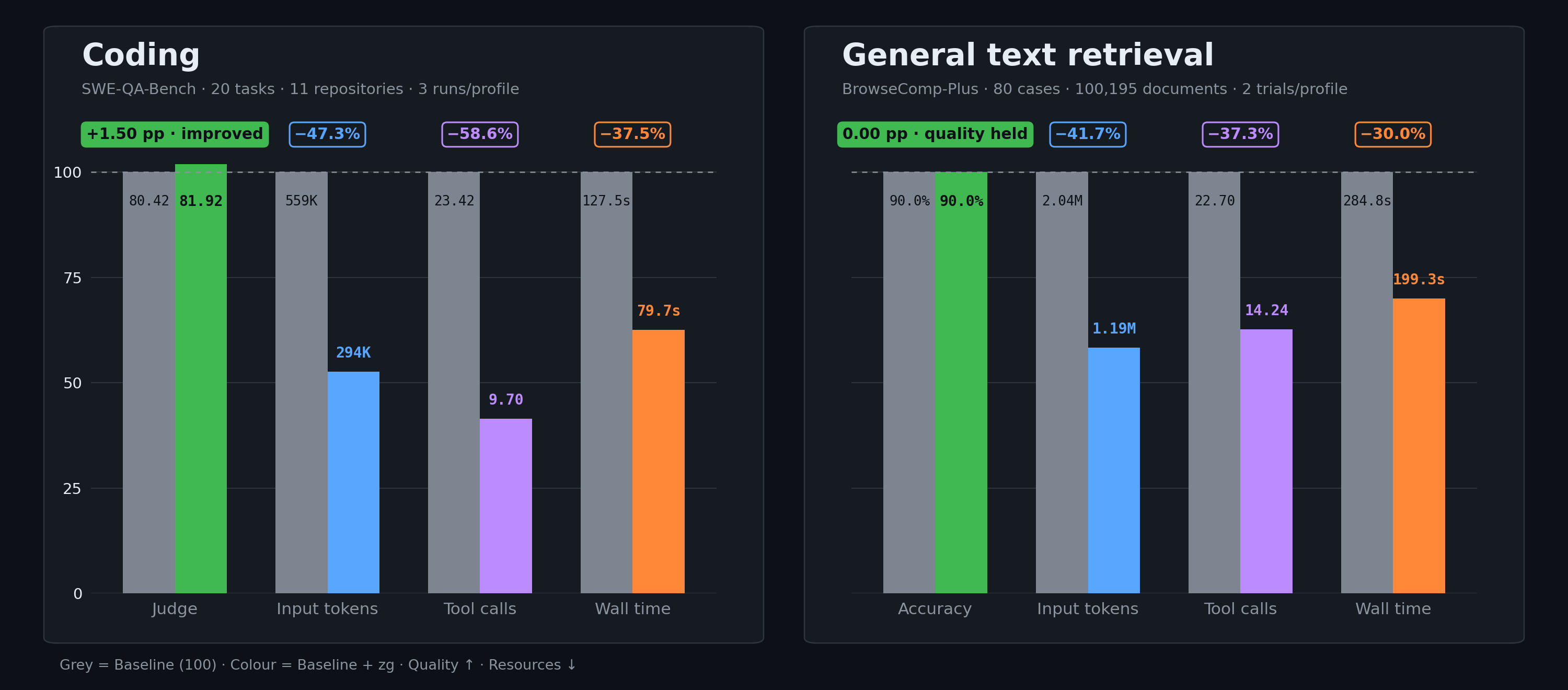
The retrieval and answer-quality numbers that matter come from upstream's own benchmark suite, which is bigger and better instrumented than anything we would run here: agent-based A/B runs (zg on and off) with judge scoring on SWE-QA-Bench (code, Claude Opus 5) and BrowseComp-Plus (general text, Codex gpt-5.6-sol), plus real-repo case studies on Pylint, Matplotlib, and Django. Method, environments, and results: upstream benchmark docs.
As a local reference we also keep a small latency and hit-rate comparison of zg against ripgrep and GNU grep on this repo's own code. The method and the numbers live in doc/benchmark.md; rerun it yourself with ./doc/bench.sh (130-line script, no dependencies).
Out of scope in 0.2.0
No override of pi's native grep/find, no MCP-client mode, no custom TUI rendering, no @-mention autocomplete, no bundled skills, no remote embeddings.
Development
git clone https://github.com/carvalab/pi-zgrep.git
cd pi-zgrep
npm install
npm run test            # unit tests (parser, arg builder, ensure chain, guidance)
ZG_TEST_E2E=1 npm run test:e2e   # real zg engine required on PATH
Fixtures under test/fixtures/ are captured from real zg 0.2.1 runs and act as the compat tripwire for both the arg builder and the parser. To regenerate a fixture, delete it and re-run the capture commands in doc/plans/2026-09-02-pi-zg-extension.md (Task 3), or copy from a fresh zg run against test/fixtures/sample-project/.
Lint and format are wired through ultracite (oxlint + oxfmt):
npm run lint
npm run format          # writes changes
npm run format:check    # CI gate
License
MIT. See LICENSE.
Changelog
Release notes live in CHANGELOG.md; each section is curated before the tag lands.