recall-pi
A local knowledge base built from Claude Code, Codex, OpenCode, and Pi conversations
Package details
Install recall-pi from npm and Pi will load the resources declared by the package manifest.
$ pi install npm:recall-pi- Package
recall-pi- Version
0.4.0- Published
- Aug 20, 2026
- Downloads
- 725/mo · 7/wk
- Author
- viggy28
- License
- MIT
- Types
- extension
- Size
- 1 MB
- Dependencies
- 0 dependencies · 5 peers
Pi manifest JSON
{
  "extensions": [
    "./extensions/recall/index.ts"
  ]
}
Security note
Pi packages can execute code and influence agent behavior. Review the source before installing third-party packages.
README
Recall
A local knowledge base built from your Claude Code, Codex, OpenCode, and Pi conversations.
Recall indexes your coding-agent sessions in SQLite so you can rediscover past work, resume sessions, and preserve important context in plain Markdown. Everything stays on your machine.

What Recall does
- Indexes conversations across Claude Code, Codex, OpenCode, and Pi.
- Searches with fuzzy matching, regular expressions, or optional local semantic search.
- Browses recent conversations and resumes supported sessions.
- Preserves reusable project context as plain Markdown context banks.
- Runs as a standalone Python CLI or as an extension inside Pi.
Local by default
Recall reads local transcripts and indexes them with SQLite FTS5. Core indexing and search use only the Python standard library and do not send your conversations anywhere. Optional semantic search downloads and runs an embedding model locally.
Recall stores its index at ~/.recall/recall.db and context banks under ~/.recall/contexts/.
Quick start
Pi extension
Install the published recall-pi package:
pi install npm:recall-pi
The extension adds the /recall dashboard and the recall_search and recall_context tools. In Pi, you can ask naturally:
Search my recent sessions for the retry backoff change.
Attach my migration-safe-notsafe context before we continue.
Standalone CLI
Core search has no required third-party dependencies:
python3 recall.py index
python3 recall.py search "retry backoff"
python3 recall.py recent
You can also install the recall command from this checkout. See the usage guide for setup and all available commands.
Knowledge graphs
recall graph extracts named entities locally with a deterministic, dependency-free
heuristic and connects entities mentioned in the same message. JSON output contains
nodes, weighted co-occurrence edges, and references to the source session, message,
path, and transcript line. DOT output can be opened by Graphviz and other graph tools.
# D3/Cytoscape-friendly JSON on stdout
recall graph --max-nodes 75 --min-edge-weight 2 > graph.json

# Scope the graph and create a Graphviz artifact
recall graph --source pi --project recall --since 2026-01-01 \
  --entity-type organization --format dot --output graph.dot
dot -Tsvg graph.dot > graph.svg
Available scopes include --since, --until, --source, --project, and
--entity-type. Use --max-nodes and --min-edge-weight to keep dense graphs
readable. Entity extraction is deterministic and dependency-free, and recognizes a
small set of precise token classes rather than every capitalized word: @people,
#topics, issue references (#123, gh-123), domains, file paths, and a curated
technology gazetteer (Postgres, React, GraphQL, …). Add --ner to layer on spaCy
named-entity recognition for people, organizations, and places in prose:
pip install spacy && python -m spacy download en_core_web_sm
recall graph --ner
For an interactive explorer, render a self-contained HTML file (no server or network needed — open it directly in a browser):
recall graph --format html --output graph.html
open graph.html
Context banks
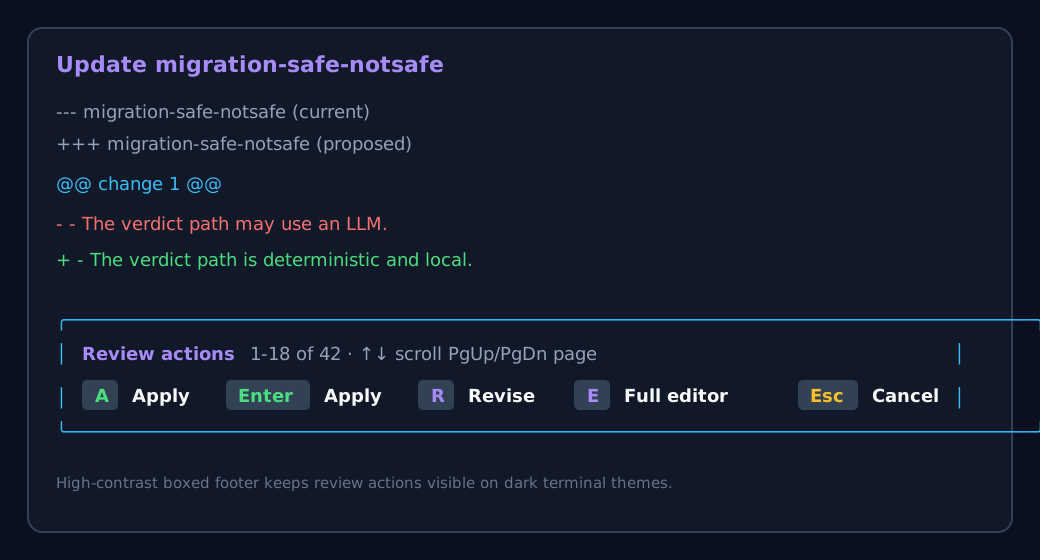
Context banks turn useful material from past conversations into reusable Markdown documents. Create, review, update, and attach them to future Pi sessions without moving your project context to a hosted service.
recall context show migration-safe-notsafe
recall context update migration-safe-notsafe "Record the latest parser and rules-engine decisions"