speak-like-you-eat
A Pi extension for plain-language companion rewrites.
Package details
Install speak-like-you-eat from npm and Pi will load the resources declared by the package manifest.
$ pi install npm:speak-like-you-eat- Package
speak-like-you-eat- Version
1.0.1- Published
- Aug 17, 2026
- Downloads
- 258/mo · 258/wk
- Author
- wtfzambo
- License
- MIT
- Types
- extension
- Size
- 1.5 MB
- Dependencies
- 0 dependencies · 2 peers
Pi manifest JSON
{
  "extensions": [
    "./src/index.ts"
  ],
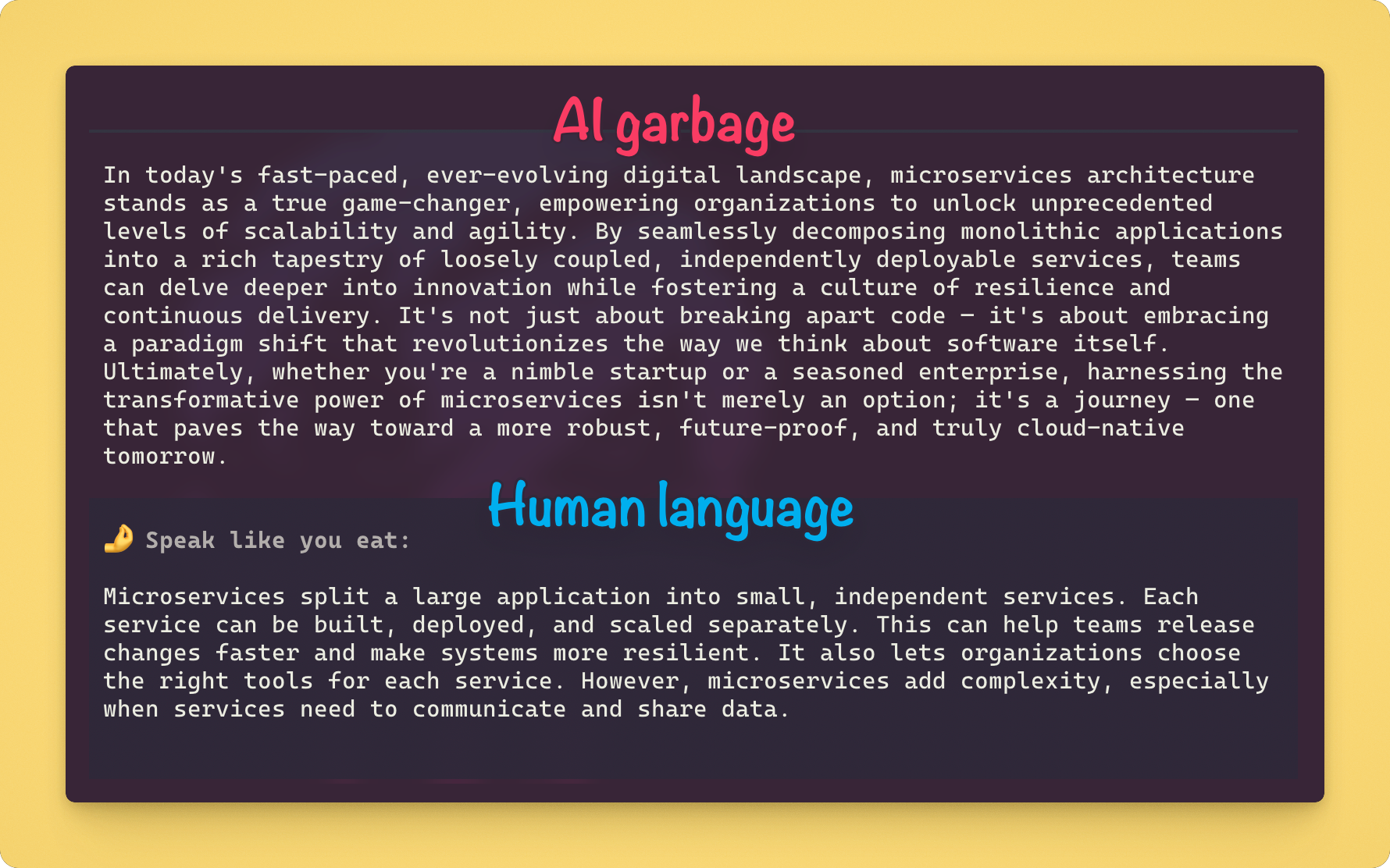
  "image": "https://raw.githubusercontent.com/wtfzambo/speak-like-you-eat/refs/heads/main/imgs/front.png"
}
Security note
Pi packages can execute code and influence agent behavior. Review the source before installing third-party packages.
README
SLYE - Speak like you eat
SLYE is a Pi package that adds a plain-language rewrite after a completed response.
In Italian, “speak like you eat” (parla come mangi) means being straightforward instead of using big, clever, empty words. SLYE applies that idea to AI output.
Deliberately inspired by Claudish to English
Install
# Available to all projects
pi install npm:speak-like-you-eat

# Available only in the current project
pi install -l npm:speak-like-you-eat
Use
- Run
/slye modelto select and save an authenticated model. SLYE enables it and saves it globally or, in a trusted project, locally. - Chat normally. After an eligible answer, read the
🤌 Speak like you eat:card below the unchanged original. - Use
/slye offlater to disable SLYE and/slye onto restore it.
| Command | What it does |
|---|---|
/slye model |
Choose a model; Tab switches between scoped and all authenticated eligible models. |
/slye on |
Enable SLYE or open the picker when no usable model is saved. |
/slye off |
Disable SLYE. |
SLYE automatically uses the selected model's lowest supported thinking level. Only normally completed final responses with at least 200 prose characters outside fenced code are eligible.
Recommended models
I ran a small, human-scored benchmark (me) to see how different cheap AI models would handle the "translation" part.
But long story short, use cheap-ish, fast models with low/no reasoning (SLYE already sets reasoning for you).
Models that I recommend:
- Terra - best overall in this benchmark but not the fastest
- DeepSeek V4 Flash - fast, good accuracy
- GPT-OSS 120B - cheapest of the three with good overall results, but more sensitive to prompt wording in this small benchmark
What SLYE guarantees
- The original response stays visible and unchanged. The display-only card never enters LLM context.
- SLYE's rewrite request tells the model to preserve the target response's language and intentional language mix rather than translate it.
- Each eligible response makes one additional provider request, with its own cost and latency.
- Escape cancels a rewrite. After 45 seconds or another failure, SLYE leaves the original alone and fails open.
- SLYE sends an isolated, SLYE-controlled payload directly to the selected provider. It does not load project instructions, skills, prompts, tools, files, or the full session history. Other extensions and provider-side processing are outside SLYE's control.
Evidence
Read the MVP specification for the complete behavior and the benchmark results for methodology, costs, and limitations.
Development
Requires Node 24+ and Pi.
npm ci
npm run check
npm pack --dry-run --json
pi -e .
pi -e . loads the clone for local testing. Do not submit a prompt when you only need to check that the extension loads.