trimegisto
Pi multi-agent orchestration: tiered parallel sub-agents, @mentions, loop guard, file locks, context broker, dashboard.
Package details
Install trimegisto from npm and Pi will load the resources declared by the package manifest.
$ pi install npm:trimegisto- Package
trimegisto- Version
1.6.13- Published
- Sep 14, 2026
- Downloads
- 1,467/mo · 235/wk
- Author
- noguerol
- License
- MIT
- Types
- extension, skill
- Size
- 442.3 KB
- Dependencies
- 0 dependencies · 5 peers
Pi manifest JSON
{
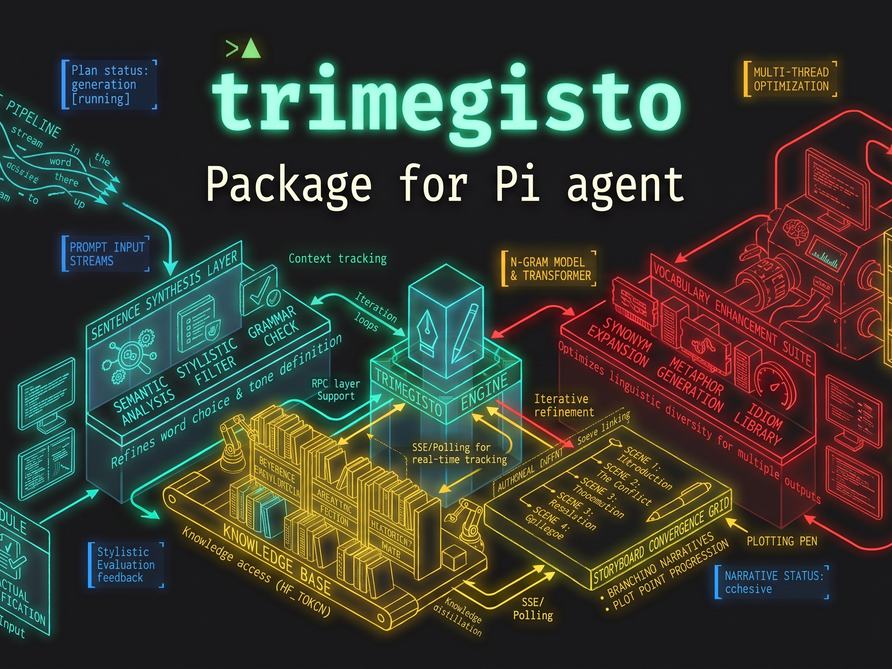
  "image": "https://raw.githubusercontent.com/noguerol/trimegisto/main/docs/preview.jpeg",
  "skills": [
    "./agents"
  ],
  "extensions": [
    "./src/index.ts"
  ]
}
Security note
Pi packages can execute code and influence agent behavior. Review the source before installing third-party packages.
README
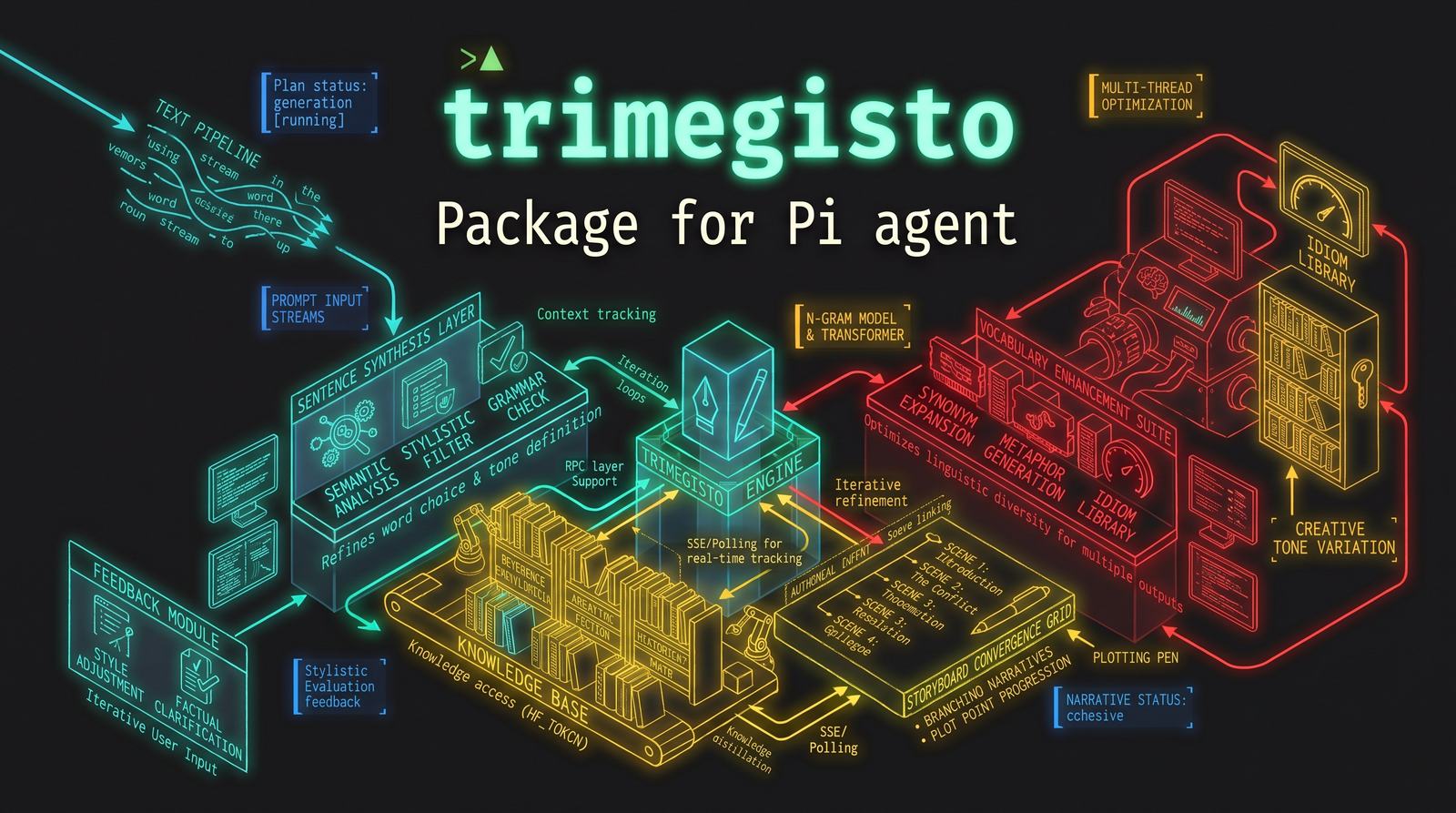
Trimegisto — Multi-Agent Orchestration for pi
Trimegisto turns pi into a multi-agent runtime. It launches parallel sub-agent processes organized in four tiers, lets you (or the main LLM) delegate work to them, and keeps the whole swarm under control with a swarm guard, advisory file locks, a context broker and a live dashboard — without ever replacing pi's native UI. (Reasoning-loop detection is delegated to the separate antiloop extension.)
Every sub-agent is a real pi process (pi -p --mode json), so agents run in complete isolation with their own context window, tools and model.
Tiers
| Tier | Role | Model | Max Parallel | Compaction | Agent IDs |
|---|---|---|---|---|---|
| active (t0) | Default worker. Runs the same model as your main session — mass-parallel by default. | the pi active model | 4 | 85% | t0a, t0b... |
| t1 | Deep thinking / planning. RESERVED for expensive models. | configured | 1 | 65% | t1a, t1b... |
| t2 | Complex problem solver (reasoning above the active model's reach). | configured | 4 | 75% | t2a, t2b... |
| t3 | Fast, cheap worker for mechanical tasks (parsing, formatting, translation, file ops). | configured | 4 | 85% | t3a, t3b... |
- The active tier is always available (it uses the model pi is currently running, captured live — even if you switch models mid-session with
/model). - t1/t2/t3 are only available once you give each tier a model via
/tmg config(or a config file / agent file). Unavailable tiers are reported to the LLM so it never tries to spawn them. - Agent IDs:
t+ tier number + instance letter (t0a,t2b,t3c...).
Install
Trimegisto is a pi package: one extension (src/index.ts) plus three tier skills (agents/), declared in package.json.
# From GitHub (recommended)
pi install git:github.com/noguerol/trimegisto

# Pin a tag/commit (refs are never moved by `pi update`)
pi install git:github.com/noguerol/trimegisto@v1.0.0

# Local checkout (development)
pi install /path/to/trimegisto

# Try it for one run only, without installing
pi -e git:github.com/noguerol/trimegisto
pi list                     # show installed packages
pi remove git:github.com/noguerol/trimegisto
pi update --extensions      # reconcile pinned git refs
Security: pi packages run with full system access — extensions execute arbitrary code and spawn processes. Install only packages you trust and review.
Requirements: a working pi installation and at least one usable model. Sub-agents inherit your providers/API keys; local servers (ollama, vLLM, LM Studio, llama.cpp, ...) work fine if configured as pi providers.
Quick Start
# Open the interactive config (pick a model for each tier, tune limits)
/tmg config

# Launch agents from the prompt
/t0 analyze the CSVs in ./data and summarize the columns
/t2b fix the failing test in src/parser.ts
@t3c translate the docs to Spanish

# Or just ask normally — when enabled, the main LLM is instructed to
# spawn first for any decomposable/parallelizable request.
"Review the diff, run the relevant tests, and summarize risks."

# Inspect & control
/tmg list
/tmg dashboard
/tmg halt            # or Ctrl+Alt+H
/tmg config          # ...
Results are harvested into the chat as each agent finishes, with per-agent logs, token/cost usage and a ✓ n/m done summary. The main agent is explicitly instructed not to sleep/poll waiting for workers; it can call trimegisto_harvest for an instant non-blocking snapshot instead.
Live throughput in the dashboard
While agents run, the dashboard shows continuous prefill and generation speeds for every target (each sub-agent plus the main session), updating ~every 500 ms without any input from you:
🧙 Tmg:on 3 active ↓246.7t/s ↑1890t/s T2 2r T3 1r · ⌁ main ↓38.1t/s
↓NNNt/s— decode/generation (summed across agents), live while streaming↑NNNt/s— prefill/prompt-processing throughput (averaged), only when the prompt is big enough that compute dominates the round trip↑817ms— a small prompt: time-to-first-token is shown instead of a fake throughput (TTFT includes network latency)↑…2.1s— the model is still chewing on the prompt, nothing generated yet⌁ main— the main session's own speed, while it answers in between agent results
The values are measured from the token stream itself (provider-agnostic), calibrated per model from real usage, and smoothed with an EMA so bursts don't flicker.
The full widget (/tmg dashboard → widget) lists each agent with its model right after the agent id, so you can tell which model each worker is using (handy with redundant-model pools):
◌ t2a Deepseek v4 Flash · T2 12s ↓38t/s 📤1.2k 📥3.4k — analyze the logs
Model ids are humanized — last path segment, separators to spaces, version prefixes kept lower-case (deepseek/deepseek-v4-flash → Deepseek v4 Flash, moonshot/kimi-k3 → Kimi K3, .../Qwen3.8-27B-ROCmFP4-FAST.gguf → Qwen3.8 27B ROCmFP4 FAST). Long labels are capped with …. Before a worker's first response the label falls back to the requested model.
The clock is honest. Each agent's timer shows total time since it started, but it freezes the moment the agent finishes, errors or is killed (it no longer counts up for a finished worker), and resumes without jumping backwards if the agent comes back to life (e.g. a failover retry). The number is wall-clock time — it does not try to measure how long the model actually spent processing, only how long the agent has been alive.
Usage
The trimegisto tool (LLM-facing)
When Trimegisto is enabled, a hidden orchestration directive is injected before each main-agent turn: decomposable work must be delegated first, and the main agent should keep coordination/synthesis. The main model can delegate work in a single non-blocking call:
{
  "goal": "make the parser accept v2 manifests without breaking v1",
  "tasks": [
    { "tier": "active", "task": "map every place v1 manifests are parsed", "why": "locate the parser entry points", "writes": ["docs/parser-map.md"] },
    { "tier": "active", "task": "port the v1 tests to v2 fixtures", "why": "agree on the expected behaviour", "writes": ["test/manifest.test.ts"] },
    { "tier": "t2",     "task": "implement v2 parsing on top of that map", "why": "the change itself", "needs": [1], "writes": ["src/manifest.ts"] }
  ],
  "cwd": "/path/to/work"
}
tierdefaults toactive; max 8 tasks per call (per-tier capacity =maxParallel, higher with redundant model pools).goalis the overall objective.whyis one line saying which part of it a task serves. A task that cannot name its need should not be spawned.needs: [i]declares a real data dependency (1-based indices inside the same call). Declared dependencies run in waves: wave 2 starts only when wave 1 is terminal, and the upstream verdict is injected into the dependent task, so the edge actually carries data instead of being cosmetic. Tasks with no edge run in parallel — that is what to parallelise.writes: [paths]lists files a task will write. Two tasks writing the same file are serialised automatically instead of racing (and instead of being silently rejected by the file lock at runtime).laneoverrides the automatic blast-radius classification:open(contained/reversible),gated(wide but reversible),closed(irreversible/high-consequence). Aclosedtask makes the whole call refuse to launch — that lane does not open.- The tool returns immediately; agents run in the background and the batch always ends with one reconciliation (see Guaranteed reconciliation).
- The tool description always lists which tiers are ENABLED right now — the LLM only spawns those.
trimegisto_harvestreturns the current agent snapshot immediately. It never waits; use it instead of sleep/poll loops.
Plan gate (stop paying for work that should not run)
Before anything is spawned, a deterministic, model-free gate (src/plan-graph.ts) turns the batch into a graph and rejects or repairs it:
- Duplicates merged. Two tasks that would produce the same answer are one node, not two. Near-duplicate text inside the batch is clustered (shingle + Jaccard) and only the lowest index is launched; the rest are reported as merged. This is on top of the cross-call registry dedup (a task that duplicates something spawned in the last 5 minutes is skipped and never registered, so it can be retried later).
- Dependencies enforced.
needsis validated (out-of-range, self-references and cycles are dropped deterministically with a warning) and topologically sorted into waves. If a task reads like a pipeline step (then,based on the findings,using the output…) but declares noneeds, the gate warns instead of guessing — an edge is only an edge when the next node actually reads the previous output. - Same-file writers serialised. No two launched nodes write the same file in the same wave.
- Code nodes flagged. A task that is a pure transformation (parse, count, rename, format, diff…) is flagged: do it with bash instead of paying a model for a step that has exactly one correct answer.
- Relevance checked. With a
goaland awhyper task, the gate computes a deterministic lexical overlap and warns when a task has no link to the stated objective. Without agoalit says so once and cannot check relevance at all. - Closed lanes refused. Irreversible, high-blast-radius work (deletions,
force-push, deploy/publish, migrations, production data, credential rotation) is never launched automatically, whatever the confidence — the human decides. - Feasible waves only. A wave larger than the tier capacity is refused with an actionable message (split it with
needs, or raisemaxParallel); a wave that merely arrives when the tier is busy is queued and launched when a slot frees, not refused. - The gate's verdict is returned in the tool result (
### Waves,### Serialised,### Duplicates merged,### Code nodes,### Warnings,### Blockersand the final**Plan verdict:**line), so the coordinator can see exactly why its plan was reshaped.
Guaranteed reconciliation
A spawn call is a batch, and a batch always produces exactly one final answer:
- Each agent's last assistant message is captured separately as its verdict (not a head-truncated slice of its whole transcript), and the reconciler distils
final verdict > last meaningful output block > stderr. Free-text fields are collapsed to one line before rendering, so an agent id, status or task containing newlines cannot forge a heading or a fake conclusion line. - The batch settles — and emits one
🪡 Trimegisto — final reconciliationmessage — as soon as every agent is terminal (done/error/killed), or when the hard batch deadline expires (TRIMEGISTO_BATCH_DEADLINE_MS, default 30 min, minimum 1 min). Killed agents, watchdog kills and agents that never report still count as settled, so the conclusion is never lost. - The message lists per-agent verdicts, status counts, usage, overlapping results (near-duplicate verdicts collapsed with a similarity note), an explicit
INCOMPLETE:list for anything that did not settle, and closes with the shared conclusion line. Agents that reported success but produced no usable verdict — empty output, or a raw provider error as their last message — are listed under Unverified with a⚠️icon instead of a silent✅, so the conclusion never over-claims. The reconciler is pure and deterministic (src/reconcile.ts); if it ever throws, a minimal fallback conclusion is still emitted. - Delivery uses
deliverAs: followUp+triggerTurn, so the main model gets exactly one turn to write the unified final answer on top of the deterministic conclusion — without interrupting work in flight. The conclusion is rendered the moment it is sent, so it reaches you even when the main model's next request fails (e.g. a provider400). - Live agent progress and logs are TUI-only entries: they render in the transcript but are not sent to the main model. Only the reconciliation participates in the main conversation, which keeps the coordinator's context small and avoids the provider-400 storms an unbounded stream of injected messages used to cause. The
contexthook additionally drops empty Trimegisto messages and caps retained progress notes.
Slash commands (user-facing)
| Command | Description |
|---|---|
/t0 <task> /t1 <task> /t2 <task> /t3 <task> |
Spawn a new agent of the tier |
/t2b <instruction> |
Steer an existing agent (kill + relaunch with combined context); spawns one with that ID if it doesn't exist |
@t2b <instruction> |
Same, @-mention syntax (intercepted before the LLM sees it) |
/tmg launch <tier> <task> |
Launch an agent (verbose) |
/tmg tell <agent-id> <msg> |
Send an instruction to a running agent |
/tmg kill <id> |
Kill one agent |
/tmg halt |
Halt all agents (shortcut: Ctrl+Alt+H) |
/tmg list |
List all agents, status, elapsed, task |
/tmg switch <id> |
Show an agent's output |
/tmg dashboard |
Cycle dashboard mode (compact → widget → off) |
/tmg enable / /tmg disable |
Toggle Trimegisto globally |
/tmg locks |
Show active file locks |
/tmg guard (alias /tmg loops) |
Show guard state (spawn depth, turn warnings, redundancy, paused models) |
/tmg reset-guard [active|t1|t2|t3] |
Reset guard/redundancy counters for a tier (or all) |
/tmg models |
Show model-health state (failures + paused models) |
/tmg reset-models [model] |
Clear the circuit breaker for one model (or all) |
/tmg config |
Interactive configuration (models, limits, flags) |
Steering
Because each agent is a separate process, "steering" means replacing: Trimegisto kills the agent and relaunches a new one (same ID, same tier) with the previous task + your new instruction combined. (Loop-stuck sub-agents are handled in-process by antiloop, which warns, force-breaks and finally aborts the run — no respawn needed.)
Configuration
/tmg config (interactive)
Menu → per-tier submenu:
- Model — scrollable picker over your pi model registry (
provider/model) - Max Parallel — 1–8 concurrent agents per tier (× pool size when redundant agents are on)
- Compaction Threshold —
off (pi default)or 50–95% of context window for forced proactive compaction. Off (default) leaves compaction to pi's native setting. - Redundant models (t1/t2) — pool for load-balancing + automatic failover
- Enabled — toggle the tier
Changing any setting keeps you in the same menu, so you can flip several options in one session; Back/Esc goes up one level and Done closes.
Global flags in the main menu:
| Flag | Default | Effect |
|---|---|---|
enabled |
true |
Master switch for the whole extension |
autoSpawn |
true |
Enables proactive delegation guidance and lets sub-agents spawn other agents (trimegisto_spawn) |
useActiveModel |
true |
active tier agents use the pi active model (OFF → pi default model) |
spawnOnlyOnActive |
false |
Force all spawns onto the active tier (t0); t1/t2/t3 never spawn |
redundantAgents |
false |
t1/t2 spawn on the least-loaded model of their pool and fail over on provider errors/exhaustion/timeouts |
dedupeTasks |
true |
Reject near-duplicate tasks before launch (exact + word-set similarity, 5 min window) |
dedupeCrossAgent |
false |
Flag near-identical outputs from different agents and report wasted tokens |
loopSupervisor.turnLimitEnabled |
false |
Opt-in turn limit: warn at maxAgentTurns (50) then kill at +turnLimitGrace (65). Off = never killed on turn count |
dashboard |
compact |
UI mode: compact / widget / off |
modelHealth |
on, 2 fails → 60 s→600 s | Circuit breaker that pauses spawns on a model failing at the provider level |
Config file
Settings persist in ~/.pi/agent/trimegisto/config.json — created automatically on first save and surviving /new, /resume, /fork. Edit it by hand anytime (a ready-to-adapt template lives in config.example.json in this repo). A session entry is also written as a fallback via pi.appendEntry().
Tier agent files (optional)
Each tier can be customized with a markdown agent file, discovered from your user or project agent directories:
---
name: trimegisto-t3
description: My custom T3 worker
tools: read,bash,edit,write,grep,find,ls,trimegisto_spawn
model: openrouter/google/gemini-flash-1.5
---
Your custom system prompt for this tier...
~/.pi/agent/agents/trimegisto-{active,t1,t2,t3}.md— user scope.pi/agents/trimegisto-{active,t1,t2,t3}.md— project scope (walks up from cwd)
Precedence: saved config > agent file > built-in defaults (per field: model, tools, systemPrompt, maxParallel, compactionThreshold, enabled).
Provider diagnostics (opt-in)
Twice now the coordinator has died with a provider 400 invalid_request_error and the rejected payload was never seen, so the cause stayed a hypothesis. Capturing every request would be invasive, so this is a post-mortem window instead:
- Nothing is written while the provider behaves. When it answers ≥ 400, Trimegisto starts recording the next requests and responses for 10 minutes and says so in the transcript.
- Set
TRIMEGISTO_CAPTURE_PAYLOADS=1to force capture on from the start (or0/false/offto disable the automatic window). - Records go to
<instance dir>/diagnostics/provider.jsonlas JSONL. Secret-named keys (api_key,authorization,token,secret, …) are always<redacted>, and a long token that mixes character classes is redacted too, and a credential embedded inside a longer string (a sentence, a URL, a header value) is redacted in place — while prose, file paths and low-entropy filler are preserved, because blanking the payload would defeat the purpose. - Diagnostics can never break a request: recording is wrapped, the parent directory is created lazily and any filesystem error is swallowed.
Loop detection (antiloop) & Swarm Guard
Reasoning/output loop detection lives in the separate antiloop extension. Antiloop is discovered by every sub-agent process (pi discovers ~/.pi/agent/extensions; Trimegisto does not pass --no-extensions) and acts mid-run (warn → force break → abort). Trimegisto does not duplicate it — keep antiloop installed for loop protection.
Trimegisto's main-process guard only covers what antiloop cannot see, because it is cross-process orchestration:
| Mechanism | Detects | Default |
|---|---|---|
| Spawn Depth | Recursive auto-spawn chains | 5 levels |
| Turn Limit (opt-in) | Agent exceeds maxAgentTurns → warning only, then +turnLimitGrace → kill. Only enforced when turnLimitEnabled is ON |
OFF (turnLimitEnabled: false); when enabled: warn at 50, kill at 65 |
| Cross-agent duplicate | Two different agents producing near-identical output (redundant parallel work) | opt-in via dedupeCrossAgent, shingle Jaccard ≥ 0.92 |
Redundancy is tracked per agent and never flags same-agent repetition — repeated output from one agent is a reasoning loop, which antiloop owns. With dedupeCrossAgent ON, near-identical results across different agents in the same tier get a ♻ alert + wasted-token metric.
The turn limit is off by default so long-running agents are never killed on turn count alone. Enable it and set the counts in /tmg config → Turn limit (Enabled, Warn at, Kill after); the values are clamped (turns ≥ 1, grace ≥ 0) and persisted in config.json. Pre-existing configs that never set turnLimitEnabled behave as off.
Inspect with /tmg guard (alias /tmg loops), clear with /tmg reset-guard.
Model health (circuit breaker)
When a provider/model starts failing at the protocol level — HTTP 400 invalid_request_error, 5xx, quota/rate limits, connection resets, or a provider hang — every spawn against it fails fast. Because a dead process frees its parallel slot immediately, the coordinator (or a sub-agent's trimegisto_spawn) can otherwise retry in a tight loop and launch an unbounded number of doomed agents: a spawn storm.
Trimegisto classifies each finished attempt as a model-level failure only when the model never produced an answer (spawn/launch error, first-response/idle timeout, zero turns with no output, a provider error with no answer text, or stopReason: error/aborted). A task that fails after the model actually answered is never counted.
After modelHealth.failureThreshold consecutive model-level failures (default 2), the breaker opens and refuses spawns on that model for a cooldown:
- Base cooldown 60 s, doubling on each re-trip up to 600 s (
cooldownSeconds/maxCooldownSeconds). - While paused, the
trimegistotool,trimegisto_spawn,/t0..t3,/tmg launchand@all return a clear “Model X is paused … retry in ~Ns” message instead of launching. - The breaker is half-open after the cooldown: one attempt is allowed; a success clears everything, a failure re-opens with a longer cooldown.
- Changing a tier's model in
/tmg config, adding a redundant model,/tmg reset-models [model], or a successful run clears the block immediately. - With
redundantAgentson, a paused model is skipped and the pool keeps working on a healthy candidate; the tier only blocks when every candidate is paused.
This is tuned in /tmg config → Model health (enabled, failures before pause, base/max cooldown) and persisted in config.json. Inspect with /tmg models or /tmg guard.
How It Works
┌────────────────────────────────────────────────────────┐
│                     pi (main)                          │
│  ┌──────────────────────────────────────────────────┐  │
│  │            Trimegisto Extension                  │  │
│  │  commands (/tmg, /t0..t3, @)   trimegisto tool   │  │
│  │  dashboard + status line        config manager   │  │
│  │  ┌────────────────────────────────────────────┐  │  │
│  │  │            Agent Manager                   │  │  │
│  │  │  t0 x4  t1 x1  t2 x4  t3 x4  (per-model   │  │  │
│  │  │  pools, failover, guarded)               │  │  │
│  │  └────────────────────────────────────────────┘  │  │
│  │  Swarm Guard · File Locks · Context Broker        │  │
│  └──────────────────────────────────────────────────┘  │
└───────────────▲────────────────────────────────────────┘
                │ file-based IPC (requests/ + responses/)
                │ per-instance isolation dir
┌───────────────┴────────────────────────────────────────┐
│  sub-agent = pi -p --mode json --no-session            │
│    --model <tier model> --tools <tier tools>           │
│    --extension subagent-extension.ts                   │
│    tools: trimegisto_spawn (batch, non-blocking),      │
│           file_lock, file_unlock, file_read_track,     │
│           trimegisto_note                              │
└────────────────────────────────────────────────────────┘
- IPC — sub-agents write spawn requests as JSON files; the main extension polls (500 ms), launches, and writes response files. All communication lives under a per-instance directory (
~/.pi/agent/trimegisto/instances/pid-<pid>-<ts>/), so multiple pi processes running Trimegisto at the same time never interfere. - Auto-spawn — with
autoSpawnon, the main agent receives a strong hidden policy to spawn first for decomposable work, then continue without idle sleeps. Sub-agents can spawn more agents viatrimegisto_spawn(batch mode preferred:{tasks: [...]}runs everything in parallel). Spawning is non-blocking (async polling, no frozen process) and depth-limited by the guard. - Task deduplication — before any launch, the task is fingerprinted and compared (exact + word-set similarity) against tasks spawned in the last 5 minutes. Near-duplicates are skipped with a
⏭note so the swarm never pays twice for the same work. Disable withdedupeTasks: false. - Shared context — each new agent receives a compact preamble of files already read and facts already published (via
trimegisto_note) by other agents, so it avoids redundant re-reading and re-derivation. - File locks — advisory, 60 s stale timeout. Agents call
file_lockbefore write/edit andfile_unlockafter; conflicts return the lock owner so agents can wait or move on. Locks are released automatically when an agent finishes, is killed or halted. Inspect with/tmg locks. - Context broker — when an agent modifies a file, other agents that previously read it (via
file_read_track) get a compact system alert: "⚠️ Stale file:x.tschanged byt3a— re-read before editing." - Proactive compaction — opt-in. Trimegisto can watch the main session's context usage and force pi compaction when it crosses the lowest enabled tier threshold (60 s cooldown). By default all thresholds are 0 (off), so pi's native compaction setting decides and we never force an early compaction; set a per-tier 50–95% via
/tmg configto re-enable it. Pre-v3 configs that still hold the old built-in defaults (85/65/75/85) are migrated to off automatically. - Plan graph (waves) — a spawn call is a graph, not a pile. The gate (
src/plan-graph.ts) merges in-batch duplicates, serialises same-file writers, flags mechanical work that needs no model, refuses irreversible lanes and sorts declaredneedsinto topological waves. The scheduler launches one wave at a time, injects each upstream verdict into its dependents, defers a wave when the tier is momentarily full, and stops advancing if a human halts or kills the wave (dependents are reported as not launched instead of being spawned anyway). - Guaranteed reconciliation — a batch never ends in scattered fragments. On top of the per-agent harvests, every batch is tracked in a session-wide registry and produces exactly one deterministic final-reconciliation message when all agents are terminal or the batch deadline expires (killed/timed-out agents included). Verdicts come from each agent's own final message, near-duplicate verdicts are flagged, and failures are listed as
INCOMPLETE:instead of being presented as answers. See Guaranteed reconciliation. - Context hygiene — sub-agent progress goes to TUI-only entries and never to the main model. Before every LLM call a pure pruner (
src/context-prune.ts) keeps only the newest orchestration directive, caps retained progress notes (8), and drops empty custom messages, so the coordinator's requests stay small and well-formed (an unbounded pile of injected user-role messages is a common source of provider400 invalid_request_error). Non-custom messages are never touched, so tool_use ↔ tool_result pairing is safe. - Watchdogs & failover — every worker has bounded first-response and idle-progress watchdogs (defaults: 90 s / 120 s). The wall-clock max-runtime watchdog is disabled by default (
maxRuntimeSeconds: 0), so an agent that keeps making progress may run for as long as it needs. All three are configurable in seconds via/tmg config → Watchdogs(0 = off) and persisted in~/.pi/agent/trimegisto/config.json. Precedence: saved config >TRIMEGISTO_FIRST_RESPONSE_TIMEOUT_MS/TRIMEGISTO_AGENT_IDLE_TIMEOUT_MS/TRIMEGISTO_AGENT_MAX_RUNTIME_MSenv vars > built-in defaults. Values are clamped to a safe range so an oversized number can never overflow the timer. A stuck sub-agent is killed and harvested instead of blocking orchestration forever. WithredundantAgentson, provider failures/no first response can fail over to the next model in the pool. Repeated model-level failures additionally trip the per-model circuit breaker (see Model health above) so a broken provider can't trigger a retry storm.
Data layout
~/.pi/agent/trimegisto/
├── config.json          # persisted settings (auto-created)
├── instances/
│   └── pid-12345-1719.../   # one dir per running pi instance
│       ├── requests/        # sub-agent spawn requests
│       ├── responses/       # spawn results
│       ├── locks/           # advisory file locks
│       └── notifications/   # context-invalidation events
└── (locks/, notifications/ at the top level for legacy single-instance runs)
Orphan instance directories from dead pi processes are cleaned up on every start.
The Three Tier Skills
The package ships compact agents/t1.md, t2.md, t3.md skills. They teach each tier's role, cost discipline ("T1 plans, T2 solves, T3 executes") and batch-spawn etiquette without adding long prompt payloads.
Load Footprint
The extension keeps startup lean: src/index.ts registers public commands/tools immediately, while command handlers, the dashboard renderer and /tmg config UI are lazy-loaded on first use. Runtime strings and tier skill prompts are intentionally compact; keep long explanations in this README, not in loaded prompt/tool metadata.
Package Structure
trimegisto/
├── package.json            # pi manifest: 1 extension + 3 skills, peer deps on pi core
├── config.example.json     # template for ~/.pi/agent/trimegisto/config.json
├── src/
│   ├── index.ts                # startup shell: tool, lifecycle, lazy command/UI hooks
│   ├── agent-manager.ts        # spawn/track/kill, model pools, failover
│   ├── subagent-extension.ts   # injected into every sub-agent process
│   ├── loop-supervisor.ts      # swarm guard: spawn depth, turn limits, redundancy
│   ├── plan-graph.ts           # pre-spawn plan gate: duplicates, deps→waves, lanes, code nodes
│   ├── wave-scheduler.ts       # wave driver: one wave at a time, re-entrancy-safe, iterative
│   ├── diagnostics.ts          # opt-in provider payload/response capture (post-mortem window)
│   ├── reconcile.ts            # deterministic final reconciliation (guaranteed batch conclusion)
│   ├── context-prune.ts        # pure LLM-context pruner (keeps coordinator requests small)
│   ├── model-health.ts         # per-model circuit breaker (pauses spawns on failing models)
│   ├── file-lock.ts            # advisory file locking
│   ├── context-broker.ts       # cross-agent file-change notifications
│   ├── ipc.ts                  # file-based request/response IPC
│   ├── config.ts               # tier config + agent-file discovery
│   ├── speed.ts                # prefill/decode telemetry (token stream, provider-agnostic)
│   ├── dashboard.ts            # lazy TUI widgets: live ↑prefill / ↓decode speeds
│   ├── commands.ts             # lazy /tmg*, /t0..t3, @mention, shortcut handlers
│   ├── config-ui.ts            # lazy /tmg config UI
│   └── types.ts
├── agents/
│   ├── t1.md  t2.md  t3.md     # tier skills
├── test-loop.ts                # swarm-guard unit tests
├── test-config.ts              # config defaults, compaction migration, /tmg config menus
├── test-watchdog.ts            # watchdog config tests
├── test-model-health.ts        # model-health circuit-breaker tests
├── test-speed.ts               # speed-tracker unit tests
├── test-reconcile.ts           # reconciliation + batch-settle guarantee tests
├── test-plan-graph.ts          # plan gate: duplicates, waves, lanes, code nodes
├── test-wave-scheduler.ts      # wave driver: re-entrancy, deferral, stop, deadline
├── test-diagnostics.ts         # payload capture: redaction, ring buffer, opt-in no-op
└── test-context-prune.ts       # LLM-context pruner tests
Development
git clone https://github.com/noguerol/trimegisto
cd trimegisto
pi install .                 # local-path install
node --experimental-strip-types test-loop.ts      # swarm-guard tests
node --experimental-strip-types test-config.ts    # config/compaction/UI tests
node --experimental-strip-types test-watchdog.ts  # watchdog config tests
node --experimental-strip-types test-model-health.ts # model-health circuit-breaker tests
node --experimental-strip-types test-speed.ts     # speed-tracker tests
node --experimental-strip-types test-reconcile.ts # reconciliation + settle guarantee tests
node --experimental-strip-types test-plan-graph.ts # plan gate tests
node --experimental-strip-types test-wave-scheduler.ts # wave driver tests
node --experimental-strip-types test-diagnostics.ts # payload-capture tests
node --experimental-strip-types test-context-prune.ts # context-pruner tests
License
MIT — © Javier Noguerol