trimegisto
Pi multi-agent orchestration: tiered parallel sub-agents, @mentions, loop guard, file locks, context broker, dashboard.
Package details
Install trimegisto from npm and Pi will load the resources declared by the package manifest.
$ pi install npm:trimegisto- Package
trimegisto- Version
1.3.1- Published
- Sep 12, 2026
- Downloads
- 1,465/mo · 257/wk
- Author
- noguerol
- License
- MIT
- Types
- extension, skill
- Size
- 286.4 KB
- Dependencies
- 0 dependencies · 5 peers
Pi manifest JSON
{
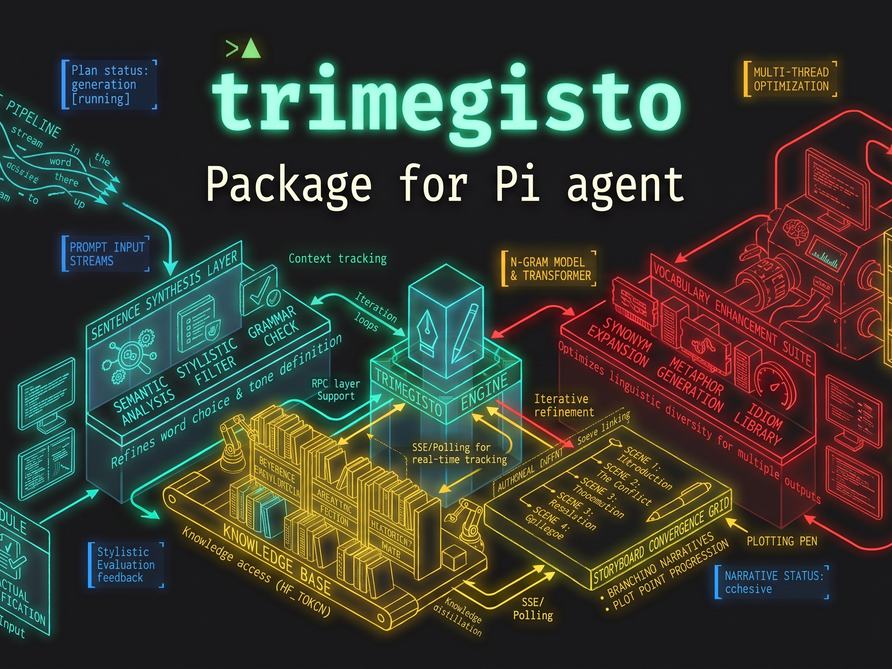
  "image": "https://raw.githubusercontent.com/noguerol/trimegisto/main/docs/preview.jpeg",
  "skills": [
    "./agents"
  ],
  "extensions": [
    "./src/index.ts"
  ]
}
Security note
Pi packages can execute code and influence agent behavior. Review the source before installing third-party packages.
README
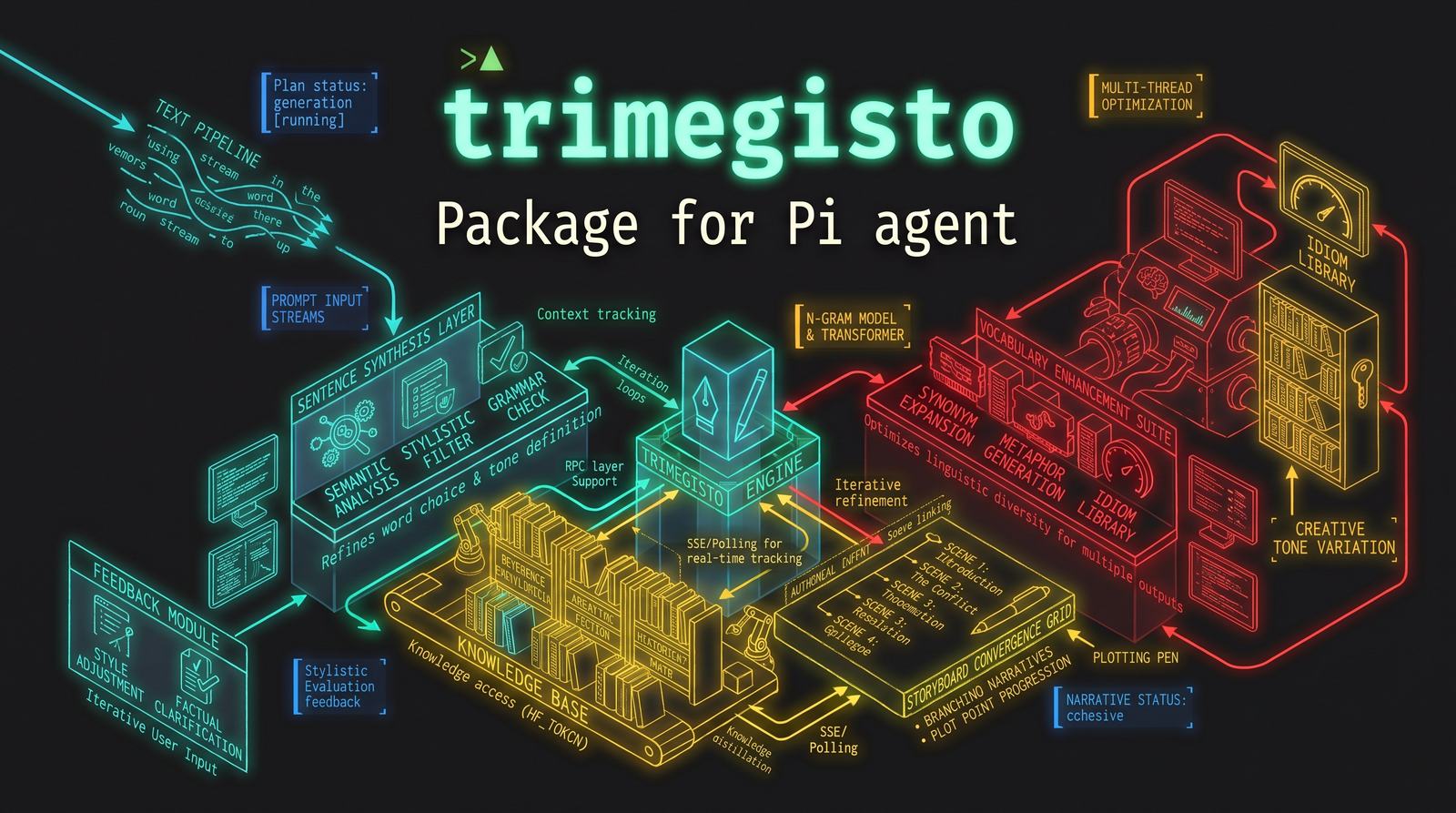
Trimegisto — Multi-Agent Orchestration for pi
Trimegisto turns pi into a multi-agent runtime. It launches parallel sub-agent processes organized in four tiers, lets you (or the main LLM) delegate work to them, and keeps the whole swarm under control with a loop supervisor, advisory file locks, a context broker and a live dashboard — without ever replacing pi's native UI.
Every sub-agent is a real pi process (pi -p --mode json), so agents run in complete isolation with their own context window, tools and model.
Tiers
| Tier | Role | Model | Max Parallel | Compaction | Agent IDs |
|---|---|---|---|---|---|
| active (t0) | Default worker. Runs the same model as your main session — mass-parallel by default. | the pi active model | 4 | 85% | t0a, t0b... |
| t1 | Deep thinking / planning. RESERVED for expensive models. | configured | 1 | 65% | t1a, t1b... |
| t2 | Complex problem solver (reasoning above the active model's reach). | configured | 4 | 75% | t2a, t2b... |
| t3 | Fast, cheap worker for mechanical tasks (parsing, formatting, translation, file ops). | configured | 4 | 85% | t3a, t3b... |
- The active tier is always available (it uses the model pi is currently running, captured live — even if you switch models mid-session with
/model). - t1/t2/t3 are only available once you give each tier a model via
/tmg config(or a config file / agent file). Unavailable tiers are reported to the LLM so it never tries to spawn them. - Agent IDs:
t+ tier number + instance letter (t0a,t2b,t3c...).
Install
Trimegisto is a pi package: one extension (src/index.ts) plus three tier skills (agents/), declared in package.json.
# From GitHub (recommended)
pi install git:github.com/noguerol/trimegisto

# Pin a tag/commit (refs are never moved by `pi update`)
pi install git:github.com/noguerol/trimegisto@v1.0.0

# Local checkout (development)
pi install /path/to/trimegisto

# Try it for one run only, without installing
pi -e git:github.com/noguerol/trimegisto
pi list                     # show installed packages
pi remove git:github.com/noguerol/trimegisto
pi update --extensions      # reconcile pinned git refs
Security: pi packages run with full system access — extensions execute arbitrary code and spawn processes. Install only packages you trust and review.
Requirements: a working pi installation and at least one usable model. Sub-agents inherit your providers/API keys; local servers (ollama, vLLM, LM Studio, llama.cpp, ...) work fine if configured as pi providers.
Quick Start
# Open the interactive config (pick a model for each tier, tune limits)
/tmg config

# Launch agents from the prompt
/t0 analyze the CSVs in ./data and summarize the columns
/t2b fix the failing test in src/parser.ts
@t3c translate the docs to Spanish

# Or just ask normally — when enabled, the main LLM is instructed to
# spawn first for any decomposable/parallelizable request.
"Review the diff, run the relevant tests, and summarize risks."

# Inspect & control
/tmg list
/tmg dashboard
/tmg halt            # or Ctrl+Alt+H
/tmg config          # ...
Results are harvested into the chat as each agent finishes, with per-agent logs, token/cost usage and a ✓ n/m done summary. The main agent is explicitly instructed not to sleep/poll waiting for workers; it can call trimegisto_harvest for an instant non-blocking snapshot instead.
Live throughput in the dashboard
While agents run, the dashboard shows continuous prefill and generation speeds for every target (each sub-agent plus the main session), updating ~every 500 ms without any input from you:
🧙 Tmg:on 3 active ↓246.7t/s ↑1890t/s T2 2r T3 1r · ⌁ main ↓38.1t/s
↓NNNt/s— decode/generation (summed across agents), live while streaming↑NNNt/s— prefill/prompt-processing throughput (averaged), only when the prompt is big enough that compute dominates the round trip↑817ms— a small prompt: time-to-first-token is shown instead of a fake throughput (TTFT includes network latency)↑…2.1s— the model is still chewing on the prompt, nothing generated yet⌁ main— the main session's own speed, while it answers in between agent results
The values are measured from the token stream itself (provider-agnostic), calibrated per model from real usage, and smoothed with an EMA so bursts don't flicker.
Usage
The trimegisto tool (LLM-facing)
When Trimegisto is enabled, a hidden orchestration directive is injected before each main-agent turn: decomposable work must be delegated first, and the main agent should keep coordination/synthesis. The main model can delegate work in a single non-blocking call:
{
  "tasks": [
    { "tier": "active", "task": "parse logs.csv and count rows" },
    { "tier": "active", "task": "extract the 10 most common error codes" },
    { "tier": "t2",     "task": "analyze the extracted codes and find root causes" }
  ],
  "cwd": "/path/to/work"
}
tierdefaults toactive; max 8 tasks per call (per-tier capacity =maxParallel, higher with redundant model pools).- The tool returns immediately; agents run in the background and results are harvested into chat as they complete.
- The tool description always lists which tiers are ENABLED right now — the LLM only spawns those.
trimegisto_harvestreturns the current agent snapshot immediately. It never waits; use it instead of sleep/poll loops.
Slash commands (user-facing)
| Command | Description |
|---|---|
/t0 <task> /t1 <task> /t2 <task> /t3 <task> |
Spawn a new agent of the tier |
/t2b <instruction> |
Steer an existing agent (kill + relaunch with combined context); spawns one with that ID if it doesn't exist |
@t2b <instruction> |
Same, @-mention syntax (intercepted before the LLM sees it) |
/tmg launch <tier> <task> |
Launch an agent (verbose) |
/tmg tell <agent-id> <msg> |
Send an instruction to a running agent |
/tmg kill <id> |
Kill one agent |
/tmg halt |
Halt all agents (shortcut: Ctrl+Alt+H) |
/tmg list |
List all agents, status, elapsed, task |
/tmg switch <id> |
Show an agent's output |
/tmg dashboard |
Cycle dashboard mode (compact → widget → off) |
/tmg enable / /tmg disable |
Toggle Trimegisto globally |
/tmg locks |
Show active file locks |
/tmg loops |
Show Loop Supervisor state (strikes, cooldowns, alerts) |
/tmg loops sensitivity <0.5..1> |
Tune similarity threshold at runtime |
/tmg reset-loops [active|t1|t2|t3] |
Reset loop strikes for a tier (or all) |
/tmg config |
Interactive configuration (models, limits, flags) |
Steering
Because each agent is a separate process, "steering" means replacing: Trimegisto kills the agent and relaunches a new one (same ID, same tier) with the previous task + your new instruction combined. If the tier is on cooldown after 3 loop strikes, the respawned agent also receives a "context shock" message forcing a different strategy.
Configuration
/tmg config (interactive)
Menu → per-tier submenu:
- Model — scrollable picker over your pi model registry (
provider/model) - Max Parallel — 1–8 concurrent agents per tier (× pool size when redundant agents are on)
- Compaction Threshold —
off (pi default)or 50–95% of context window for forced proactive compaction. Off (default) leaves compaction to pi's native setting. - Redundant models (t1/t2) — pool for load-balancing + automatic failover
- Enabled — toggle the tier
Changing any setting keeps you in the same menu, so you can flip several options in one session; Back/Esc goes up one level and Done closes.
Global flags in the main menu:
| Flag | Default | Effect |
|---|---|---|
enabled |
true |
Master switch for the whole extension |
autoSpawn |
true |
Enables proactive delegation guidance and lets sub-agents spawn other agents (trimegisto_spawn) |
useActiveModel |
true |
active tier agents use the pi active model (OFF → pi default model) |
spawnOnlyOnActive |
false |
Force all spawns onto the active tier (t0); t1/t2/t3 never spawn |
redundantAgents |
false |
t1/t2 spawn on the least-loaded model of their pool and fail over on provider errors/exhaustion/timeouts |
dedupeTasks |
true |
Reject near-duplicate tasks before launch (exact + word-set similarity, 5 min window) |
dedupeCrossAgent |
false |
Flag near-identical outputs from different agents and report wasted tokens |
dashboard |
compact |
UI mode: compact / widget / off |
Config file
Settings persist in ~/.pi/agent/trimegisto/config.json — created automatically on first save and surviving /new, /resume, /fork. Edit it by hand anytime (a ready-to-adapt template lives in config.example.json in this repo). A session entry is also written as a fallback via pi.appendEntry().
Tier agent files (optional)
Each tier can be customized with a markdown agent file, discovered from your user or project agent directories:
---
name: trimegisto-t3
description: My custom T3 worker
tools: read,bash,edit,write,grep,find,ls,trimegisto_spawn
model: openrouter/google/gemini-flash-1.5
---
Your custom system prompt for this tier...
~/.pi/agent/agents/trimegisto-{active,t1,t2,t3}.md— user scope.pi/agents/trimegisto-{active,t1,t2,t3}.md— project scope (walks up from cwd)
Precedence: saved config > agent file > built-in defaults (per field: model, tools, systemPrompt, maxParallel, compactionThreshold, enabled).
Loop Supervisor
Deterministic loop detection in the main process (no prompt changes):
| Mechanism | Detects | Default |
|---|---|---|
| Output Similarity | Same agent repeating near-identical output 3× consecutively (shingle Jaccard ≥ 0.92, whole output + progress tail) | 3 repeats, threshold 0.92, min 80 chars |
| Error Pattern | Same agent repeating the same normalized error 3× consecutively | 3 repeats |
| Cross-agent duplicate | Two different agents producing near-identical output (redundant parallel work) | opt-in via dedupeCrossAgent, sim ≥ 0.92 |
| Spawn Depth | Circular auto-spawn chains | 5 levels |
| Turn Limit (soft) | Agent exceeds maxAgentTurns → warning only, not killed |
50 turns |
| Turn Limit (hard) | soft + turnLimitGrace → kill the agent |
65 turns |
Repetition is tracked per agent, never per tier: different agents working on the same material (same contract, same codebase) can never trigger a false loop. With dedupeCrossAgent ON, the supervisor also compares outputs across different agents in the same tier and flags near-identical results as redundant work (a ♻ alert + wasted-token metric), without inflating loop strikes.
On detection, a 3-strike escalation applies:
- Strike 1 — chat alert
- Strike 2 — context shock: prune last turns + inject a "do a different approach" message on respawn
- Strike 3 — tier cooldown for 60 s (no spawns from that tier)
Inspect with /tmg loops, tune with /tmg loops sensitivity <0.5..1> (higher = fewer false positives), clear with /tmg reset-loops.
How It Works
┌────────────────────────────────────────────────────────┐
│                     pi (main)                          │
│  ┌──────────────────────────────────────────────────┐  │
│  │            Trimegisto Extension                  │  │
│  │  commands (/tmg, /t0..t3, @)   trimegisto tool   │  │
│  │  dashboard + status line        config manager   │  │
│  │  ┌────────────────────────────────────────────┐  │  │
│  │  │            Agent Manager                   │  │  │
│  │  │  t0 x4  t1 x1  t2 x4  t3 x4  (per-model   │  │  │
│  │  │  pools, failover, loop-supervised)        │  │  │
│  │  └────────────────────────────────────────────┘  │  │
│  │  Loop Supervisor · File Locks · Context Broker   │  │
│  └──────────────────────────────────────────────────┘  │
└───────────────▲────────────────────────────────────────┘
                │ file-based IPC (requests/ + responses/)
                │ per-instance isolation dir
┌───────────────┴────────────────────────────────────────┐
│  sub-agent = pi -p --mode json --no-session            │
│    --model <tier model> --tools <tier tools>           │
│    --extension subagent-extension.ts                   │
│    tools: trimegisto_spawn (batch, non-blocking),      │
│           file_lock, file_unlock, file_read_track,     │
│           trimegisto_note                              │
└────────────────────────────────────────────────────────┘
- IPC — sub-agents write spawn requests as JSON files; the main extension polls (500 ms), launches, and writes response files. All communication lives under a per-instance directory (
~/.pi/agent/trimegisto/instances/pid-<pid>-<ts>/), so multiple pi processes running Trimegisto at the same time never interfere. - Auto-spawn — with
autoSpawnon, the main agent receives a strong hidden policy to spawn first for decomposable work, then continue without idle sleeps. Sub-agents can spawn more agents viatrimegisto_spawn(batch mode preferred:{tasks: [...]}runs everything in parallel). Spawning is non-blocking (async polling, no frozen process) and depth/cooldown-limited by the supervisor. - Task deduplication — before any launch, the task is fingerprinted and compared (exact + word-set similarity) against tasks spawned in the last 5 minutes. Near-duplicates are skipped with a
⏭note so the swarm never pays twice for the same work. Disable withdedupeTasks: false. - Shared context — each new agent receives a compact preamble of files already read and facts already published (via
trimegisto_note) by other agents, so it avoids redundant re-reading and re-derivation. - File locks — advisory, 60 s stale timeout. Agents call
file_lockbefore write/edit andfile_unlockafter; conflicts return the lock owner so agents can wait or move on. Locks are released automatically when an agent finishes, is killed or halted. Inspect with/tmg locks. - Context broker — when an agent modifies a file, other agents that previously read it (via
file_read_track) get a compact system alert: "⚠️ Stale file:x.tschanged byt3a— re-read before editing." - Proactive compaction — opt-in. Trimegisto can watch the main session's context usage and force pi compaction when it crosses the lowest enabled tier threshold (60 s cooldown). By default all thresholds are 0 (off), so pi's native compaction setting decides and we never force an early compaction; set a per-tier 50–95% via
/tmg configto re-enable it. Pre-v3 configs that still hold the old built-in defaults (85/65/75/85) are migrated to off automatically. - Watchdogs & failover — every worker has bounded first-response and idle-progress watchdogs (defaults: 90 s / 120 s). The wall-clock max-runtime watchdog is disabled by default (
maxRuntimeSeconds: 0), so an agent that keeps making progress may run for as long as it needs. All three are configurable in seconds via/tmg config → Watchdogs(0 = off) and persisted in~/.pi/agent/trimegisto/config.json. Precedence: saved config >TRIMEGISTO_FIRST_RESPONSE_TIMEOUT_MS/TRIMEGISTO_AGENT_IDLE_TIMEOUT_MS/TRIMEGISTO_AGENT_MAX_RUNTIME_MSenv vars > built-in defaults. Values are clamped to a safe range so an oversized number can never overflow the timer. A stuck sub-agent is killed and harvested instead of blocking orchestration forever. WithredundantAgentson, provider failures/no first response can fail over to the next model in the pool.
Data layout
~/.pi/agent/trimegisto/
├── config.json          # persisted settings (auto-created)
├── instances/
│   └── pid-12345-1719.../   # one dir per running pi instance
│       ├── requests/        # sub-agent spawn requests
│       ├── responses/       # spawn results
│       ├── locks/           # advisory file locks
│       └── notifications/   # context-invalidation events
└── (locks/, notifications/ at the top level for legacy single-instance runs)
Orphan instance directories from dead pi processes are cleaned up on every start.
The Three Tier Skills
The package ships compact agents/t1.md, t2.md, t3.md skills. They teach each tier's role, cost discipline ("T1 plans, T2 solves, T3 executes") and batch-spawn etiquette without adding long prompt payloads.
Load Footprint
The extension keeps startup lean: src/index.ts registers public commands/tools immediately, while command handlers, the dashboard renderer and /tmg config UI are lazy-loaded on first use. Runtime strings and tier skill prompts are intentionally compact; keep long explanations in this README, not in loaded prompt/tool metadata.
Package Structure
trimegisto/
├── package.json            # pi manifest: 1 extension + 3 skills, peer deps on pi core
├── config.example.json     # template for ~/.pi/agent/trimegisto/config.json
├── src/
│   ├── index.ts                # startup shell: tool, lifecycle, lazy command/UI hooks
│   ├── agent-manager.ts        # spawn/track/kill, model pools, failover
│   ├── subagent-extension.ts   # injected into every sub-agent process
│   ├── loop-supervisor.ts      # loop detection, strikes, cooldowns
│   ├── file-lock.ts            # advisory file locking
│   ├── context-broker.ts       # cross-agent file-change notifications
│   ├── ipc.ts                  # file-based request/response IPC
│   ├── config.ts               # tier config + agent-file discovery
│   ├── speed.ts                # prefill/decode telemetry (token stream, provider-agnostic)
│   ├── dashboard.ts            # lazy TUI widgets: live ↑prefill / ↓decode speeds
│   ├── commands.ts             # lazy /tmg*, /t0..t3, @mention, shortcut handlers
│   ├── config-ui.ts            # lazy /tmg config UI
│   └── types.ts
├── agents/
│   ├── t1.md  t2.md  t3.md     # tier skills
├── test-loop.ts                # loop-supervisor unit tests
└── test-speed.ts               # speed-tracker unit tests
Development
git clone https://github.com/noguerol/trimegisto
cd trimegisto
pi install .                 # local-path install
node --experimental-strip-types test-loop.ts    # loop-supervisor tests
node --experimental-strip-types test-speed.ts   # speed-tracker tests
License
MIT — © Javier Noguerol