ultra-fabric
A resilient, adaptive orchestration runtime for Pi
Package details
Install ultra-fabric from npm and Pi will load the resources declared by the package manifest.
$ pi install npm:ultra-fabric- Package
ultra-fabric- Version
0.31.1-ultra.6- Published
- Aug 6, 2026
- Downloads
- 1,275/mo · 1,275/wk
- Author
- ryanjoserbrosas
- License
- MIT
- Types
- extension, skill
- Size
- 5.6 MB
- Dependencies
- 9 dependencies · 3 peers
Pi manifest JSON
{
  "image": "https://raw.githubusercontent.com/monotykamary/pi-fabric/main/media/cover.jpg",
  "skills": [
    "./skills"
  ],
  "extensions": [
    "./dist/index.js"
  ]
}
Security note
Pi packages can execute code and influence agent behavior. Review the source before installing third-party packages.
README
⚙️ Ultra Fabric
A Pi extension that turns many tool calls into one type-checked program.



Status: experimental fork of monotykamary/pi-fabric, based on upstream 0.31.1. See the architecture and the fork-boundary ADR.
You talk to Pi the way you always do. Fabric adds one tool, fabric_exec, that the model uses to combine reads, edits, MCP servers, agents, and coordination into a single TypeScript program. The program is type-checked, runs in a sandbox, and only its result comes back to the conversation. Branching, loops, and fan-out become code instead of a stack of tool calls you watch one by one.
Why?
Without Fabric, the model makes one tool call per step and waits. With fabric_exec, it writes one program that reads in parallel, branches on the results, fans out to agents, and loops. Type-checking catches shape errors before the program runs.
| What it gives you | |
|---|---|
| ⚡ | One tool schema; branching, loops, and fan-out as checked TypeScript |
| 🧰 | Pi tools, MCP servers, extension tools, and Fabric providers through one runtime |
| 🧠 | Context offload through read-only workers that return validated evidence |
| 🕸️ | Phased workflows plus durable shared topics and state |
| 🛡️ | Approvals, isolation, language-aware quality gates, timeouts, and cost budgets |
| 🎚️ | A live activity panel and dashboard inside the Pi TUI |
How it works
- You ask in plain language.
- Pi writes one program that calls the tools, agents, and MCP servers it needs. The program is type-checked before it runs.
- Only the result returns to your conversation. Intermediate work stays in the sandbox and shows in the activity panel.
The model writes something like this, you do not:
const [manifest, sources] = await Promise.all([
  pi.read({ path: "package.json" }),
  pi.find({ pattern: "**/*.ts", path: "src" }),
]);
return {
  package: JSON.parse(manifest).name,
  sourceCount: sources.split("\n").filter(Boolean).length,
};
Independent calls run in parallel; only the returned object enters the model context.
Code map
Fabric reads code structurally instead of scanning it as text. ast-grep parses each source file into an outline of symbols, signatures, and line numbers, and Fabric turns those outlines into a graph the model can walk.
Measured on this repository with ast-grep 0.45.0:
| Source | Size |
|---|---|
| 223 TypeScript files, raw | 2,493,559 chars |
| The same tree as an ast-grep outline | 223,667 chars |
| Compression | 11.1x |
Reproduce:
cat $(find src -name '*.ts') | wc -c
ast-grep outline $(find src -name '*.ts') | wc -c
The whole outline is roughly 56K tokens. That fits a modern context window but spends most of it on code the task never touches, so the codemap provider discloses the map in stages. Every operation takes an explicit maxTokens budget and reports whether it truncated.
| Operation | What it returns |
|---|---|
skeleton |
The minimal compressed map to start from |
search |
A query routed to the symbol and literal index |
expand |
The dependency neighborhood around named entities, upstream or downstream |
cascade |
Files or symbols that have historically changed together with a seed |
cascade blends git history with the dependency graph, so it answers which files a change will drag along rather than which files contain a string. That is the part text search cannot do.
The graph is built once per root and cached on file mtime, so repeated calls within a turn stay cheap. Language coverage comes from ast-grep, so TypeScript, JavaScript, Go, Python, Rust, and Java all index through one path. @ast-grep/cli ships as a declared dependency, so there is nothing to install separately.
DeepSWE smoke comparison
A matched Pier benchmark recorded on 2026-08-03 compared the published packages on the scc-bounded-memory-spilling DeepSWE task. Both arms used Pi 0.83.0, openai-codex/gpt-5.6-sol at low thinking, the same Docker task image and verifier, and three serial attempts.
| Package | Full solves | Mean partial score | Median agent wall time | Total model cost |
|---|---|---|---|---|
pi-fabric@0.25.6 |
0/3 | 0.9748 | 320.9s | $2.79 |
ultra-fabric@0.31.1-ultra.1 |
2/3 | 0.9947 | 398.1s | $2.90 |
The binary verifier awards a full solve only when all 31 task-specific fail-to-pass tests and all 286 pass-to-pass regression tests pass. The reference arm preserved all regression tests but missed task-specific edge cases in every attempt. Ultra passed all 31 task-specific tests in every attempt and produced two fully correct patches. All six trials completed without infrastructure errors.
This is a one-task smoke comparison with three stochastic attempts across different package versions, so it neither proves broad superiority nor isolates Ultra-native behavior from upstream evolution. See the benchmark harness and reproduction notes.
Prewalk handoff
Prewalk lets a frontier model plan and take the first concrete implementation step, then hands the same session to a faster executor. The switch is in-session: the executor inherits the live conversation and the real tool set, so no plan has to be re-serialised into a fresh context. One path, no modes.
Three isolated clean-room runs on 2026-08-04, each a fresh pi -p session in an empty workspace with --session-dir, planner claude-bridge/claude-opus-5, executor makora/zai-org/GLM-5.2-NVFP4, and the standalone pi-prewalk extension uninstalled so attribution is unambiguous.
| Task | Trigger | Plan | Execute | Planner median | Executor median | model_change |
|---|---|---|---|---|---|---|
slugify |
pi.edit |
153s | 48s | 149.9 tok/s | 300.0 tok/s | 3 |
truncate |
pi.write |
106s | 84s | 132.0 tok/s | 285.5 tok/s | 3 |
clamp |
pi.edit |
81s | 77s | 120.9 tok/s | 204.7 tok/s | 3 |
Every run recorded exactly three model_change entries, planner, executor, planner, proving both the switch and the restore. The executor produced 45,682 of the 68,442 total output tokens (67%) across 12 of 33 requests, at roughly 2.2x the planner median generation rate.
Cost
Measured tokens across the same three runs:
| Model | Requests | Input | Output | Cache read | Cache write |
|---|---|---|---|---|---|
claude-opus-5 |
21 | 42 | 22,760 | 319,049 | 63,157 |
GLM-5.2-NVFP4 |
12 | 87,151 | 45,682 | 187,456 | 0 |
Priced at published API rates. Opus 5 is $5 per 1M input and $25 per 1M output (Anthropic), with Anthropic standard cache ratios of 1.25x input for writes and 0.1x for reads. GLM-5.2 is $1.40 per 1M input, $0.26 per 1M cached input, and $4.40 per 1M output (Z.AI).
| Cost | |
|---|---|
| Planner (Opus 5) | $1.1235 |
| Executor (GLM-5.2) | $0.3718 |
| Actual total | $1.4952 |
| Same work all-Opus | $2.7950 |
| Saving | 46.5% |
The executor produced 67% of the output for 24.9% of the spend.
These are estimates at published rates, not billed amounts. The planner ran through an OAuth subscription bridge, so those tokens were not charged per request, and Z.AI list rates stand in for the actual GLM host. The all-Opus figure is a counterfactual that assumes identical token counts, which a different model would not reproduce exactly.
Compared to the previous Fabric prewalk
Fabric previously offered three prewalk modes. Only one switched the live session; the other two handed a copied transcript to an off-session child that had no workspace tools, so it could report success having changed nothing.
Previous in-place / trajectory |
Current single path | |
|---|---|---|
| Model switches observed | 0 across 2 arms | 3 per run, 3 of 3 runs |
| Executor tool calls | 0 | 12 requests, real edits |
| Restores Main afterwards | no | yes, by default |
No cost comparison is offered against the previous modes, because they did no work to price.
Compared to the Stencil write-up
The technique originates with Stencil Prewalk and the todo-gated handoff in oh-my-pi. Stencil reported 41% lower cost and 1.9x faster completion on SWE-Bench Pro; we estimate 46.5% lower cost and measure 2.2x generation throughput.
These are not the same measurements. Stencil ran a real task suite with a different model pair and reported end-to-end completion time and pass rate. Ours is a three-task shape check on trivial functions measuring generation rate, with cost derived from list prices rather than invoices, and no pass rate at all. The agreement in direction is worth noting; the numbers are not comparable, and Stencil figures are not inherited here. Paired task-level evidence remains the job of the 20-task contract corpus in certification and benchmarks.
Agents
An agent is either one-shot or persistent. Roles like scout, worker, advisor, and supervisor are profiles on that one runtime, not separate systems. List them with (await agents.roles()).roles, pick one with role, and override its goal, completion contract, or turn budget per call. Add your own in ~/.pi/agent/agents/*.md or trusted project profiles in .pi/agents/*.md.
The built-in supervisor is runtime behavior, not a skill: it subscribes to settled and error events, steers only when useful, coalesces repeats, and drops stale directives, with a four-turn activation bound. /skill:fabric-supervisor only creates or reuses that role for a concrete goal.
Installed Pi provider extensions and ~/.pi/agent/models.json are auto-detected for Pi-backed agents, settings, and tools.models(). Known Fabric providers take direct calls such as mcp.fal_ai.get_model_schema(...), memory.recall(...), state.get(), schema.status(), and compact.status(). Use tools.call({ ref, args }) for refs computed at runtime.
Install
Requires Node.js 24+ and Pi 0.80.6+. Fabric checks the host version at startup and warns when an older host may ignore continuation APIs.
npm prerelease
Pin an exact experimental version so it does not move:
pi install npm:ultra-fabric@0.31.1-ultra.1
If pi-fabric is installed, replace it rather than loading both:
pi remove npm:pi-fabric
pi install npm:ultra-fabric@0.31.1-ultra.1
Restart Pi after changing extension packages.
Git
pi install git:github.com/ryan-brosas/ultra-fabric
From a local checkout:
pnpm install
pnpm build
pi install /absolute/path/to/ultra-fabric
For one development run:
pi -e /absolute/path/to/ultra-fabric
What you can ask for
Advanced patterns are user-invoked and are not advertised for automatic selection. Run /skill:fabric-guide for a recommendation, or invoke the exact /skill:<name> yourself. An ordinary coding task keeps Pi on the core fabric-exec path.
| You want | Run |
|---|---|
| Help choosing the smallest advanced mechanism | /skill:fabric-guide Choose a mechanism to audit every auth file and verify the findings. |
| Parallel audits, migrations, or research with verification | /skill:fabric-workflow Audit every auth file and synthesize verified findings. |
| Work too big for one context window | /skill:fabric-rlm Produce a compact architecture map of this repo. |
| A persistent watcher for one measurable goal | /skill:fabric-supervisor Watch this migration until it is complete and tested. |
| A strict auditor for one feature design spec | /skill:fabric-spec Implement docs/specs/checkout.md to the tee; nothing missing, nothing extra. |
| A quiet decision-point reviewer | /skill:fabric-advisor Focus on migration correctness. |
| Same-model independent reviewers and one decision | /skill:fabric-council Review this design for correctness, security, and operability. |
| Multi-model compare-not-merge deliberation | /skill:fabric-fusion Deliberate this design across models. |
| One command that infers advisor versus supervisor | /skill:fabric-ambient advisor Focus on migration correctness. |
| A durable team coordinating through versioned tasks | /skill:fabric-swarm Coordinate this migration across owned task partitions. |
| Evidence-gated edits with postconditions | /skill:fabric-schema Make this parser change only if focused tests stay green. |
The fabric-exec reference skill loads before the first fabric_exec call and again when a call errors on argument shape.
The dashboard
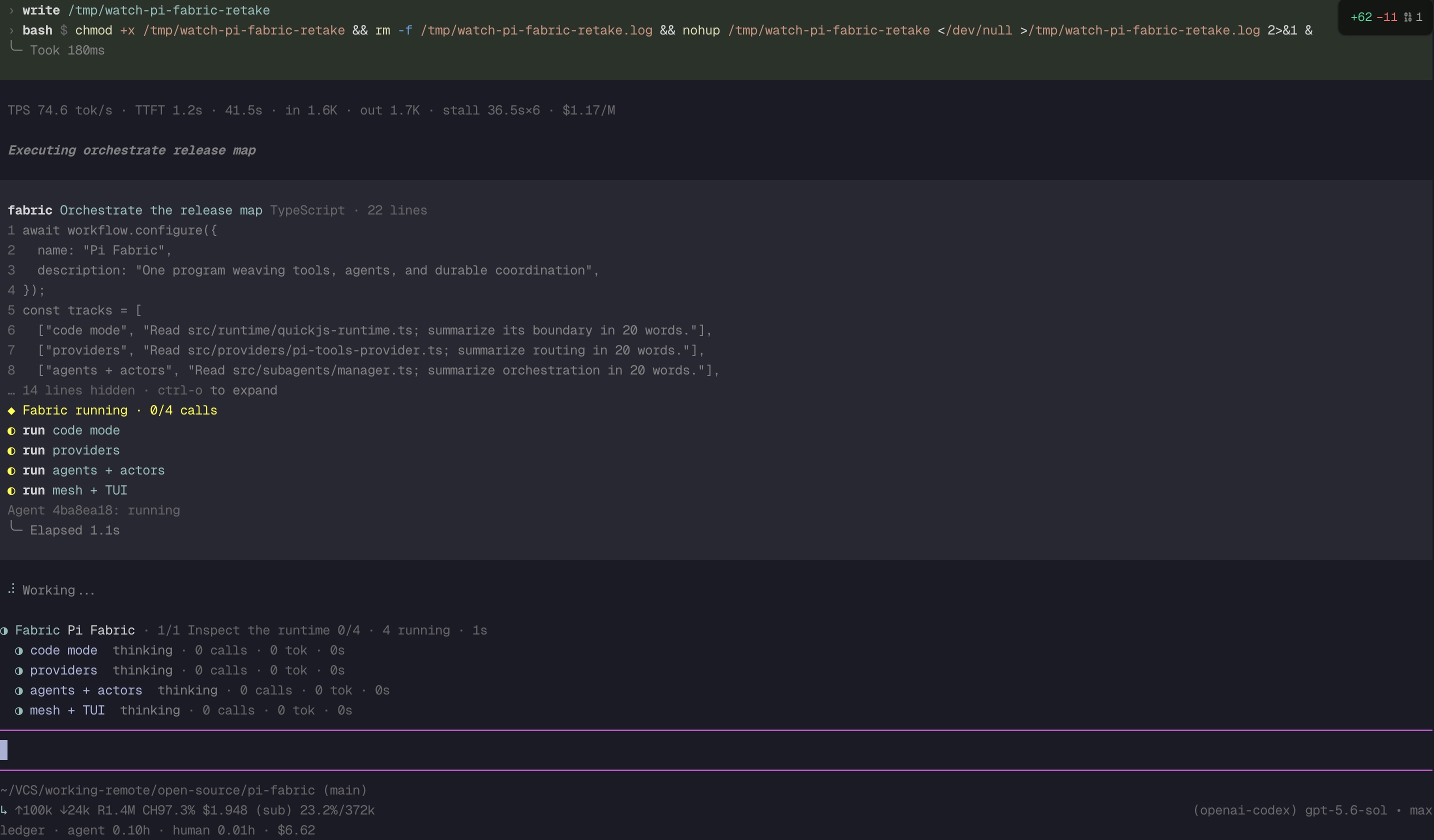
Fabric adds a live activity surface to Pi:
- A compact widget above the chat whose header follows the current phase and whose rows show active and completed agents with their recent tool or code-change activity.
/fabric(or/fabric dashboard) opens Activity and Topology views. The user-facing session is always Main. Queue or steer Main, one-shot and persistent agents, and mesh participants; navigate a unified topology of runs with paged transcripts, topics, state, and routes./fabric settingsmirrors Pi/settingsand writes tofabric.json.
See the interface & commands reference for every view, keybinding, and slash command.
Reference
- Ultra Fabric architecture — the power wheel, verified gaps, delivery slices, and acceptance criteria.
- Fork boundary — what stays upstream-shaped and what becomes Ultra-native.
- Configuration —
fabric.json, code modes, tool capture, approvals, and budgets. - Quality enforcement — trusted changed-file checks for programming languages, HTML, CSS, and custom formats.
- Code map research — measured compression baselines, aider's repomap algorithm, and the plan for AST-rank fusion.
- Certification and benchmarks — offline certification, the 20-task Prewalk contract corpus, bounded evidence analysis, and opt-in real-model benchmarks.
- Interface & commands — dashboard, settings, keybindings, slash commands, and headless runs.
- Agents & mesh — Ultra Consult, agents, model handoff and
/fabric prewalk, the Claude runner, transports, steering, persistent agents, templates, councils, recursion, and coordination. - External providers — the versioned provider protocol for extensions.
- Architecture & security — the host bridge, sandboxing, tool-call robustness, and limitations.
- Skills — the core-first invocation policy and user-invoked advanced patterns.
Development
pnpm install
pnpm typecheck
pnpm test
pnpm build
The suite covers configuration, schema validation, language-aware quality enforcement, provider dispatch, tool interception and execution, QuickJS isolation, Pi built-in invocation, Ultra Consult admission and evidence, agents, Claude stream-JSON and model discovery, workflows, durable mesh state, persistent-agent mailboxes, and runner restoration. Claude fixtures never make a billable request.
License
MIT. Ultra Fabric retains the original pi-fabric copyright and license; see LICENSE and THIRD_PARTY_NOTICES.md.