@adamjen/pi-one-subagent-at-a-time
Enforces sequential subagent execution — prevents concurrent subagent spawns that cause model swapping overhead on single-GPU setups.
Package details
Install @adamjen/pi-one-subagent-at-a-time from npm and Pi will load the resources declared by the package manifest.
$ pi install npm:@adamjen/pi-one-subagent-at-a-time- Package
@adamjen/pi-one-subagent-at-a-time- Version
0.1.2- Published
- May 23, 2026
- Downloads
- 84/mo · 13/wk
- Author
- adamjen
- License
- MIT
- Types
- extension
- Size
- 1.6 MB
- Dependencies
- 0 dependencies · 0 peers
Pi manifest JSON
{
  "extensions": [
    "extensions/one-subagent-at-a-time.ts"
  ],
  "image": "https://raw.githubusercontent.com/adamjen/pi-one-subagent-at-a-time/master/screenshot.png"
}
Security note
Pi packages can execute code and influence agent behavior. Review the source before installing third-party packages.
README
@adamjen/pi-one-subagent-at-a-time
Enforces sequential subagent execution — prevents concurrent subagent spawns.
Why This Exists
This extension was born from a real hardware constraint.
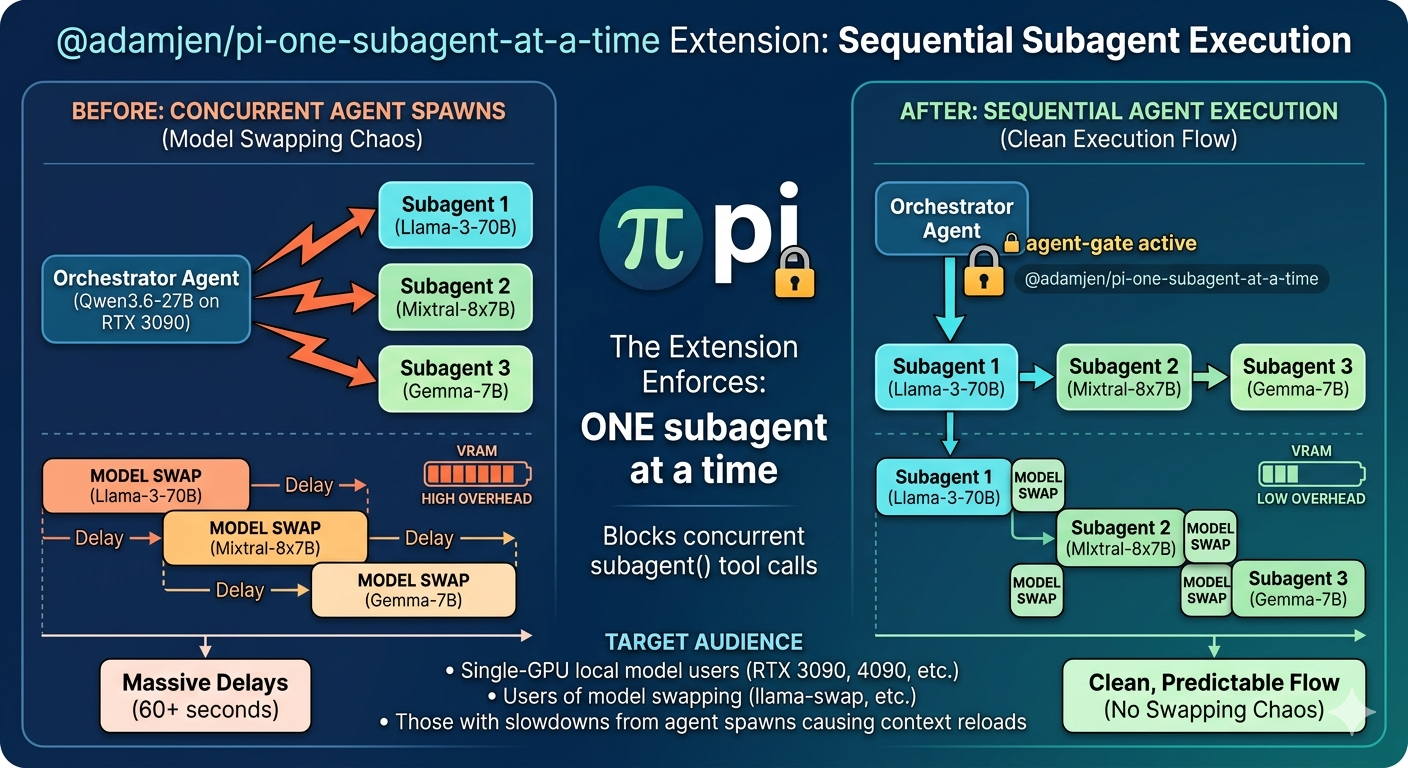
I'm running a Qwen3.6-27B orchestrator on an RTX 3090 (24GB VRAM) using llama-swap for model swapping between agents. The orchestrator would naturally want to spawn multiple subagents simultaneously — but each subagent spawn triggers a model swap, which means:
- Unload current model from VRAM
- Load new model into VRAM (takes seconds per swap)
- Reload full context (adds more overhead)
With 3-4 agents spawning concurrently, this meant constant swapping — models loading and unloading in rapid succession. The time overhead was massive: what should take 10 seconds of actual work would take 60+ seconds just waiting for model swaps to complete.
The solution? Force subagents to run one at a time. No concurrent spawns, no model swapping chaos, no unnecessary context reloads. Just clean sequential execution.
If you're running local models on a single-GPU setup and experiencing similar slowdowns from agent spawning, this extension solves that problem.
What It Does
Blocks concurrent subagent() tool calls. When one subagent is already running, subsequent spawn attempts are blocked with a clear message until the first completes.
Before: Orchestrator spawns 3 agents simultaneously → model swapping chaos → 60+ second delays
After: Agents run sequentially → no swapping overhead → clean execution flow
Install
pi install npm:@adamjen/pi-one-subagent-at-a-time
Or try without installing:
pi -e npm:@adamjen/pi-one-subagent-at-a-time
For local development:
pi install ~/projects/pi-one-subagent-at-a-time
How It Works
The extension hooks into three pi lifecycle events:
session_start— Shows status indicator ("🔒 agent-gate active")tool_call— Interceptssubagentcalls; blocks if one is already pendingagent_end— Decrements the pending counter when an agent finishes
// Simplified logic
let pending = 0;

pi.on("tool_call", async (event, ctx) => {
  if (event.toolName === "subagent") {
    if (pending >= 1) {
      return { block: true, reason: "BLOCKED: subagent already running. Wait for steer-back." };
    }
    pending++;
  }
});

pi.on("agent_end", async () => {
  if (pending > 0) pending--;
});
Target Audience
This extension is ideal for users who:
- Run local models on single-GPU hardware (RTX 3090, 4090, etc.)
- Use model swapping (llama-swap or similar) between agents
- Experience slowdowns from concurrent agent spawns causing context reloads
- Want predictable sequential execution rather than parallel chaos
If you have multiple GPUs or cloud models with no swap overhead, this extension is optional — but it still enforces cleaner execution patterns.
Configuration
No configuration needed — works out of the box with a hard limit of 1 concurrent subagent.
The status indicator shows in the pi TUI:
🔒 agent-gate active— extension loaded, no agents running🔒 1 running— one subagent is currently executing
Browse All Packages
pi.dev/packages/@adamjen/pi-one-subagent-at-a-time?name=adamjen — browse all my pi extensions.
License
MIT