@danypops/pi-web-spider
Pi extension for web_fetch, web_search, and live browser sessions: 7 search providers (Brave, Brave LLM Context, Tavily, Exa, Serper, SerpApi, You.com) with automatic fallback, robots.txt-respecting crawl, GitHub/Wikipedia/llms.txt-aware fetching, and a d
Package details
Install @danypops/pi-web-spider from npm and Pi will load the resources declared by the package manifest.
$ pi install npm:@danypops/pi-web-spider- Package
@danypops/pi-web-spider- Version
0.25.1- Published
- Aug 20, 2026
- Downloads
- 462/mo · 83/wk
- Author
- danypops
- License
- MIT
- Types
- extension
- Size
- 205.5 KB
- Dependencies
- 5 dependencies · 3 peers
Pi manifest JSON
{
  "extensions": [
    "./src/index.ts"
  ],
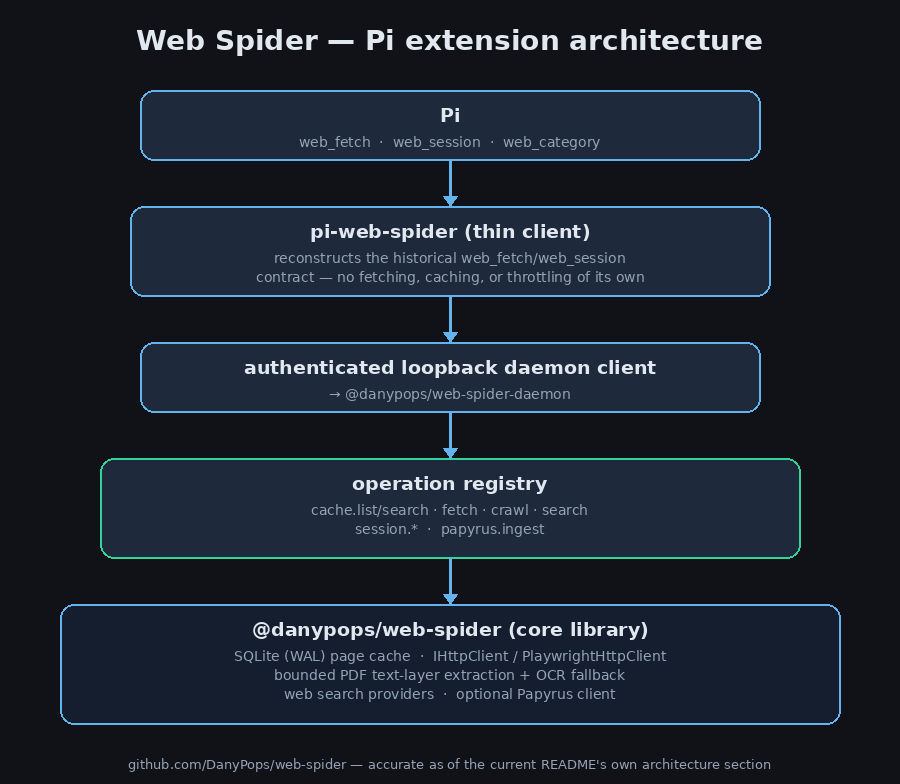
  "image": "https://raw.githubusercontent.com/DanyPops/web-spider/main/packages/pi-web-spider/assets/architecture.png"
}
Security note
Pi packages can execute code and influence agent behavior. Review the source before installing third-party packages.
README
@danypops/pi-web-spider


Web fetch, web search, and real browser sessions for Pi — an agent-ready alternative to raw HTML scraping.
Why Web Spider
- Zero-config search — works with no API key via a bounded keyless fallback (Firecrawl); configure any of 7 keyed providers (Brave, Brave LLM Context, Tavily, Exa, Serper, SerpApi, You.com) for higher limits, with automatic round-robin quota-spreading and fallback once you do.
- Honest PDF extraction — bounded text-layer extraction with an automatic OCR fallback for scanned or garbled pages. A page that genuinely can't be recovered reports
contentOk: false, never a false-success claim. - Real structured extraction, not scraping — GitHub (REST/GraphQL), MediaWiki (Wikipedia and any MediaWiki wiki),
llms.txt, and.md-suffix docs (AWS-docs-style) are queried through their actual APIs. - A disk-backed page cache that survives restarts — every fetch is cached to SQLite (WAL) and searchable by full text, domain, tag, curated category, or date range, at zero network cost on a hit.
- Real interactive browser sessions —
web_sessionfor pages a single fetch can't handle: type, click, select, wait on async results, read tables, screenshot, handle native dialogs, capture downloads, or open a headed browser so a human can complete CAPTCHA/login/consent before the agent resumes the same session. - A standalone resource finder, not just a summarizer —
web_quotesreturns ranked, verbatim quotes per URL with a copy-pasteable citation link, never an LLM-digested answer.
pi install npm:@danypops/pi-web-spiderQuick Start
// Fetch a page as clean markdown
web_fetch({ url: "https://example.com/docs/getting-started" })

// Crawl one hop of same-domain links
web_fetch({ url: "https://example.com", depth: 1 })

// Search the web instead of fetching a URL
web_fetch({ searchQuery: "readability extraction library comparison" })

// Query everything already cached, no network call
web_fetch({ query: "readability extraction", domain: "github.com" })

// Open an interactive browser session for a page that needs real input
web_session({ operation: "create", name: "research" })

// Deep research: find sources, then pull exact quotes from them
web_fetch({ searchQuery: "precision time protocol clock synchronization" })
web_quotes({ query: "clock synchronization accuracy", urls: ["https://example.com/ptp-overview"] })
See docs/web-fetch-api.md for the full parameter/output reference behind these examples.
Tools
web_fetch
Fetch a URL, crawl N hops deep, or search the web — one tool, three modes:
- Fetch:
url→ clean markdown, lean outline, link list, BM25F highlights, or a semantic tree. JSON/text is normalized, while PDFs get bounded text-layer extraction withpdfPageStart/pdfPageEnd(1-based, inclusive, maximum 50 pages). Empty/garbled pages get an automatic, bounded OCR fallback; a page it still can't recover reportscontentOk: falsehonestly rather than implying success. - Crawl:
url+depth→ BFS crawl same-domain links,robots.txt-respecting and per-domain throttled, with an explicit auditedignoreRobotsopt-out for a human-directed one-off. - Search:
searchQueryinstead ofurl→ real ranked results instead of a guessed slug. Routes across whichever of Brave, Brave LLM Context, Tavily, Exa, Serper, SerpApi, and You.com you've configured, round-robining for quota spread and falling back automatically on a rate limit or empty result. - Cache query: omit
urlentirely → full-text search or filter (domain, tag, curated category, date range) over every page already fetched, disk-backed, survives restarts, zero network cost.
Structured extraction beats generic scraping where a real API exists: GitHub (REST/GraphQL), MediaWiki (Wikipedia and any MediaWiki wiki), llms.txt, and .md-suffix docs (AWS-docs-style) are recognized and queried directly.
web_session
Persistent, named browser sessions for pages that need real interaction, not a single fetch: type into search boxes, select dropdowns, wait on async results, read a table. Supports navigate/click/hover/type/select/waitFor, structured extraction (queryText/readTable), accessibility-tree snapshots, screenshots, native dialog handling, file downloads, tab management, and console/network capture. Create with headed: true (and preferably forceChromeChannel: true for anti-bot-sensitive sites) to hand a visible browser to the user for CAPTCHA/login/consent, then resume agent actions on that same cookie-bearing session.
web_category
Your own curated relevance categories over cached pages (e.g. "Code", "PTP Protocol") — distinct from a page's domain or its publisher's own tags. A page can belong to more than one category; assign, remove, rename, or list.
web_quotes
A standalone resource finder: given a query and an explicit list of URLs (typically a prior web_fetch(searchQuery=...) call's own results), fetches each one and returns ranked, verbatim BM25F quotes per URL as resource cards — never an LLM-digested summary. Every quote carries a citationUrl, a real URL Text Fragment (#:~:text=...) that scrolls to and highlights the exact quoted passage in any modern browser. maxQuotesPerUrl/maxQuotesTotal bound the per-source and combined result; a URL that fails to fetch becomes its own { url, error } card instead of failing the whole batch.
Architecture
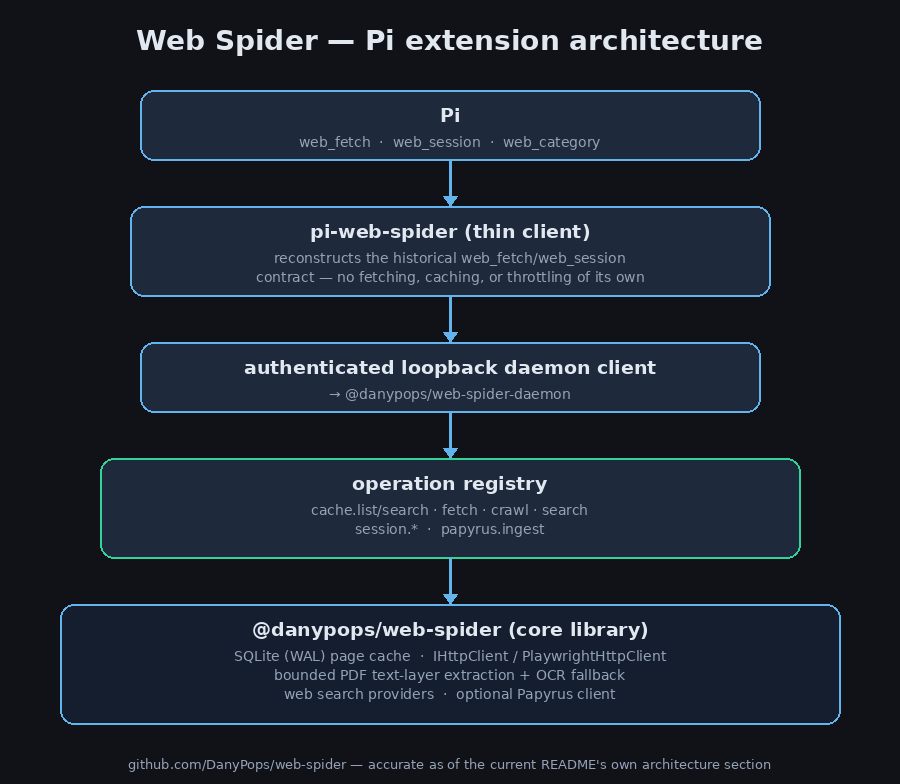
A supervised daemon (@danypops/web-spider-daemon) owns the SQLite page cache and every network fetch, crawl, throttle, and robots.txt check. This extension is a thin authenticated client — it never touches the network or a cache file directly, and auto-starts the daemon transparently on first use.
pi web_fetch / web_session / web_category / web_quotes
      ↓
this extension (thin client)
      ↓
authenticated loopback daemon → web-spider-daemon
      ↓
SQLite (WAL) cache · fetch/PDF/crawl/search execution · optional Papyrus ingestion
Configuring search
Search works without configuration through Firecrawl's bounded keyless fallback. For higher and more predictable limits, set a provider API key as an environment variable (BRAVE_SEARCH_API_KEY, TAVILY_API_KEY, EXA_API_KEY, SERPER_API_KEY, SERPAPI_API_KEY, YOU_API_KEY) or store it locally:
web-spider search-key set braveConfigured providers are tried before keyless Firecrawl; configuring more than one gets automatic round-robin quota spreading plus fallback — no code changes, just more keys.
Running as a service
The daemon auto-starts on first tool call. For persistence across reboots/logins (and to forward search keys into a systemd --user unit, which does not inherit the installing shell's environment):
web-spider service installLearn more
docs/web-fetch-api.md— fullweb_fetchparameter/output referencedocs/web-session-api.md— fullweb_sessionreferencepackages/web-spider-daemon/README.md— daemon architecture, CLI reference, service install
Security
This extension executes with full system access, like any Pi extension. Review the source before installing.