fv-skills-baif
Formal verification skills for Pi, Claude Code, Codex, OpenCode, and Antigravity. Rust -> Lean 4 via Aeneas.
Package details
Install fv-skills-baif from npm and Pi will load the resources declared by the package manifest.
$ pi install npm:fv-skills-baif- Package
fv-skills-baif- Version
2.3.11- Published
- Nov 3, 2026
- Downloads
- 1,090/mo · 599/wk
- Author
- a-dangelo
- License
- MIT
- Types
- skill
- Size
- 2.2 MB
- Dependencies
- 0 dependencies · 0 peers
Pi manifest JSON
{
  "skills": [
    "./pi/skills"
  ]
}
Security note
Pi packages can execute code and influence agent behavior. Review the source before installing third-party packages.
README
Formal Verification Skills
FVS helps AI coding assistants write Lean 4 specifications and proofs. The functional-correctness track verifies Rust translated by Aeneas. The paper track formalises mathematics and cryptography directly from papers. You choose the targets, review the statements and decide when proof work begins.

Getting started
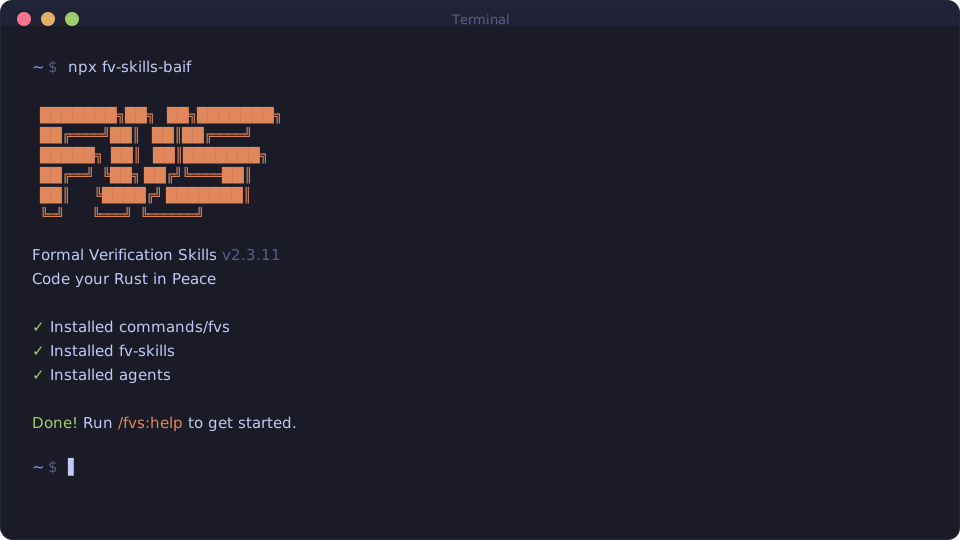
Run npx fv-skills-baif for an interactive installation, or select your runtime explicitly:
| Runtime | User/global install | Help after restarting the session |
|---|---|---|
| Pi | npx fv-skills-baif --pi --global |
/skill:fvs-help |
| Claude Code | npx fv-skills-baif --claude --global |
/fvs:help |
| Codex | npx fv-skills-baif --codex --global |
$fvs-help |
| Antigravity (agy) | npx fv-skills-baif --antigravity --global |
/fvs:help |
| OpenCode | npx fv-skills-baif --opencode --global |
/fvs-help |
Replace --global with --local to install for the current project. Non-Pi installs copy the
commands and support files into the runtime's configuration directory. Use
npx fv-skills-baif --help for custom directory options. Keep one FVS installation per runtime.
Antigravity gets a native agy plugin in ~/.gemini/config/plugins/fvs/ (or .agents/plugins/fvs/
in the project), loaded after restarting agy. --gemini was removed with the retired Gemini CLI;
installing or removing with --antigravity also clears an old FVS Gemini install.
Pi
The installer delegates to Pi's native package manager. You can also use it directly:
pi install npm:fv-skills-baif
pi install npm:fv-skills-baif --local
pi update npm:fv-skills-baif
Project packages require project trust and take precedence over the user installation.
The default latest source stays updateable. --pi-version X.Y.Z selects a chosen published version;
X.Y.Z is a metavariable. Exact pins are skipped by pi update; rollback means reinstalling a chosen
published pin. If FVS exists in the opposite scope, choose keep, move or cancel. Scripts must pass
--pi-conflict keep or --pi-conflict move. Pi owns its settings paths, so --config-dir does not
redirect them. See Pi package documentation.
Claude Code and Codex marketplace
Install from the BAIF catalog:
claude plugin marketplace add Beneficial-AI-Foundation/plugins
claude plugin install fvs@beneficial-ai-foundation
codex plugin marketplace add Beneficial-AI-Foundation/plugins
codex plugin add fvs@beneficial-ai-foundation
Claude's default is user scope; --scope project and --scope local select plugin scopes.
Codex has its own plugin interface; do not reuse Claude's scope flags. After restarting, use
/fvs:help in Claude or $fvs:help in Codex.
The Codex marketplace ships specialist prompts as Markdown without registering Codex agent roles. FVS warns when a requested role is missing. A settings-independent step may use a labelled generic agent with the full specialist prompt; its identity, sandbox, model and reasoning effort are not guaranteed. A settings-dependent step stops before dispatch or file writes. Registered roles also need their settings checked.
The npm installer supplies a complete, separately managed Codex installation with roles, hooks and configuration. To switch channels, remove the plugin first:
codex plugin remove fvs@beneficial-ai-foundation
npx fv-skills-baif --codex --global
Plugin updates, including $fvs:update, do not register roles or run the npm installer.
Before your first Lean task
Use a Lean project with lakefile.lean or lakefile.toml and its existing lean-toolchain pin.
For Rust verification, supply Aeneas-generated Types.lean and Funs.lean, or start with
/fvs:aeneas-extract. Papers need no Rust or Aeneas. NotebookLM integration via /fvs:kb-setup is optional.
We recommend lean-lsp-mcp for goal states and diagnostics. Configure it in your chosen runtime and check that the writing agent can access it; IDE diagnostics alone do not provide goal states. If live feedback is required but unavailable, the task stops. Compiler-only work needs your explicit acceptance of that fallback. Project build, style and trust checks still apply. Practical Lake builds explains targeted checks, import artifacts and caches without changing your project's toolchain or dependency pins.
FC dependency graphs use probe-aeneas.
/fvs:map-code and /fvs:fc-plan first check your project's probe/toolchain combination and print
readable setup diagnostics, so you never need to read the compatibility data yourself. If the
combination is not verified, they offer probe setup, continuing without a graph, or cancelling.
Verified mapping writes the function inventory and progress to .formalising/CODEMAP.md.
Unsupported platforms or unverified probe/toolchain combinations cannot produce a verified graph.
SPQR compatibility is not supported. Tools are not installed automatically, and runtime installation
alone does not establish tool access.
The optional verified probe workflow supports tested toolchain combinations on macOS arm64
and Linux x86_64. Linux requires native tools, an absolute Linux-only PATH, /usr/bin/xz,
and /usr/bin/bwrap with working unprivileged namespaces, --disable-userns, and seccomp.
FVS does not install these
prerequisites or change system security policy; unavailable confinement stops execution.
The receipt records preparation requirements and indexing/proof limitations. Native Windows
and Linux arm64 remain unsupported.
Linux extraction stages an independent project copy and keeps tool homes read-only.
Helper executable or library links through an intermediate symlink are rejected during resolution.
Malformed .git pointer files and symlinked .git entries are unsupported and rejected;
ordinary linked Git worktrees remain supported with read-only external Git metadata.
FVS asks for runtime, model and effort choices at each relevant stage. Requested settings,
resolved settings and observed settings are recorded separately; unavailable observations are stated
explicitly. Use /fvs:configure to save defaults. See model profiles
for selection rules and runtime limitations.
Workflows
Functional correctness
/fvs:natural-language → /fvs:lean-specify → automatic fresh /fvs:lean-spec-review
                                                   ↓ when you request proof work
                                             /fvs:lean-verify → repeat
Use /fvs:map-code to map dependencies and /fvs:fc-plan to choose targets in dependency order.
The FC prover works on its own within a wall-clock budget, checks its own builds and reports
VERIFIED only after a cheat audit. Finish with /fvs:lean-refactor and /fvs:trust-audit.
/fvs:model-external handles external Rust stubs with separate model and specification reviews,
reversible writes, proof completion and a trust audit.
Papers and crypto
/fvs:crypto-plan → automatic fresh /fvs:crypto-review → /fvs:crypto-execute
       ↑                                               (when you request it)
/fvs:crypto-followup ← /fvs:crypto-eval ←────────────────────┘
       └──────────── automatic fresh review before execution
/fvs:lean-formalise creates definitions and specification skeletons in one pass. For larger work,
the crypto loop uses a dedicated whole-unit executor. Evaluation returns ACCEPT, FOLLOWUP,
HUMAN_RULING or BLOCKED; unresolved human rulings and blockers stop the loop.
Opt-in /fvs:crypto-eval <topic> nN --fix-prose permits one qualified editorial correction in the
parent seat followed by one fresh normal eval of corrected files. This avoids a planning restart
for eligible prose findings; no measured speed improvement is claimed. Scientific meaning and formal content
stay fixed; unresolved or ambiguous findings retain semantic followup rather than acceptance.
Thinking stages can explicitly use --codex; execution has no such flag. An unavailable requested
runtime requires a new choice rather than a silent fallback.
Both tracks use a fresh read-only reviewer and immutable review evidence. The author owns triage
and accepted edits. Approval after edits requires the prescribed checks; revision rounds are bounded.
Skipped, disabled, failed or pending review does not approve a statement or start proof/execution.
You can opt out of automatic review and explicitly request trusted-path work while retaining its
unreviewed status. Review can also use Google's Argon through the Antigravity CLI (agy). An Argon
review sends the review packet (your sources and plans) to Google under your own agy account terms,
and on consumer accounts Google may use that content. See review policy,
FC statement review and
crypto plan review.
The learning store lives in .formalising/proof-engineering/. Commands read index.md first,
load at most eight relevant lessons from lessons/ (fc/, crypto/, shared/) as untrusted data,
and propose at most three evidence-backed updates. Fresh crypto review remains memory-blind.
Learning-store details.
Commands
The table uses Claude command notation. Use the help entry for your channel to find its spelling and arguments. Bundle routers list their members when invoked without arguments. Full command help.
| Bundle | Members |
|---|---|
/fvs:aeneas |
/fvs:aeneas-extract, /fvs:model-external, /fvs:sync-aeneas-verif |
/fvs:context |
/fvs:map-code |
/fvs:fc |
/fvs:fc-plan, /fvs:natural-language, /fvs:lean-specify, /fvs:lean-spec-review, /fvs:lean-verify, /fvs:lean-refactor, /fvs:model-external, /fvs:trust-audit |
/fvs:formalise |
/fvs:lean-formalise, /fvs:lean-refactor, /fvs:crypto-plan, /fvs:crypto-review, /fvs:crypto-execute, /fvs:crypto-eval, /fvs:crypto-followup, /fvs:protocol-prose |
/fvs:manage |
/fvs:help, /fvs:configure, /fvs:update, /fvs:reapply-patches, /fvs:kb-setup, /fvs:roadmap, /fvs:issues-setup, /fvs:to-issues, /fvs:ask-baif |
/fvs:ask-baif gives a concise evidence-backed goal/state/blocker brief and routes one next step.
It is optional before, within and between issue batches. Explicit or already-authorized requests
can reconcile or reserve existing tickets; new issues still require to-issues' exact batch consent.
Batch completion is distinct from whole-goal completion and proof acceptance.
/fvs:roadmap synthesizes existing context, clarifies lightly or deeply where needed, and confirms
shared intent. It reuses current owner-approved agreements without repeating settled questions;
semantic agreement, file edits and execution/publication authority remain separate.
/fvs:to-issues [path/ROADMAP.md] drafts reviewable outcomes with blockers and acceptance
evidence from a roadmap or the current conversation. It quizzes the decomposition, then previews
the full batch before local export or GitHub publication. The tracker comes from the roadmap's
override or project configuration; GitHub publication requires explicit consent for sanitized
content and relationships, with a retained log for safe retries.
Protocol exposition: /fvs:protocol-prose <file-or-topic> is an opt-in prose-only revision using
the source paper and target documentation conventions, with formal-content comparison and build
checks. Existing crypto authoring calls also receive the shared prose guidance; no extra model
call or review stage is added.
Updates and removal
Use your channel's FVS update command, or rerun the npm installer with fv-skills-baif@latest and
the same runtime/scope flags. /fvs:reapply-patches helps retain local customizations.
For marketplace updates:
claude plugin marketplace update beneficial-ai-foundation
claude plugin update fvs@beneficial-ai-foundation
codex plugin marketplace upgrade beneficial-ai-foundation
codex plugin add fvs@beneficial-ai-foundation
Remove an npm installation with the same runtime/scope and --uninstall, for example
npx fv-skills-baif --claude --local --uninstall. For Pi, use pi remove npm:fv-skills-baif
for the user installation or pi remove npm:fv-skills-baif --local for the project. Unified Pi removal
also supports npx fv-skills-baif --pi --global --uninstall (or --local). Remove a marketplace
installation with its host's plugin remove fvs@beneficial-ai-foundation command.
If you use the skills CLI, it reports each install to skills.sh: the CLI version, the public
repository, the skill names and their paths in it, and the target agents, plus, when they apply, a
global-install flag, the name of the AI agent running the CLI, a CI flag and any --metadata you
pass. skills.sh sees your IP address; no account, machine ID, local path or file contents are sent.
To opt out, set DISABLE_TELEMETRY=1 or DO_NOT_TRACK=1 before invoking it; opting out also turns
off the CLI's security-audit lookup, so retain independent source and integrity checks. See the
skills CLI FAQ and privacy policy.
The fvs-setup entry provides native installation guidance; copying it alone does not install the
full FVS workflows.
Credits and license
FVS adapts documentation and proof skills from Aeneas
(Apache 2.0; retained upstream documentation). Its distribution
architecture follows GSD Core. We also use
probe-aeneas and recommend
lean-lsp-mcp. The Lake reference credits its source talk.
Jin Xing Lim proposed independent crypto-plan review and its reviewer prompt.
The ordinary-Lean entry point, compiled-proof prerequisite, reuse/strategy focus and helper-locality
defaults draw on /lean4:refactor; sequence-packing hints draw on /lean4:golf, from
lean4-skills by Cameron Freer and the Lean 4 Theorem
Proving Skill Contributors (MIT, pinned commit
83582df9d9172456993929f32ac4dd9d99c6211c).
FVS newly writes the guidance rather than copying upstream text or code. Its refactor workflow
first agrees protected meaning and editable scope, then measures net LoC including helpers and
actual build/elaboration cost. Parent-only serial gates compare a pre-edit printed boundary; the comparison is not a kernel identity proof.
Unsupported printed coverage or metric syntax uses an explicit reviewed comparison, with compilation
and axiom checks retained. Broader scope or public-API changes need an explicit proposal.
MIT. See LICENSE.