pi-minimal-kanban
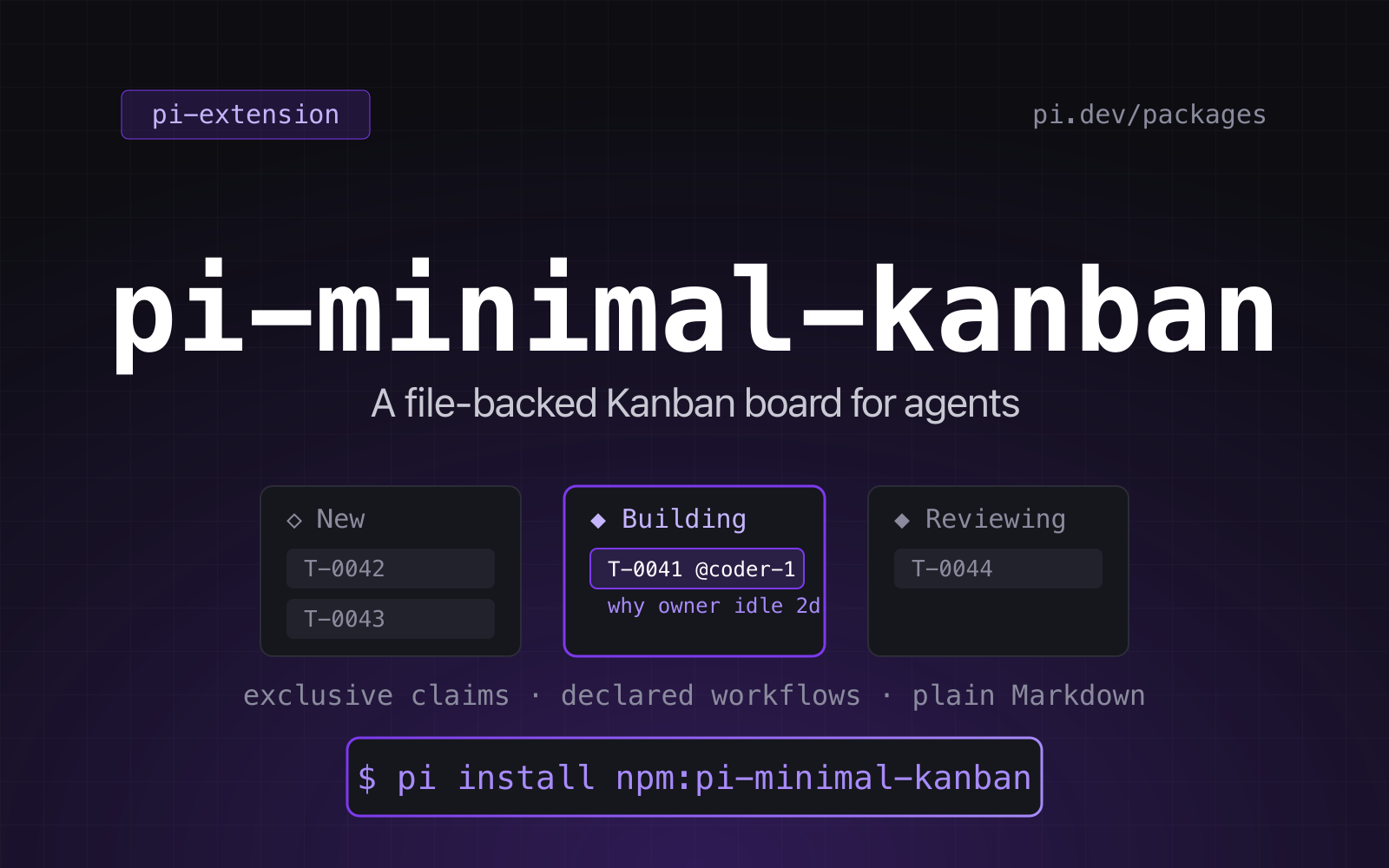
Minimal file-backed Kanban for Pi agents: project-specific workflows, exclusive task claims, and a /kanban board view.
Package details
Install pi-minimal-kanban from npm and Pi will load the resources declared by the package manifest.
$ pi install npm:pi-minimal-kanban- Package
pi-minimal-kanban- Version
0.5.0- Published
- Nov 1, 2026
- Downloads
- 683/mo · 683/wk
- Author
- tychenjiajun
- License
- MIT
- Types
- extension, skill, prompt
- Size
- 1 MB
- Dependencies
- 1 dependency · 2 peers
Pi manifest JSON
{
  "image": "https://raw.githubusercontent.com/tychenjiajun/pi-minimal-kanban/main/assets/preview.png",
  "video": "https://raw.githubusercontent.com/tychenjiajun/pi-minimal-kanban/main/assets/demo.mp4",
  "skills": [
    "./skills"
  ],
  "prompts": [
    "./prompts/*.md"
  ],
  "extensions": [
    "./src/index.ts"
  ]
}
Security note
Pi packages can execute code and influence agent behavior. Review the source before installing third-party packages.
README
pi-minimal-kanban
English | 简体中文
Pi extension that gives a whole team of agents one shared, file-backed Kanban board: project-declared workflows, exclusive task claims, and Markdown tasks you can diff and commit. No database, no server, no daemon.


# works today, straight from the repository
pi install git:github.com/tychenjiajun/pi-minimal-kanban
# once it is published to npm
pi install npm:pi-minimal-kanban
Several agents share one project's work without stepping on each other:
- Project-specific workflows. Each project declares its own statuses and
transitions in
.pi/kanban/workflow.yaml— fromnew → doneto a seven-stage pipeline. - Exclusive claims. A task has at most one assignee. Moving a task into an
activestatus claims it; another agent cannot move or release it withoutforce, and a forced takeover can carry thereasonthat makes it auditable. - Files only. No database, no server, no daemon. Tasks are Markdown files you can read, diff, and commit.
- Minimal UI. Five tools and one read-only
/kanbancommand that renders plain text.
Install
pi install git:github.com/tychenjiajun/pi-minimal-kanban
# or from the npm registry, once published:
pi install npm:pi-minimal-kanban
While developing, load it from a checkout:
pi --extension ./src/index.tsA running session keeps the code it loaded at start-up: after editing the
extension, /reload or restart before judging a change from the tools. Tests
and direct module calls always see the working tree.
Quick start
/kanban init # writes .pi/kanban/workflow.yamlThen, from an agent session:
Create a kanban task for "Add retry to the upload client" and move it to working.
The agent calls kanban_create and kanban_move, and the board looks like:
/Users/me/app/.pi/kanban

  ◇ new ────────────────────────────────────────────────────────────────── 0
    (empty)

  ◆ planning ───────────────────────────────────────────────────────────── 0
    (empty)

  ◆ working ────────────────────────────────────────────────────────────── 1
    T-0001  Add retry to the upload client                   @coder-1  rev 2

  ◆ reviewing ──────────────────────────────────────────────────────────── 0
    (empty)

  done ···························································· 0

  1 task · 1 open · 0 done · 1 claimed
Tools
| Tool | Purpose |
|---|---|
kanban_create |
Create a task in the workflow's initial status. |
kanban_move |
Move along a declared transition; entering an active status claims it. reason annotates a forced takeover. |
kanban_comment |
Append a Markdown comment. |
kanban_assign |
Set or clear the single assignee; assigning to any handle but your own needs force, and reason annotates a forced write. |
kanban_list |
List tasks (paged), read one task in full, print counts, or print the board briefing. |
Every tool takes an agent handle (except kanban_list) and returns
structuredContent for codemode scripts and other extensions. Mutations also
emit kanban:task_changed on pi.events with { project, board, taskId, action }.
A failure returns { ok: false, code, error, hint, root, dir }; code is a
stable string such as wrong_owner, stale, or no_workflow, and hint is an
actionable sentence. kanban_move takes an optional expectedRev: pass the
rev you last read to fail instead of overwriting another agent's write.
Listing and paging
kanban_list rows show id, status, title, @assignee, and rev, ordered
by workflow status then task id. To keep a large board cheap:
| Parameter | Default | Meaning |
|---|---|---|
limit |
50 (max 500) |
Maximum rows printed. |
offset |
0 |
Rows to skip after filtering and sorting. |
summary |
false |
Per-status counts instead of rows. |
briefing |
false |
The board briefing instead of rows; wins over every other parameter. |
An incomplete page says how many rows were omitted and which offset continues
it, and structuredContent carries total, offset, limit, returned, and
hasMore so a script can page without counting text lines. total is always
the post-filter count, including on a briefing, so briefing: true on a large
board never looks empty. The workflow block is
always printed, and its size follows the workflow rather than the board.
On a board with no tasks, the list is the briefing: the claim rules, the self-asserted handle convention, and the first calls to make. A task file that cannot be read is not an empty board: the briefing then prints the warning and the file it could not read.
The /kanban command
/kanban                     the board
/kanban T-0007              one task in full
/kanban --all               expand terminal columns
/kanban --json              machine-readable board
/kanban init                create .pi/kanban/workflow.yaml
/kanban validate            check the workflow and task claims
/kanban validate --stale 12h  warn about claims older than 12h
/kanban status <id>         only tasks in one status
/kanban mine <handle>       only tasks assigned to a handle
Rendering is plain text in the transcript — scrollable and copyable, and it works
in headless and RPC modes. Every subcommand reads. No /kanban form writes to
the board: mutations belong to the five tools, so the command is always safe to
run in a review, a demo, or a read-only session. Clearing a claim, for example,
is kanban_assign {task: "T-0003", assignee: null, force: true}.
/kanban help (or /kanban --help) prints a 14-line card, not a manual: the
claim rule (moving into an active ◆ status claims the task for your handle),
that a terminal status releases the claim and a claim never expires on its own,
that handles are self-asserted names the board does not verify, that assigning a
task to another handle needs force: true, that the command only reads and the
kanban_* tools write, and where completions look.
Tab completion lists the subcommands, the task ids on this session's board (with status and title), and the handles the board has seen — up to 20 task ids and 10 handles, scanned from the first 500 task files; with no board it completes only the subcommands.
/kanban validate also reports a task whose frontmatter id disagrees with its
filename, an unreadable task file (unreadable_task), and a counter.json value
that would reissue an existing task id. /kanban validate reports those two but
never fixes them, because the command does not write: rename the file to the id
its frontmatter declares (never the reverse — an issued id is never discarded)
and raise a low counter by hand, never lower it. A T-0007 mentioned in a
description or a comment stays as written: prose is not rewritten.
A claim older than the threshold (24 h by
default, overridable with --stale or PI_KANBAN_STALE_MS, alias
PI_KANBAN_STALE_CLAIM_MS) is a
stale_claim warning: it is reported but keeps the board valid. An
assignment older than the threshold in a non-active status is the same warning,
worded as an assignment — it is what blocks the move that would create a claim.
A forced takeover that carries no reason is a unannotated_forced
warning: kanban_assign and kanban_move accept reason with force, and
a takeover recorded before 0.3.0 stays valid — it just becomes visible.
Claim age and releasing a claim
Wherever an assignee appears, its claim age is shown — @coder-1 3d in task
rows, /kanban mine, /kanban status, and /kanban <id> as
assignee coder-1 (claimed 3d). Every one of those lists uses the same row
shape, so rev is visible too. The age only exists inside an active status;
an assignee in any other status is an assignment, not a claim, and has no age.
A claim never expires on its own. When its owner has gone quiet:
- From an agent:
kanban_assign {task: "T-0003", assignee: null, force: true}clears the claim, records the unassignment in history, and bumpsrev. /kanbanshows the claim and its age; it never clears one. A stale claim is reported by/kanban validate, and released by that tool call.
Assignment is exclusive, and third-party assignment is forced
A task has at most one assignee, and any write to an assignee that is not your
own handle needs force: true — taking another handle's task, assigning a
task nobody holds to a third handle, or handing your own task to somebody else.
A forced write is recorded as force-assign + forced: true (plus an optional
reason), so history tells a takeover from a self-claim; assigning a task to
yourself on an unassigned task needs no force and records a plain assign.
The rule is ADR 0009, and
the refusal reuses the wrong_owner code.
Where the board lives
The board is <project>/.pi/kanban/, where <project> is the nearest ancestor of
the working directory that contains .git or an existing .pi/kanban/.
Override the board directory with PI_KANBAN_DIR, or pass project to a tool.
Boards are meant to be committed to git so the work travels with the code. Two agents in separate worktrees have separate boards and will not see each other's claims.
Workflow
name: feature work
initial: new

statuses:
  - id: new
  - id: planning
    active: true
  - id: working
    active: true
  - id: reviewing
    active: true
  - id: done
    terminal: true

transitions:
  new: [planning, working]
  planning: [new, working]
  working: [planning, reviewing]
  reviewing: [working, done]
  done: [working]
A shorter linear form works too, and makes the last status terminal:
statuses: [new, working, done]Missing or invalid workflows are hard errors for mutations, and /kanban
explains what to fix. See docs/workflow.md for every rule and
the JSON form.
Files
.pi/kanban/
├── workflow.yaml      the lifecycle (or workflow.json)
├── counter.json       next task id
├── tasks/
│   ├── T-0001.md      one Markdown file per task
│   └── T-0002.md
└── .lock/             transient lock directory
Task files are documented in docs/task-file.md.
Skills and prompts
The package ships two skills and two prompt templates beside the extension, so an installed board arrives with the conventions its agents need. Each covers one role and points at the references rather than repeating them.
Skills — loaded by the model when their description matches (or forced by a
human with /skill:<name>):
skills/kanban/SKILL.md— the working agreement: read the board withkanban_listbefore claiming, claim by moving into anactivestatus, carry areasonon a takeover, and comment when you stop.skills/kanban/references/holds the coordination and workflow-authoring details it points at.skills/kanban-setup/SKILL.md— the maintainer role: author.pi/kanban/workflow.yamlfor the real project with ordinary file tools, check it by listing the board, and commit it. Load it when a project needs its first board or when kanban calls fail because the workflow is missing or invalid.
Prompt templates — typed by a human as /review, /standup; Pi expands the
body and hands it to the agent, so each body is written for the agent to perform
with tools, never as a command for it to run:
prompts/review.md— the reviewer role: clear the tasks in the project's review-like statuses, review the actual change, comment the verdict, and move each task to where it belongs. It respectswrong_ownerinstead of forcing other agents' claims.prompts/standup.md— the handoff step: report what each handle holds, what has gone stale, and what is waiting, for a handle or the whole board.
Together they cover the loop: set the board up, work and claim tasks, review them,
and stand up. Every one reads from the board (kanban_list) rather than from
memory, and none hand-edits status or assignee.
All live at conventional paths, are declared in package.json (pi.skills,
pi.prompts) and shipped in the tarball (files), so pi install discovers them
with no project-side copying.
Design notes
- GLOSSARY.md — board, workflow, status, task, claim.
- docs/adr/ — why the board lives in the repo, why workflows are declared, why tasks are Markdown, why claims are part of the state machine.
- docs/product/ — the product audit and backlog behind 0.2.0, 0.3.0, and 0.4.0, the design spec for the tool surface, and the scope decisions, including what was deliberately deferred.
- CHANGELOG.md — what changed in each release.
- pi.dev/packages/pi-minimal-kanban — the gallery page.
- pi packages documentation — how Pi extensions are packaged.
FAQ
What does pi-minimal-kanban do?
It gives Pi agents a shared Kanban board stored as files in your repository: agents create tasks, claim them by moving them into an active status, and see who owns what before starting. It is a coordination primitive, not a project tracker with a UI.
How is this different from a todo list in the prompt?
A todo list lives in one agent's context and dies with the session. The board lives in the repository: it survives sessions, is shared by every agent on the project, and enforces that only one agent holds a task at a time.
Do I need multiple agents to use it?
No. One agent plus a human reading /kanban is a useful setup. The board earns its keep the moment two
sessions — or two machines — touch the same project.
What happens when an agent dies holding a task?
Nothing expires on its own, by design: a claim is never released behind its owner's back. /kanban
shows the claim's age and /kanban validate warns past a threshold (24 h by default); a human or an
agent releases it with kanban_assign {assignee: null, force: true}, or another agent takes over with
force: true and a reason.
Why require force to assign a task to someone else?
Because writing another handle's name is a coordination act the owner never consented to. Self-claims
need no flag; every other assignee write is explicit and lands in history as force-assign.
Can two agents really not corrupt the board?
Every mutation re-reads and rewrites under a short-lived file lock, so two agents racing for a task end
with one winner and one wrong_owner. Tasks carry a rev; pass expectedRev to fail instead of
overwriting a write you did not see.
How many tasks can it hold?
A 120-task board renders fine; kanban_list pages (50 rows by default, 500 max) so a large board never
costs a large context window. A board is a directory of small files, so anything git can handle works.
Does it work in headless / RPC mode?
Yes. Rendering is plain text in the transcript, and every tool returns structuredContent for codemode
scripts and other extensions.
License
MIT