pi-verdict
A minimal permission gate for Pi, inspired by Claude Code's auto mode
Package details
Install pi-verdict from npm and Pi will load the resources declared by the package manifest.
$ pi install npm:pi-verdict- Package
pi-verdict- Version
0.15.0- Published
- Oct 6, 2026
- Downloads
- 3,615/mo · 1,270/wk
- Author
- jesse.t
- License
- MIT
- Types
- extension
- Size
- 189.3 KB
- Dependencies
- 0 dependencies · 1 peer
Pi manifest JSON
{
  "extensions": [
    "./extensions"
  ]
}
Security note
Pi packages can execute code and influence agent behavior. Review the source before installing third-party packages.
README
pi-verdict


pi-verdict is a minimal permission gate for pi, inspired by Claude Code's auto mode: every tool call gets checked before it runs — allow, deny, or ask you first.
- Minimal — a ~2k-line single-file core (the classifier rides pi's native
classify()since 0.13) - Built-in danger rules and your own allow/deny rules settle the clear cases first, at zero latency
- Everything else goes to a model classifier that sees the conversation context
- Any uncertainty or failure fails closed; nothing ever runs silently
- Self-protection: the gate guards itself against snooping and tampering
The problem
pi has no built-in permission prompts — every tool call executes with the permissions of the pi process (pi security docs).
pi-verdict adds the missing gate: a model decides whether each call should run, based on the conversation context and your intent.
Why three states
verdict is an adjudication, not a switch. Most classifiers in this space output a binary allow/block. Three states matter: ask routes genuinely ambiguous actions to a human (and degrades to deny in non-interactive sessions), so "not sure" never silently becomes "go ahead" — the goal is safe automation, not maximum automation: both approval fatigue and silent unsafe execution lose.
Design principles
- Fail closed — uncertainty produces friction, never permission.
- Deterministic floor before AI — hard denies are never overridden by the classifier or user allow rules.
- Semantics over syntax — the classifier judges what an action does, not how long it is.
- Judgments, not proofs — a classifier
allowis an informed opinion; the floor exists because that is all it is. - Minimal trusted input — no tool results in the transcript (#22), zero path plaintext to the classifier (ADR-0002).
- Canonical identity — lexical + realpath dual-form matching; a workspace-looking path is not trusted as one (#20/#21).
- The gate guards itself — self-protection that no configuration can disable (ADR-0001).
- A permission gate, not a sandbox — stack OS isolation on top; this gate never replaces it.
Full statement in docs/security-principles.md.
Screenshots
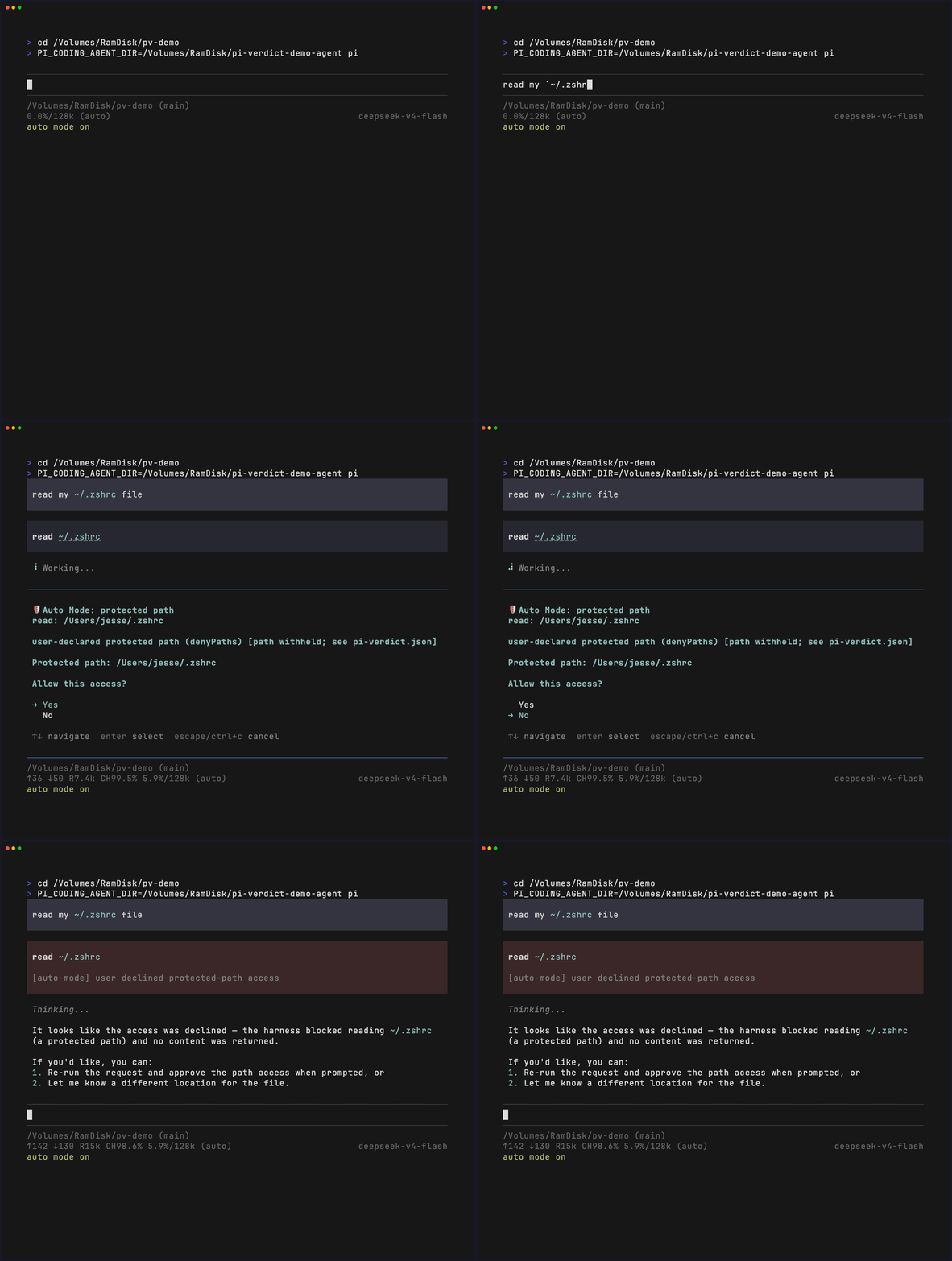
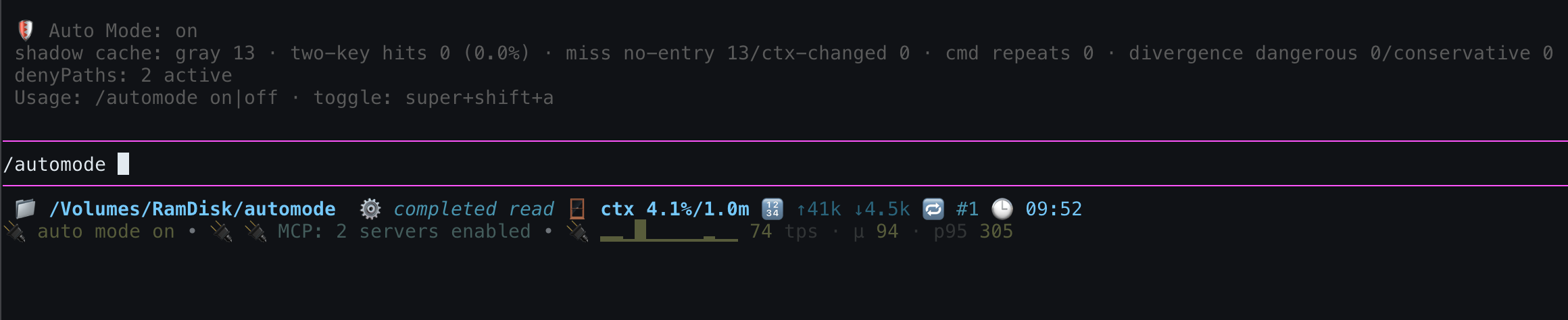
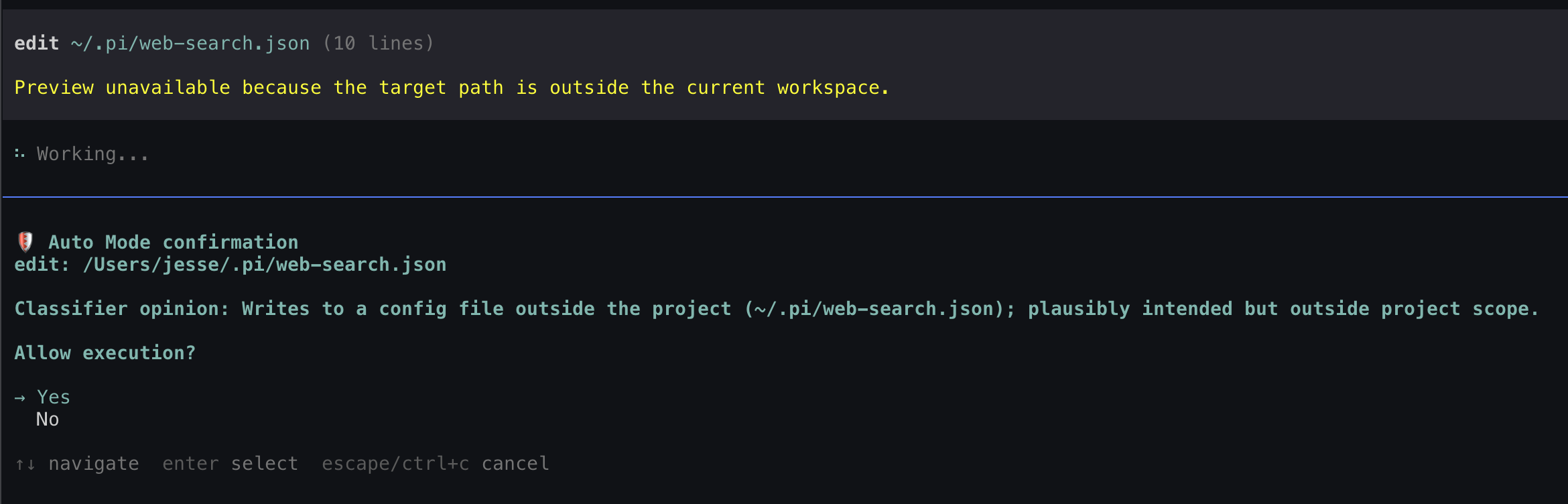
Quick start
# install from npm (pi):
pi install npm:pi-verdict

# install from npm (oh-my-pi / omp):
omp plugin install npm:pi-verdict

# or directly from git — try it once
pi --extension ./extensions/pi-verdict.ts
Requires pi ≥ 0.99. Works in interactive and non-interactive (-p/json/rpc) sessions; in non-interactive modes ask degrades to deny.
Hosts
pi-verdict 0.13+ requires pi ≥ 0.99 and runs on pi only (native classifier support, ADR-0005). Older hosts — pi < 0.99 and oh-my-pi (omp) — keep using the 0.12.x line from npm (old hosts run old extensions). The 0.12 line still self-anchors to whichever agent tree it is installed in and follows the extension copy's own location on dual-install machines; its classifier completion falls back to the pi-ai compat API on omp 18 (still fail-closed). Details: docs/configuration.md.
| pi | omp (0.12.x line) | |
|---|---|---|
| install | pi install npm:pi-verdict |
omp plugin install npm:pi-verdict |
| extension copy | ~/.pi/agent/extensions/ |
~/.omp/plugins/node_modules/pi-verdict/ (omp 18.1+; ≤18.0: under agent/) |
| user rules | ~/.pi/agent/config/pi-verdict.json |
~/.omp/agent/config/pi-verdict.json |
| credential file (S0 hard deny) | ~/.pi/agent/auth.json |
~/.omp/agent/auth.json |
/automode— show current status: on/off/automode on/automode offctrl+shift+a— toggle the master switch silently (the always-on footer is the only feedback; rebind or disable viatoggleShortcut)- footer always shows
auto mode on(green) /auto mode off(yellow)
| Option | Default | Description |
|---|---|---|
--auto-mode / --no-auto-mode |
on | master switch |
--auto-mode-model provider/id |
session model | classifier model ("self-reflection" by default) |
--auto-mode-debug |
off | full verdict notifications |
PI_AUTO_MODE_MODEL |
— | env form of the model flag |
PI_AUTO_MODE_DEBUG=1 |
off | env form of debug (flag wins) |
User rules (~/.pi/agent/config/pi-verdict.json)
{
  "allow": ["^ls\\b", "^git (status|log|diff)\\b"],
  "deny":  ["rm ", "docker ", "^/etc/"],
  "denyPaths": [
    "~/.ssh/",
    "~/.profile",
    "~/.gnupg",
    "~/.mc",
    "~/.kube",
    "~/.zshrc",
    "~/.bashrc"
  ],
  "ignoreTools": [
    "todo",
    "ask_user_question",
    "memory_write",
    "memory_search"
  ],
  "builtinDenyFloor": true,
  "classifierModel": null,
  "toggleShortcut": "ctrl+shift+a",
  "audit": false,
  "auditRedactSecrets": true,
  "notifyAllows": false,
  "classifierMinConfidence": null,
  "classifierFallbackModel": null,
  "classifierFallbackMode": "enforce"
}allow/denyare JS regex arrays;denywins overallow, both beat the classifierdenyPathsare plain paths you declare protected — touches trigger a terminal ask you adjudicate (non-interactive → deny); the classifier never learns the paths themselves, only that they exist.grep/find/lscompare their whole search scope: an omittedpath(pi's default: the current directory) or a parent directory of a declared path triggers the ask as well. A fresh install pre-fills a starter list (~/.ssh/,~/.gnupg,~/.mc, shell rc/profile files)ignoreToolsnames uncovered tools (todo,web_search, MCP/custom tools) that skip adjudication — allow with zero model calls; entries naming covered tools (bash/read/write/edit/grep/find/ls/powershell) are inert: those stay governed by the deny floor and your allow/deny rules, and the self-protection layer always runs first. A fresh install pre-fills a starter list (todo,ask_user_question,memory_write,memory_search— observed harmless across the 1265-verdict production audit). Caveat: an exempted tool loses the classifier'sdenyPathsexistence-hint vigilance (uncovered tools never hit the path extractor anyway); MCP tool names are normalized before matching — see codemode & MCPbuiltinDenyFloor: falseturns off the built-in danger/path floor (your risk; the self-protection layer below always stays on)classifierModelpins the classifier model, e.g."zai/glm-5.3-flash:low"(thinking suffix supported; default: session model with thinking off)classifierModel: "typesafe/jev-latest"opts into the native jev classifier — one structuredclassify()call per gray-zone verdict via pi's built-in classifier catalog (TypeSafe direct, or Jev on OpenRouter/OpenCode/Cloudflare/Vercel); see ADR-0005audit: truerecords every gray-zone adjudication (the full transcript sent to the classifier, its raw response, the parsed verdict) as JSONL under~/.pi/agent/verdicts/<sessionId>.jsonl— one file per session, the 20 most recent kept. Interactive asks also record your answer (userAnswerground truth, written after the confirm resolves), and protected-path asks are recorded too (#62); rule allow/deny stays unaudited. Local-only and full-fidelity (protected-path plaintext may appear — it never leaves your machine; ADR-0002 boundary note); secret-shaped text is redacted on append (<redacted:type#fingerprint>, deterministic so cross-record tracing survives —auditRedactSecrets: falseopts out; ADR-0007); the agent can neither read nor write the directory./automodeshows the audit state and path while onnotifyAllows: truenotifies on every classifier allow (reason + action line — e.g. jev's probability breakdown); defaultfalsekeeps passes silent. Mechanical passes (your own allow rules, protected-path confirms) never notify; with both switches on the notification appears onceclassifierMinConfidence(optional, ADR-0004) sets the confidence floor: a native-classifier verdict below it is demoted — cascaded toclassifierFallbackModelif set (enforce, the default = the second layer adjudicates; a demoted deny or ask can never be auto-relaxed to an allow; a fail-closed layer emitted no verdict, so its rescue stands;shadow= records its opinion only and you are asked —/automodehints the activation switch), otherwise asked of you directly. At/above the floor the first layer is autonomous. The floor applies to native classifier models only (protocol-native confidence) — with a chat/LLM classifier it is inert, and a one-time warning says so. A natural pairing: jev first + a haiku/flash-class fallback
No built-in allowlist — every "always allow" claim is yours (why). Full reference: docs/configuration.md.
Native jev classifier (ADR-0005)
- Install:
pi install npm:pi-verdict(v0.13+; pi ≥ 0.99 required — older hosts keep 0.12.x) - Ensure a credential for one of the built-in Jev transports:
- TypeSafe direct (
typesafe/jev-latest):export TYPESAFE_API_KEY=apikey_...(self-service at console.typesafe.ai) - OpenRouter (
openrouter/~typesafe/jev-latest,openrouter/typesafe/jev-1.13):/login openrouterinside pi, orexport OPENROUTER_API_KEY=sk-or-v1... - also served on OpenCode Zen, Cloudflare Workers AI, and Vercel AI Gateway with each provider's login; llama.cpp chat models double as free local classifiers (
model.type: "classifier"siblings)
- TypeSafe direct (
- Point the classifier at jev (applies to new sessions)
- persistent: edit
~/.pi/agent/config/pi-verdict.jsonoutside pi and set{ "classifierModel": "typesafe/jev-latest" } - or try it once:
PI_AUTO_MODE_MODEL=typesafe/jev-latest pi
- persistent: edit
Notes:
- Verdicts are structured
classify()answers (choice + probabilities + confidence); the reason line keeps the historicaljev:probability breakdown (tag-free — the<verdict>prefix survives only in the audit record's rawResponse), other classifier APIs renderclassifier: - Classifier specs resolve through pi's classifier catalog first (
findOfType), chat registry second; on same-id dual listings (llama.cpp) the native entry wins; thinking suffixes on a classifier spec warn once and drop (recordedthinking: null) - Custom endpoints: override the provider's
baseUrlin models.json (the 0.12PI_VERDICT_JEV_URLescape hatch is gone, as isPI_VERDICT_JEV_TRANSPORT— transport choice is now the spec itself) - Carried-over limit: the denyPaths existence hint still does not reach classifier-typed models (ADR-0005); on the TypeSafe direct transport per-call cost shows $0 (its API does not report it)
jev's calibrated confidence is exactly what the confidence floor keys on — pair it with a second layer ("classifierMinConfidence", "classifierFallbackModel") so its low-confidence calls go to a deeper model instead of standing (ADR-0004).
pi 0.99 codemode & MCP: indirect calls are still gated
pi 0.99 can run model-written JavaScript in a QuickJS sandbox (codemode) that calls pi's tools, and MCP servers register tools as mcp__<server>__<tool>. Neither surface bypasses this gate:
- Nested calls are gated exactly like direct ones — pi routes every tool call a codemode script makes through the same
tool_callpipeline (taggedparentToolCallId, ids<parent>/<n>); a blocked call returns as an error to the script, which the model sees - MCP tools land in the gray zone — the rule layer covers the built-in command/file tools only; each
mcp__*call is classified, fail-closed included ignoreToolsand MCP names: tool names are normalized — every character outside[A-Za-z0-9_]becomes_(mcp__dev-radius__x→mcp__dev_radius__x); exemption entries must use the normalized form- Cost amplification: one script may issue up to 256 nested calls; gray-zone calls classify one by one, so a slow LLM classifier multiplies per-call latency
- Exposure boundary: adding an MCP server auto-enables codemode, and
pi --no-extensions -e builtin:mcpruns MCP tools with no extensions loaded — i.e. without this gate. The gate is itself an extension, so it cannot be active in a session that loads none; the boundary is inherent to pi's extension model, stated here rather than papered over - Batch latency is configurable (ADR-0006): every nested call adjudicates individually and gray-zone adjudication is serial (~350ms/call measured), so large script batches pay real latency.
"codemodeNestedCalls": "rules-only"opts nested calls into the deterministic layers only (rules, floor, self-protection, denyPaths + ask) — the gray zone passes; the trade-off is that rule-passing actions the classifier would have caught (e.g. a nestedbash head ~/.ssh/configwithout a denyPaths declaration) pass too. Audit records carrytoolCallId/parentToolCallIdeither way
Self-protection (the gate guards itself — ADR-0001)
The gate's own files — the config and the installed extension copy — are user-editable only: writes from inside the gate hard-deny (reads pass); your editor never passes through the gate, the sudoers/visudo precedent.
- Not disableable by any config —
builtinDenyFloor: falseand userallowrules cannot touch this layer - Tamper detection as the backstop: watched files are snapshotted at
session_startand re-verified before every verdict — a changed extension copy is auto-restored and the session goes fail-closed; a changed config gets one explicit keep/restore confirm when a UI is available (headless auto-restores, same as the extension copy; ADR-0001 for the differential-disposal rationale)
How it compares
| three-state verdict | classifier sees context | fail direction | runtime deps | |
|---|---|---|---|---|
| pi-verdict | ✅ allow / ask / deny | ✅ recent user intent + tool calls | closed (errors/timeout/bad output → deny; headless ask → deny) | 0 |
| @czottmann/pi-automode | rules 3-state, classifier 2-state | ✅ budgeted transcript | closed | 1 |
| @zhushanwen/pi-permission | ✅ (outcome) | ❌ single-turn, no context | closed (→ ask) | 4 |
| @gotgenes/pi-permission-system | ✅ deterministic only | — (no built-in classifier) | closed | 3 |
Full landscape: research/pi-permission-landscape.md · convergence analysis with the closest architectural relative: research/pi-automode-convergence.md.
Honest framing: pi-automode and pi-verdict have converged on the same architecture (deny floor → user rules → classifier, fail-closed — see the convergence analysis). What remains distinct here: a classifier that can say ask (runtime human-in-the-loop, not just rule-declared), a built-in floor you can turn off (builtinDenyFloor — user sovereignty), a self-protection layer that no config can turn off (ADR-0001 — gate integrity), a zero-dependency single file (one readable file, still one file on purpose), and the measurement habit — every design decision in this repo is backed by shipped research.
Pipeline

Diagram source & regeneration: docs/diagrams/. Pipeline as of v0.14 — the ASCII version below is the text-faithful equivalent.
tool_call
  │
  ├─ 0. Self-protection layer (ADR-0001; not disableable by any config)
  │     ├─ write/edit/bash touching the gate's own files → deny; reads pass
  │     └─ tamper detection: re-verify before every verdict →
  │         auto-restore + fail-closed, or one keep/restore confirm
  │
  ├─ 1. Rule layer (deterministic, zero latency)
  │     ├─ built-in deny floor: bash danger regexes + path sensitivity S0–S5
  │     ├─ your rules: user deny beats user allow
  │     ├─ denyPaths (ADR-0002): protected paths → terminal ask,
  │     │   before user allow; classifier sees an existence hint only
  │     ├─ ignoreTools: your declared uncovered tools → allow, zero model calls
  │     ├─ headless subagent-artifacts writes (ADR-0008): a no-UI session's
  │     │   write/edit under <agentDir>/sessions/**/subagent-artifacts/ →
  │     │   deterministic allow (interactive sessions keep the ask); your
  │     │   deny rules and denyPaths still outrank it
  │     └─ no built-in allowlist on your surfaces — every "always allow"
  │       claim is yours to make (the one built-in allow is pi's own
  │       subagent-artifacts subtree, headless-only, ADR-0008)
  │
  ├─ 2. Gray zone → nested-call policy, then model classifier
  │     ├─ nested call (codemode) + codemodeNestedCalls=rules-only → pass;
  │     │   deterministic layers above already ran (ADR-0006)
  │     ├─ gate (default, or a direct call) → classifier: native classify()
  │     │   (choice + probabilities + confidence; tag-free reason, full contract
  │     │   line in the audit rawResponse) or, on the chat path (session-model
  │     │   self-reflection), <verdict>…</verdict> prefix-anchored free text
  │
  └─ 3. Three-state adjudication
        ├─ allow → pass
        ├─ deny  → block, reason returned to the agent
        └─ ask   → human confirm; non-interactive modes degrade to deny
fail-closed: classifier exception / timeout (25s) / contract violation → deny. Never silently allow.
Evidence-driven, not vibes-driven
Design decisions here are settled by measurement, and the lab notes ship with the repo:
research/cache-sim— replayed 1.2k+ real classifier verdicts to measure verdict-cache hit rate (3.2% → serving cache declined; the runtime shadow telemetry built afterwards measured 3.3% and was later removed too, #73)research/thinking-param-blackhole.md— three-layer forensic root-cause of thinking models burning the classifier budget; why the fix isthinkingEnabled: falseresearch/rule-engine-sim— measured a tree-sitter rule-engine port against 746 real bash calls (absorbs 0 gray calls) and rejected itresearch/pi-permission-landscape.md— the competitive landscape this README's positioning is checked againstresearch/rule-layer-security-audit.md— rule-layer bypass testing (8/8 reproduced → fixed architecturally in 0.2.0)research/pi-automode-convergence.md— where this project genuinely converges with pi-automode, and what remains distinctresearch/claude-code-classifier-prompts.md— structural reconstruction of Claude Code's classifier design (via self-hosted Langfuse observations) that this extension's transcript contract descends from
Status & limitations
- no built-in allowlist on user surfaces by design (see the bypass writeup; the one built-in allow is pi's own subagent-artifacts subtree, headless-only, ADR-0008); with an empty
allowconfig most commands go to the classifier — point--auto-mode-modelat a fast model if per-call latency matters - the path sensitivity floor applies to file tools only: bash command strings are matched by the danger regexes alone, so e.g.
cat ~/.ssh/id_rsagoes to the classifier rather than the deterministic S0 deny (the file-tool spellingread ~/.ssh/id_rsadoes deny) - on Windows the built-in floor covers bash-shaped patterns only — PowerShell-native dangerous commands (
Remove-Item -Recurse -Force,Invoke-Expression,Set-ExecutionPolicy, …) rely on the classifier (fail-closed) - on macOS the per-user temp tree (
$TMPDIR, the/var/folders/…/Tconfstr dir) is exempt from the system-directory floor: reads allow at zero cost, writes adjudicate as ordinary outside-project writes (classifier). The exemption anchors to the runtime-resolved confstr family — a hand-setTMPDIRlifts nothing — and/var/tmp(POSIX shared temp) stays denied; symlink spellings whose real form escapes the temp tree still hit S1 - AGENTS.md is not passed to the classifier as downweighted intent evidence (Claude Code does this)
- parallel gray-zone calls are adjudicated serially
- self-reflection means the session model adjudicates — point
--auto-mode-modelat a lighter model if verdict latency/cost matters (open question tracked in the issue tracker) denyPathsbash extraction is token-level (ADR-0002): command substitution, base64-embedded paths and external script contents produce no hit signal — those calls fall back to the classifier's existence-hint vigilance. MCP and custom tools bypass the extractor entirely (their gray-zone adjudication still carries the hint). Path normalization is base-tier only (ADR-0002): a nonexistent target written through a symlinked directory rebuilds no real form and produces no hit — that indirection falls to the hint vigilance too (the ancestor-rebuilding tier applies to the self-protection layer and the sensitivity floor, not denyPaths). Honest framing, same as the self-protection substring precedent: the deterministic layer is obfuscatable, which is exactly why a hit routes to you rather than silently decidingdenyPathsbash tokens contain no spaces: a declared path containing spaces cannot be spelled in a bash command in a way the extractor sees —cat "/path with space/x"splits into two tokens and never hits (file tools still hit, their path is not tokenized). A glob covering the final segment of a base (cat /proj/pers*againstdenyPaths: ["/proj/personal"]) also misses — the base's own name never appears literally. A recursive search issued from a shell misses in both spellings — no path argument (defaults to the cwd, e.g. a barerg foo) or a parent-directory argument (rg foo <parent-of-a-declared-path>): an argument-less command contributes no token at all and bash tokens otherwise compare one-directionally, while the file tools' bidirectional subtree compare covers the same shapes issued throughgrep/find/ls. All three holes fall back to the classifier's existence hint, alongside substitution/base64 above- self-protection bash matching is substring regex — obfuscatable; the tamper-detection backstop catches within-session bypasses, but a cross-session baseline (hash + change confirmation at startup, incl. upgrade UX) is phase 2 per ADR-0001
- dev checkouts (running the extension from a repo, not
<agentDir>/extensions/) are not self-protected — the installed copy the next normal session loads is only covered by its own sessions' gate
verdict is not a sandbox. It runs inside the pi process and adjudicates tool calls; it does not contain malicious code, protect against a compromised process, or guard manual ! shell escapes. For isolation, use an OS-level sandbox.
The name: the three-state verdict is the core concept. The UX keeps /automode — the mode concept traces back to Claude Code's auto mode, which this project borrows its transcript design from.
Development
bun install
bun run typecheck
bun test          # offline stub tests: self-protection, tamper detection, deny floor, user rules, denyPaths, bypass regression, classifier retry, commands, toggle shortcut
Issue tracker and decision records live in the GitHub issues ("map" issue #1 indexes them).