tower-do
Shared multi-agent task board for Pi coding agent — Kimi Tower style orchestration (todo-flavored)
Package details
Install tower-do from npm and Pi will load the resources declared by the package manifest.
$ pi install npm:tower-do- Package
tower-do- Version
0.3.7- Published
- Sep 15, 2026
- Downloads
- 1,150/mo · 1,150/wk
- Author
- wweir
- License
- MPL-2.0
- Types
- extension
- Size
- 652.2 KB
- Dependencies
- 0 dependencies · 3 peers
Pi manifest JSON
{
  "image": "https://raw.githubusercontent.com/wweir/tower-do/main/docs/pi-tower-do.png",
  "extensions": [
    "./index.ts"
  ]
}Security note
Pi packages can execute code and influence agent behavior. Review the source before installing third-party packages.
README
tower-do — Shared Multi-Agent Task Board (Pi extension)
A todo-flavored Pi extension inspired by Kimi Tower's multi-worker orchestration design. Multiple agents (sessions / subagents) share a live view of "what's in progress" plus task-bound communication state.




What it does
Parallel coding agents fail at coordination, not at coding: they clobber each other's files, redo finished work, and never know who is doing what. tower-do gives every agent in the project one shared board to plan, claim, and finish work — and the manners to talk about it.
- One board, many agents. Plan, claim, complete, and block tasks with owners and dependencies. Every session and subagent reads and writes the same board — no daemon, no database, no setup beyond installing the extension.
- Finish with receipts. Completing a task records the files you actually
changed (
changedFiles), so whoever picks up the next task knows what just moved under them. - Talk where the work lives. Addressed messages to a task's owner (or broadcast to all), plus structured findings (bug / improve / vuln / idea) for out-of-scope discoveries — routed to the right agent, not lost in chat.
- Conflict awareness. The dashboard flags when your task's declared scope overlaps files a peer just changed, or when two in-progress tasks declare intersecting scopes — advisory warnings you resolve by messaging, never gates that block you.
- Who is around. Presence shows which sessions are active, idle, or gone quiet while still owning unfinished work — so a coordinator knows whom to ping instead of reassigning blind.
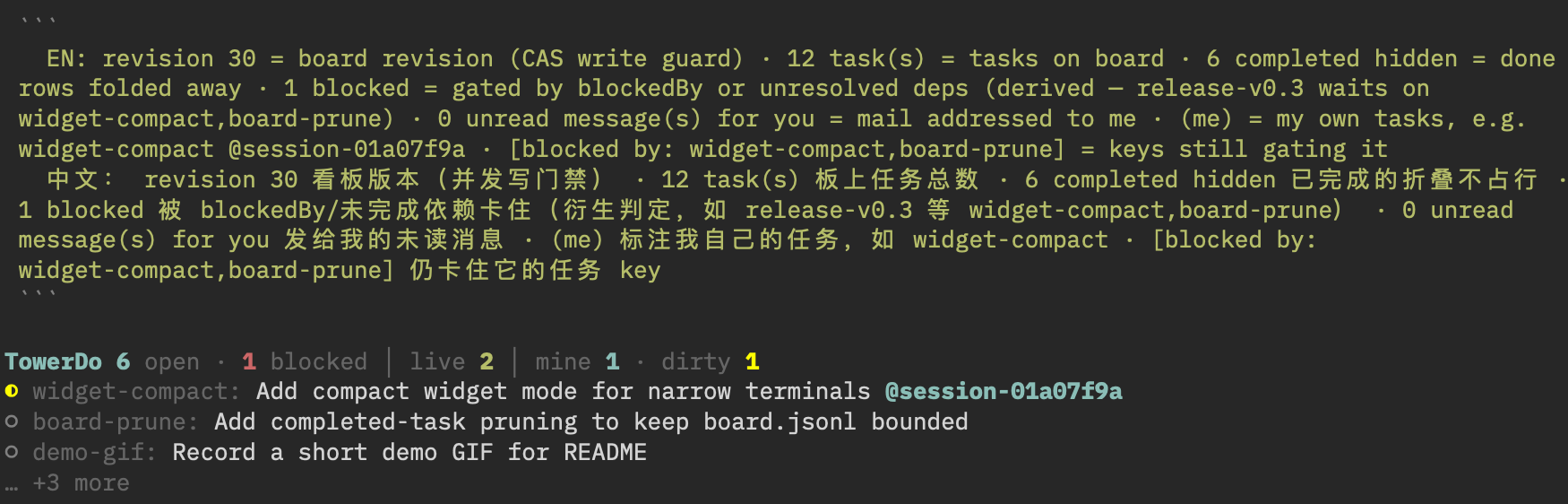
- A widget that explains the room. The above-editor line shows remaining
work (
TowerDo 2 open · 1 blocked), how many sessions are live, which dirty files are yours vs. the worktree's, and the unfinished tasks with owners (yours first; the open count is still the whole board).
Three tools:
| Tool | Purpose |
|---|---|
tower_do |
One-shot atomic board update: plan / claim (owner + in_progress) / complete (changedFiles receipt) / block (blocked + blockedBy). baseRevision protects against clobbering |
tower_do_talk |
Cross-agent messaging: send (owner / recent-activity identity / all; self-send rejected), inbox, finding (structured out-of-scope report / status update) |
tower_do_status |
Shared dashboard: everyone's in-progress work (owner / deps / scope / changedFiles / block reasons), scope conflicts, messages, open findings, activity + presence; taskKey returns one task's full detail |
Install
Option 1 — from npm (recommended)
pi install npm:tower-do
Option 2 — from git
pi install git:https://github.com/wweir/tower-do.git@main
Option 3 — manual copy to the global extensions dir
mkdir -p ~/.pi/agent/extensions && cp -r tower-do ~/.pi/agent/extensions/
Pi auto-discovers the extension at startup; existing sessions pick it up with /reload.
Quick tour
One session + subagents (typical). Parent plans tasks on the board and
claims owners; hands subagents the board path from tower_do_status
(file-as-state); they report back; parent closes out. Multiple sessions, one
project. Both read/write the same ~/.pi/tower-do/<project>/board.jsonl — send
a message, the peer reads it via inbox.
Identity resolution: as param > config identity > session name >
session id. Recording work for a subagent: pass its id (e.g. as: "coder-1").
Configuration
One optional key — ~/.pi/agent/tower-do/config.json (global, applies to every
project). No environment variables.
{ "identity": "team-orchestrator" }
| key | default | meaning |
|---|---|---|
identity |
session name/id | pin this session's board identity (global, applies to every project); must not be the reserved orchestrator identity tower |
How it works
One append-only JSONL file per project (~/.pi/tower-do/<project>/board.jsonl)
is the single source of truth — state and communication are the same storage.
Every read re-folds the log; writes carry a monotonic revision so a peer's
concurrent update is rejected instead of silently clobbered. System boundary,
event semantics, and read derivations:
docs/ARCHITECTURE.md.
Documentation
| Doc | Content |
|---|---|
| docs/PRODUCT.md | Product scope & high-level experience |
| docs/ARCHITECTURE.md | System boundary, event log & folding, source layout, read derivations (presence / block / scope conflicts / retention) |
| docs/CONTRACTS.md | Task-model invariants (incl. changedFiles receipt + scope-conflict contracts), ownership guard, revision gate, test gate |
| docs/DECISIONS.md | Why: share boundary facts not diffs (P0/P1), widget segments, file-as-state, every-field owner guard, advisory scope |
| docs/OPERATIONS.md | Install, config, release flow (tag → CI → npm), troubleshooting |
| README.zh-CN.md | 中文版说明 |
Quality gate: bunx tsc --noEmit plus ten test suites, enforced in CI on
every release tag — the list and what each suite proves live in
docs/CONTRACTS.md.
References: Kimi Tower's multi-worker orchestration design (official Tower blog/docs) and the reference extension implementation https://github.com/99percentpeople/pi-extensions/blob/master/extensions/todo/index.ts.